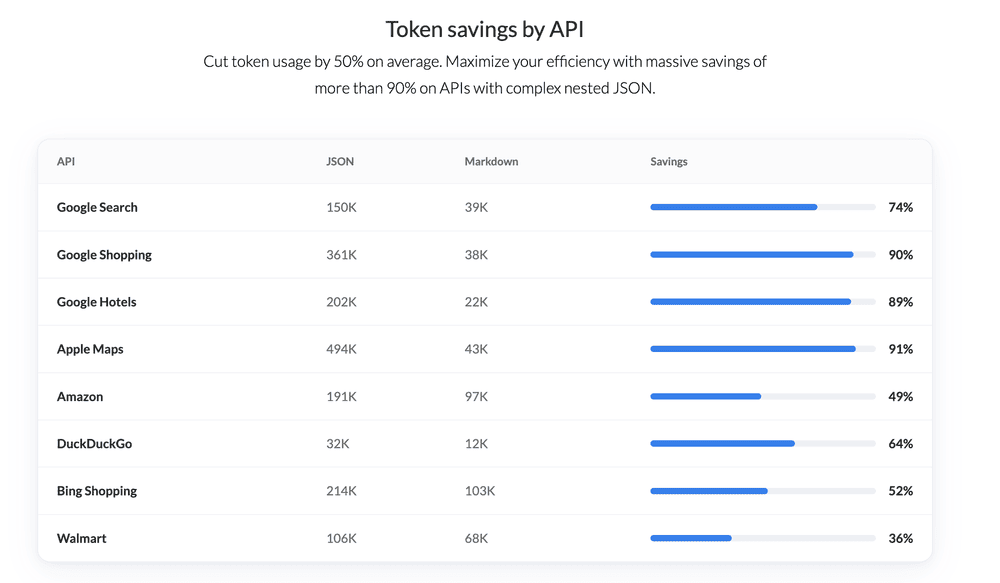
The rapid proliferation of autonomous AI agents has brought a hidden architectural bottleneck to the forefront of machine learning operations: token bloat. As developers integrate sophisticated agents capable of recursive web searches, file retrievals, and complex data analysis, the operational costs associated with Large Language Model (LLM) context windows have surged. A significant portion of this expenditure is not driven by the inherent complexity of the user’s request, but by the inefficient format of the data being fed into the model. Recent industry benchmarks suggest that by transitioning from traditional JSON-based data delivery to optimized Markdown outputs, developers can achieve token reductions of up to 74 percent, fundamentally altering the economics of agentic workflows.
The Anatomy of Token Inefficiency
The core of the problem lies in the structural divergence between how machines read data and how LLMs process natural language. Traditionally, APIs have relied on JavaScript Object Notation (JSON) to transmit information. JSON is an excellent format for programmatic interoperability, offering rigid schemas, typed variables, and machine-readable structures. However, when an AI agent performs a search—such as retrieving information on local businesses or technical documentation—the JSON payload often contains extensive metadata, internal tracking links, nested objects, and redundant code blocks that are essential for a web browser or a backend script but extraneous for an LLM’s reasoning process.
When an LLM parses a JSON response, it must consume tokens for every bracket, key, and null value in the string. Because LLM pricing models are tied directly to the total token count of the prompt and completion, developers are essentially paying to transmit and process "noise"—data that does not contribute to the model’s ability to synthesize a correct answer. In a recursive agentic loop, where an agent may perform dozens of sequential queries to arrive at a conclusion, these inefficiencies compound, leading to exponential increases in operational costs and latency.
The Shift Toward Markdown: A Strategic Pivot
SerpApi, a leading provider of search engine data, has recently introduced a native Markdown output feature designed specifically to address this token inflation. The technical shift involves transforming structured data into a human-readable, model-optimized format that retains the semantic essence of the search result while discarding the structural overhead of JSON.
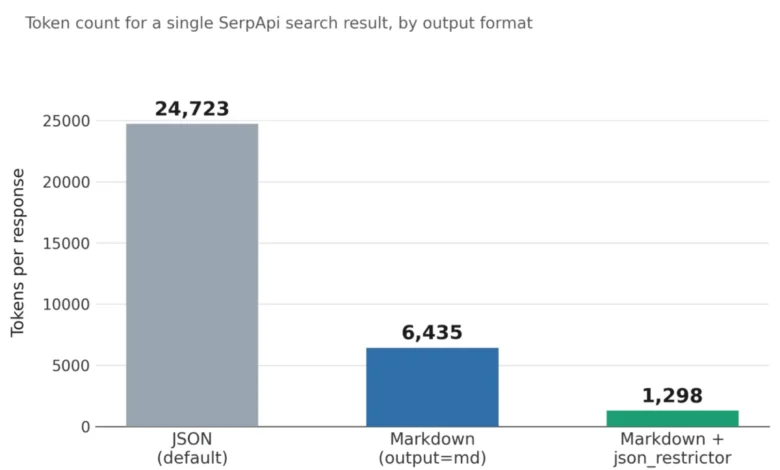
The results of this transition are statistically significant. In a controlled test comparing a standard search query for "coffee shops," a JSON response required approximately 24,723 tokens. Upon switching to the Markdown-optimized format, the same query required only 6,435 tokens. By applying further server-side filtering, that total can be reduced to as low as 1,298 tokens. This represents a reduction of over 94 percent in total token consumption for the same semantic output.
The implications for developers are twofold: first, there is a direct reduction in the financial cost of API consumption; second, there is a technical gain in context window management. By consuming fewer tokens per search result, agents can keep more relevant information in their active memory, enabling them to process larger sets of documents or conduct more exhaustive research without hitting the context limits of their underlying models.
Chronology of Data Delivery Evolution
The evolution of data delivery for AI has moved through several distinct phases, each responding to the technological capabilities of the time:
- The Pre-API Era: Data was scraped via brittle HTML parsers, leading to high maintenance costs and frequent service failures as website UIs evolved.
- The JSON Dominance Era: As APIs matured, JSON became the industry standard. It provided the structure necessary for stable, automated workflows but was built for server-to-server communication, not for the cognitive processing requirements of generative AI.
- The LLM-Centric Era (Present): With the rise of autonomous agents, the industry is witnessing a shift toward "model-native" formats. Developers are increasingly prioritizing the semantic weight of data over its programmatic structure, leading to the adoption of Markdown, YAML, and other lightweight formats that align with the training data patterns of modern LLMs.
The Trade-offs: When JSON Remains Indispensable
While the transition to Markdown is highly effective for summarization and agentic research, it is not a universal replacement for JSON. Industry experts note that precision-based workflows—such as financial modeling, inventory management, or applications requiring strict data typing—still necessitate the structure of JSON.
If a pipeline requires an integer for a price calculation, a float for a rating, or a structured array to feed into a database, stripping that metadata via Markdown would cause a functional breakdown. In these instances, the data’s utility is derived from its rigid type-safety rather than its readability. Therefore, the current best practice for machine learning engineers is to employ a "hybrid delivery" strategy: using Markdown for agentic discovery and summarization, and retaining JSON for downstream data processing and analytics.
Implementation and Technical Integration
Integrating Markdown output into existing pipelines has been streamlined to minimize developer friction. Solutions like those provided by SerpApi allow for a seamless toggle via simple query parameters or headers. By adding a specific flag to the API call, developers can receive their payload already pre-processed and stripped of internal tracking noise, duplicate fields, and unnecessary structural delimiters.
Furthermore, the integration of server-side "json_restrictors" allows developers to perform granular data pruning before the payload even leaves the server. This reduces the network load and ensures that the LLM is only exposed to the fields that are strictly necessary for the task at hand. This level of control is becoming a standard requirement for enterprises looking to scale their AI operations without incurring massive cost overruns.
Broader Economic and Operational Implications
The focus on token efficiency is reflective of a maturing AI market. In the early stages of the generative AI boom, the primary goal was feasibility—getting agents to work at all. Now, the focus has shifted toward efficiency and ROI. For large-scale deployments, where an agent might process thousands of queries per hour, a 70-80 percent reduction in token costs can translate to significant annual savings.
Beyond the financial impact, there is the issue of "model performance degradation." LLMs are prone to "lost in the middle" phenomena, where they struggle to attend to relevant information if it is buried under a mountain of irrelevant context. By cleaning the data and removing noise through Markdown, developers can theoretically improve the accuracy of their agents. By presenting the model with a cleaner, more focused set of information, the signal-to-noise ratio is increased, allowing the model to perform more reliable reasoning and reducing the likelihood of hallucinations triggered by extraneous data.
Future Outlook
As the industry moves toward more complex multi-agent systems, the "shape" of the data will become as important as the data itself. Developers who treat data delivery as a static, "one-size-fits-all" process will likely face higher costs and slower performance. The movement toward Markdown, YAML, and other LLM-friendly formats suggests a future where data providers will increasingly compete on their ability to deliver "model-ready" information.
For organizations currently managing high-volume agentic systems, auditing the token cost of their data streams is a critical step in optimizing performance. By measuring the "before-and-after" token counts, teams can determine exactly how much bloat exists in their current workflows. As the tools for reshaping this data become more sophisticated, the ability to dynamically switch between structured and human-readable formats will likely become a core competency for AI engineers, ensuring that as models grow more capable, the systems feeding them remain as lean and efficient as possible.