Implement least-privilege access with designations in Amazon SageMaker Unified Studio | Amazon Web Services

The Evolution of Collaborative AI Environments
The rise of the "data lakehouse" and integrated machine learning platforms has transformed the composition of project teams. Modern data projects are rarely siloed; they frequently feature a diverse cross-section of professionals, including data engineers responsible for pipeline stability, data stewards managing compliance and lineage, analysts extracting business intelligence, and ML engineers iterating on predictive models.
Historically, managing access for these disparate personas within a single, shared environment forced organizations into a binary choice: grant broad, permissive access—which introduces significant operational risk—or fragment teams into isolated projects, which creates data silos and increases management overhead. The introduction of designations represents a shift toward a more nuanced, "least-privilege" architectural approach. By allowing administrators to define specific permission sets (designations) once and apply them across multiple projects, Amazon SageMaker Unified Studio enables a unified data experience without compromising on security.
Addressing the Governance Gap
The impetus for this feature stems from a growing demand for "security as code" in AI development. According to industry reports from organizations like Gartner and Forrester, the most significant risk in enterprise AI adoption is not the complexity of the models themselves, but the failure of access governance. Unauthorized modification of production pipelines or accidental deletion of critical data sources can lead to significant financial and regulatory consequences.
In the past, to prevent these outcomes, many teams adopted the practice of creating separate projects for every role. While this isolated sensitive production data from exploratory environments, it created a "governance tax." Each project required its own lifecycle management, member onboarding process, and resource provisioning. As organizations scaled, this resulted in hundreds of orphaned projects and fragmented data catalogs, making it nearly impossible for teams to maintain a "single source of truth."
By centralizing the definition of roles (e.g., "ML Engineer" or "Data Steward"), companies can now ensure that a "Data Steward" has the same authority to approve subscription requests in every project they join, regardless of whether that project is in the development, testing, or production phase.
Technical Architecture: The Two-Layer Authorization Model
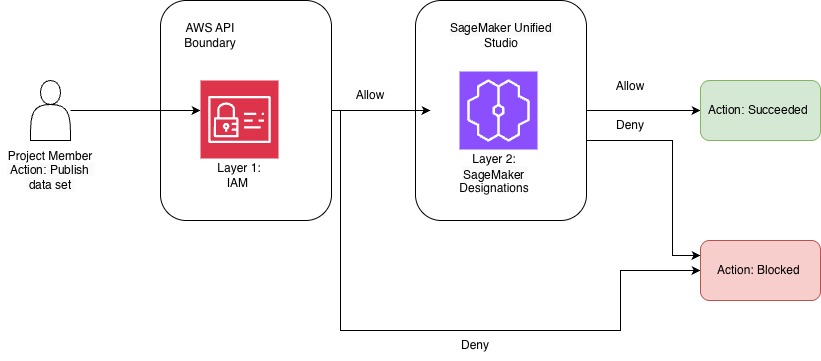
To maintain compatibility with existing AWS infrastructure, designations operate as a secondary layer of authorization. The system does not replace IAM; rather, it complements it. The authorization flow follows a strict, two-tiered validation process:
- The API Boundary Layer (IAM): When a user initiates an action, the AWS API first checks whether the user’s underlying IAM role or user profile has the necessary permissions to call that specific service endpoint. If this check fails, the process terminates immediately.
- The Project Designation Layer: If the IAM check passes, the request is evaluated against the specific designation assigned to the user within the SageMaker Unified Studio project. This layer determines whether the user has the business-level authority to perform the action within that specific workspace.
This dual-layer approach provides a defense-in-depth strategy. It allows IT administrators to maintain high-level, least-privilege IAM policies at the account level while delegating the specific, granular project-level permissions to project owners via the SageMaker interface. Furthermore, because these designations are integrated with AWS CloudFormation, they can be deployed as part of an infrastructure-as-code (IaC) pipeline, ensuring that permission models are consistent across the entire enterprise ecosystem.
Industry Impact and Practical Implementation
The adoption of this feature is expected to significantly reduce the operational burden for organizations that rely on automated project provisioning. By codifying permissions into the project setup workflow, companies can ensure that "day-one" access is perfectly aligned with user responsibilities.
Tim Kopacz, a Cloud Platform Architect at Swiss Life Germany, highlighted the necessity of this automation in a recent briefing: "The one thing we couldn’t automate was controlling what each person could do once they were inside. With designations, we now define each user type’s permissions as part of the same automation that creates the project, so the right access is enforced from day one."
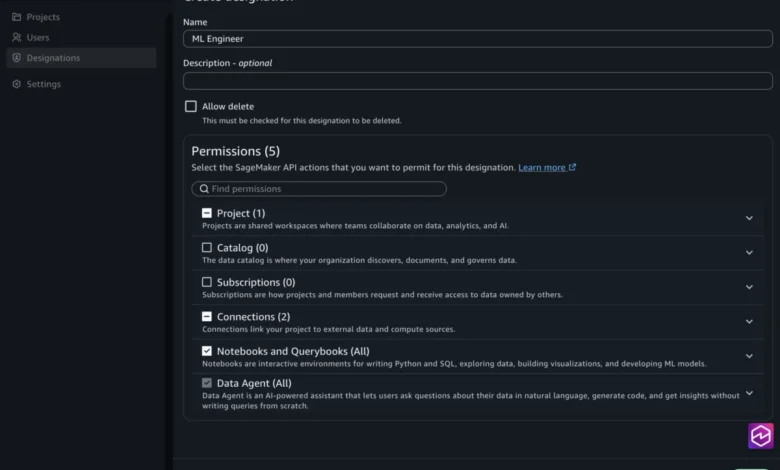
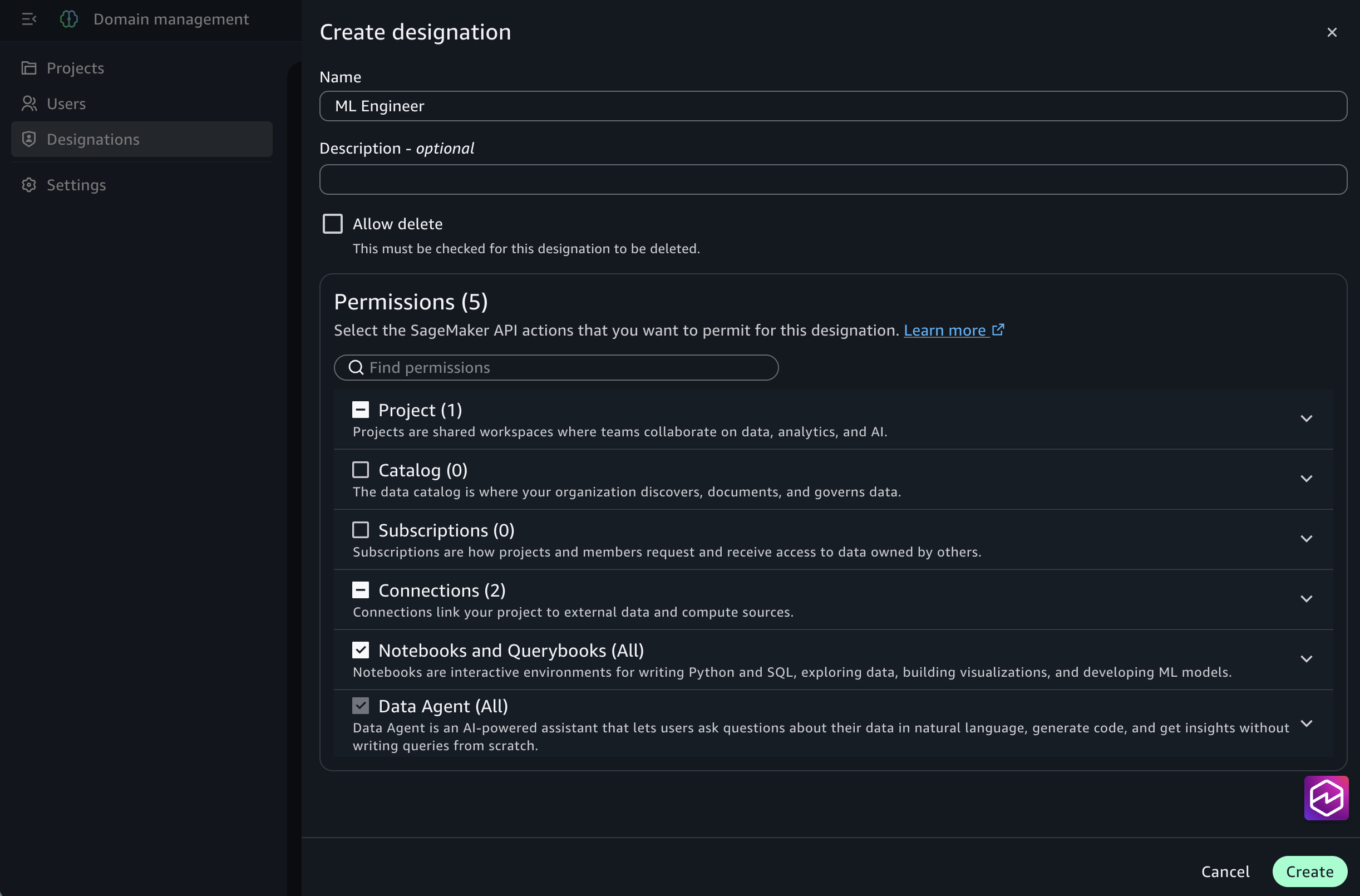
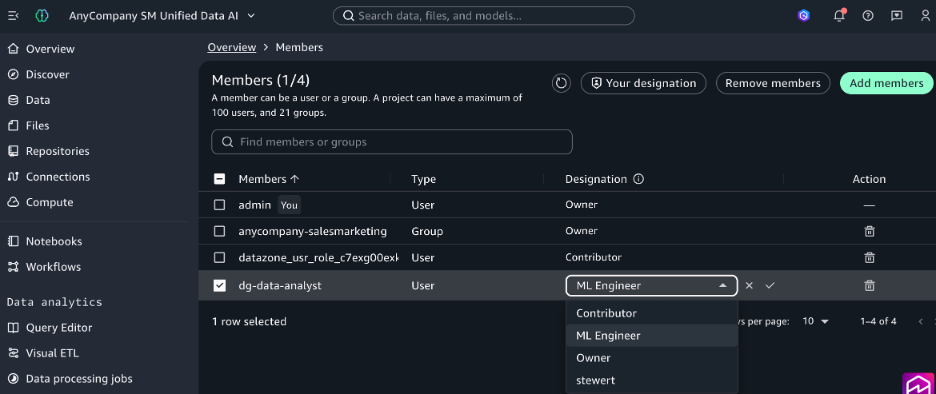
For administrators, the process is streamlined through a visual permission selector in the domain management portal. Once a designation is created—such as a "Data Scientist" profile that allows model training but restricts the modification of ETL pipelines—it becomes globally available across the organization’s domain. This eliminates the need for manual, repetitive policy creation and reduces the risk of human error during the onboarding of new team members.
Operational Lifecycle: From Creation to Deletion
The lifecycle management of designations includes built-in safeguards, such as "deletion protection." This feature, enabled by default, prevents the accidental removal of a designation that is currently in use. For organizations that utilize automation to manage their infrastructure, this can be programmatically configured using the AWS CLI or CloudFormation templates.
If a designation is modified, the changes take effect globally and immediately across all projects to which it is assigned. This creates a powerful mechanism for rapid security remediation. For instance, if an organization identifies a vulnerability in how a specific role interacts with a new dataset, updating the base designation will instantly propagate the restricted permission set to all users in that role across the entire organization.
Broader Implications for Enterprise AI
The introduction of designations is a direct response to the "maturity phase" of enterprise AI. As companies move past the experimentation stage and into long-term production, the focus shifts from "how do we build this" to "how do we manage this at scale."
The ability to maintain a unified data environment while enforcing granular access controls is critical for compliance frameworks such as GDPR, HIPAA, and SOC2. By providing a transparent audit trail through AWS CloudTrail and ensuring that authorization decisions are centralized within the SageMaker domain, organizations can better satisfy the rigorous documentation requirements imposed by internal and external auditors.
Furthermore, this development signals a broader trend in cloud-native AI platforms. As these services become more sophisticated, the management layer is becoming just as important as the computational layer. By moving away from "broad-brush" permissions and toward a model that treats roles as reusable, manageable software assets, Amazon is enabling its customers to treat governance as a standard engineering challenge rather than a persistent administrative hurdle.
Future Outlook and Strategic Considerations
While designations provide a robust framework, the effectiveness of the system still relies on the diligence of administrators in defining the roles appropriately. The "least-privilege" principle remains paramount; IT teams should conduct periodic reviews of their designations to ensure that as project requirements evolve, access levels do not suffer from "permission creep."
Looking ahead, the integration of these designations into broader identity management systems will likely continue to tighten. As organizations adopt more sophisticated CI/CD pipelines for their data and ML workflows, the ability to version-control these permission sets alongside the actual code, data schemas, and model artifacts will become the industry standard for production-grade AI.
In conclusion, the launch of designations within Amazon SageMaker Unified Studio offers a pragmatic, scalable, and secure solution for one of the most persistent challenges in modern data engineering. By bridging the gap between identity management and project-level execution, it allows enterprises to focus on the value-add of their AI initiatives—innovation, speed, and accuracy—while maintaining the strict oversight required in today’s complex regulatory and security landscape. The lack of additional costs associated with this feature makes it a low-barrier, high-impact upgrade for any organization currently operating on the platform.