The rapid commercialization of generative artificial intelligence has inadvertently trapped the software design community in a period of conversational tunnel vision. Because Large Language Models (LLMs) are fundamentally trained on dialogue and text prediction data, product development teams across industries have collectively defaulted to the chat bubble as the universal container for every conceivable AI capability. While the chat interface remains a powerful and versatile tool for specific exploratory tasks, it represents only a single mechanism within a much broader design toolkit.
As enterprises spend billions integrating machine learning models into daily operations, user experience (UX) and product teams face mounting pressure to be intentional about modality choice. Modality—the sensory channels through which humans interact with a digital system via sight, sound, touch, speech, or typing—dictates how users provide commands and how systems present outputs. Aligning these modalities with a user’s immediate physical context, cognitive load, and intent is becoming the defining challenge of modern product design.
The Consequences of Mismatched Modalities in the Field
The friction caused by defaulting to chat interfaces is not merely aesthetic; it has measurable operational and psychological consequences. Consider a commercial airline passenger sprinting through a congested terminal following a sudden gate change. Burdened with luggage and a beverage, the traveler opens the airline’s mobile application to query an AI assistant for updated directions.
Under a standard conversational paradigm, the application forces the user to halt, balance their belongings, and type a lengthy alphanumeric booking reference into a cramped text input box. Upon submission, the system delivers a dense narrative paragraph explaining the broader atmospheric weather patterns causing the delay, burying the critical gate number at the very bottom of the screen.
Although the traveler may successfully board the flight, the interaction induces acute anxiety and validates a prevailing consumer perception that enterprise software remains disconnected from practical human needs. In this scenario, the underlying artificial intelligence is functionally advanced, but the interface architecture fails completely. The input mechanism demands physical dexterity the user lacks in motion, while the output mechanism requires a level of reading focus that is impossible to sustain in a high-stress environment.
To prevent these systemic failures, product architects must evaluate the physical and cognitive load imposed on users, tailoring both input and output modalities to match immediate operational intent.
The Myth of the Do-It-All Chatbot and the Cognitive Tax of Text
The allure of the general-purpose chatbot is easily understood from a product development perspective. Acting as a blank slate, it implies that the system can theoretically interpret any query a user submits. However, text-heavy interfaces impose a significant adaptation load, increasing cognitive demands over time. This burden manifests as a psychological tax, forcing users to alter their natural thought processes to accommodate the operational constraints of the machine.
When an application relies exclusively on conversation, it introduces a dual burden: a linguistic challenge for data input and a cognitive challenge for output interpretation.
On the input side, a blank chat box creates a severe barrier to feature discovery. Traditional graphical user interfaces (GUIs) leverage menus, buttons, and visual affordances to signal available actions. In contrast, open-ended chat boxes routinely induce choice paralysis. Users are forced to guess what the AI is capable of handling and must recall the precise technical phrasing required to generate an accurate result. For example, a financial analyst seeking to filter a dataset can execute the action via a dropdown menu in milliseconds, whereas a chat interface requires them to construct a grammatically complete natural language sentence describing the underlying logic.

On the output side, returning long blocks of text transfers heavy interpretive labor to the human user. Text is fundamentally a serial medium requiring sequential reading word by word, whereas graphical data allows for parallel processing where users can interpret a trend from a chart in under a second. For professionals operating in high-stakes environments—such as a physician reviewing patient vitals or a stock trader monitoring rapid price fluctuations—narrative-based AI outputs introduce dangerous delays and elevate the risk of human error.
A Taxonomy of Interactive Modalities
Establishing a shared industry vocabulary is a prerequisite for effective interface engineering. Product teams must recognize that modalities are not universally superior or inferior; rather, they serve distinct roles within specific workflows.
Input modalities range from simple button taps and binary toggles, which eliminate recall overhead through recognition, to voice interfaces designed for hands-busy or eyes-busy environments. Structured forms and step-by-step wizards minimize data-entry errors in complex multi-field tasks, while graphical control elements like sliders and drag-and-drop canvases handle complex spatial manipulation. Multi-modal inputs, combining image uploads with text annotations, drastically reduce the effort required to describe complex visual requirements.
Similarly, output modalities must be diversified. Push notifications and ambient alerts provide time-sensitive awareness without requiring deep concentration breaks. Audio summaries deliver critical status updates directly to the user’s ear while in motion, keeping operators visually grounded in their physical surroundings. Short text summaries serve rapid, direct queries, while interactive canvases and visual dashboards support comparative analysis and iterative creative work.
Frameworks for Modality Selection: The Task Audit

To move beyond design assumptions, product organizations are increasingly adopting formal Task Audits prior to interface development. This evaluative framework replaces guesswork with empirical evidence gathered directly from the environments where work occurs.
Contextual inquiry and direct observation capture hidden physical constraints that users frequently omit during retrospective interviews. Researchers embedding themselves in warehouses, hospitals, or utility fields observe environmental factors such as mandatory safety gloves, extreme screen glare, ambient noise levels, and spatial mobility limits. Focused interviews subsequently surface the mental models and decision-making structures of end-users, clarifying threshold requirements for cognitive load and verification anxiety. Finally, collaborative workshops involving product managers, engineers, and UX researchers synthesize these findings into a unified task inventory, systematically eliminating mismatched interface designs.
Translating Intent to Architecture: The Alignment Matrix
Once empirical data is secured through a Task Audit, teams utilize an Input/Output Alignment Matrix to map distinct user intentions to optimal modality combinations.
For quick status checks in hands-busy scenarios, voice inputs paired with audio outputs or push notifications prove most effective. Complex analytical tasks, by contrast, require graphical user interfaces such as filters and sliders coupled with high-resolution visual dashboards. Creative generation workflows benefit from multi-modal inputs paired with interactive canvases, while monitoring tasks rely on passive background monitoring paired with ambient push notifications.
Case Study: Adaptive Modality in Critical Infrastructure

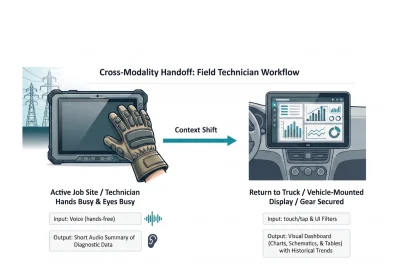
The practical application of these principles is visible in high-risk industrial sectors. Field technicians servicing high-voltage electrical grids historically relied on ruggedized tablets to access technical manuals and log maintenance data. However, the physical reality of wearing heavy protective insulation gloves while operating in elevated bucket trucks rendered touchscreens virtually unusable. Furthermore, reading dense diagnostic reports under intense sunlight created severe cognitive overload and compromised physical safety.
Following a comprehensive Task Audit incorporating contextual observation and veteran interviews, utility providers redesigned their operational software around a multi-modal handoff model. While active in the field, technicians utilize voice-activated commands to query system data and receive concise audio summaries of immediate voltage and fault locations. This eliminates the need for manual typing or visual engagement with screens, allowing workers to maintain situational awareness.
Upon returning to the service vehicle, the system automatically transitions the workflow to a 15-inch vehicle-mounted visual dashboard, providing the high-resolution screen real estate necessary for complex schematic analysis and historical trend review. This adaptive transition reduced diagnostic times by 20 percent and substantially increased daily tool adoption among field crews.
Implications for the Future of Enterprise Software
As artificial intelligence capabilities continue to expand, the architectural maturity of user interfaces will determine commercial success. Engineering brilliant underlying machine learning models is no longer a sufficient product strategy; matching those capabilities to the cognitive and physical realities of human users is paramount. By abandoning conversational tunnel vision and embracing a diverse ecosystem of visual, vocal, haptic, and ambient modalities, product designers can build systems that truly adapt to human workflows, reducing cognitive friction and establishing new benchmarks for enterprise software usability.