The rapid integration of AI-powered coding assistants and sophisticated code generation workflows, exemplified by tools such as Claude Code, Kiro, and OpenAI Codex, is fundamentally reshaping the landscape of software development. These innovative solutions enable developers to generate code in real-time, often producing thousands of characters across extended, interactive sessions. As organizations increasingly adopt these generative AI capabilities for large-scale code generation, ensuring the detection and mitigation of unsafe code patterns becomes a paramount concern. Amazon Bedrock Guardrails emerges as a critical safeguard in this evolving environment, offering robust mechanisms for content moderation, prompt attack prevention (including jailbreaks, prompt injection, and prompt leakage), and sensitive information filtering to redact or block Personally Identifiable Information (PII) and other confidential data.
However, the unique operational characteristics of coding workflows, particularly those involving agentic loops, present distinct challenges to the seamless application of Amazon Bedrock Guardrails. These workflows are characterized by long streaming outputs, concurrent developer sessions, and repetitive context evaluation. Applying guardrails without proper architectural considerations can lead to significant constraints, including throttling errors, escalating costs, and suboptimal latency, thereby hindering developer productivity and the overall efficiency of AI-powered development. This article delves into strategic configurations and architectural patterns designed to optimize Amazon Bedrock Guardrails for code generation workflows, providing a blueprint for effective capacity planning and robust safety coverage in enterprise-scale generative AI applications.
The Rise of AI in Software Development and the Inherent Need for Safety
The proliferation of generative AI in software development marks a pivotal shift, promising unprecedented gains in productivity and innovation. AI coding assistants automate repetitive tasks, suggest code completions, debug, and even generate entire functions or modules, allowing developers to focus on higher-level problem-solving. This acceleration, while transformative, introduces new vectors for risk. Malicious or unintentionally insecure code generated by AI can propagate vulnerabilities across critical systems, leading to data breaches, compliance failures, and reputational damage. The imperative to integrate robust safety mechanisms from the outset, rather than as an afterthought, has therefore become a cornerstone of responsible AI adoption.
AWS’s Amazon Bedrock, a fully managed service that provides access to foundation models (FMs) from Amazon and leading AI companies, has positioned itself at the forefront of this evolution. Bedrock Guardrails, a feature within this service, is specifically engineered to help organizations build safe generative AI applications by detecting and filtering harmful or undesirable content from both user inputs and model responses. For code generation, this includes preventing the creation of code that could introduce vulnerabilities, leak sensitive data, or facilitate malicious actions. Specific safeguards within Guardrails are designed to protect against:
- Security Vulnerabilities: Preventing the generation of code with common security flaws (e.g., SQL injection, cross-site scripting, insecure deserialization).
- Malware and Harmful Code: Blocking code that could be interpreted as malware, ransomware, or other harmful scripts.
- Insecure Configurations: Identifying and flagging code snippets that configure systems in an unsafe manner (e.g., overly permissive IAM policies).
- Credential Leakage: Redacting or blocking hardcoded secrets, API keys, or other sensitive credentials.
- Intellectual Property Protection: Preventing the inadvertent use of proprietary code snippets that might violate licensing agreements or internal policies.
These safeguards are not merely beneficial but essential when AI-generated code is destined for production systems, where the stakes are highest.
A Critical Scenario: When Unoptimized Guardrails Disrupt Development
Consider a common scenario illustrating the pitfalls of unoptimized guardrail implementation. A development team within a large enterprise, eager to leverage the productivity benefits of AI, deploys Claude Code on Amazon Bedrock for its 15 developers. The team configures a comprehensive guardrail with three key safeguards: prompt attack detection to prevent injection, a sensitive information filter to redact leaked credentials, and a content filter to block unsafe code patterns. A pilot program involving two developers runs flawlessly, reinforcing confidence in the setup.
However, upon full rollout, as all 15 developers commence their coding sessions concurrently, the system quickly falters. Within minutes, developers report widespread ThrottlingException responses from Amazon Bedrock model inference, causing code completions to stall mid-stream and leading to significant frustration.
The root cause of this disruption lies not in insufficient quota allocation but in an architectural mismatch. Each developer’s session typically generates around 5,000 characters of code per function. With the default streaming configuration, Amazon Bedrock Guardrails evaluates every 50 characters of output. This translates to 100 API calls per function, per developer. With 15 concurrent sessions, the system generates a staggering 1,500 evaluation requests per second. Compounding this, the activation of three distinct safeguards means each evaluation consumes three "text units" instead of one, effectively tripling throughput consumption. The architecture, designed for short conversational exchanges, proved inadequate for high-throughput, verbose code generation pipelines. This highlights the critical need for tailored architectural patterns to circumvent such operational constraints.
Understanding "Text Units": The Guardrails Currency
Before diving into optimization strategies, it’s crucial to grasp the concept of "text units" – the fundamental currency governing guardrail consumption. A text unit is defined as 1,000 characters of text. An ApplyGuardrail API call evaluating 1,000 characters against three safeguards results in three text units of consumption. This multiplicative relationship, where consumption scales with both content length and the number of active safeguards, is a critical factor in capacity planning for verbose code generation workflows. For instance, a guardrail configured with content filters, denied topics, and sensitive information filters will be metered based on the combined text units processed by each individual safeguard. It’s important to note that content filters are charged as a single text unit per 1,000 characters, irrespective of how many categories (e.g., Hate, Insults, Sexual, Violence, Misconduct, Prompt Attack) are enabled within that filter. The multiplicative factor applies across distinct policy types, not within categories of a single policy type.
The Challenge: Unique Demands of Code Generation Workflows
Traditional conversational AI workflows typically involve short, discrete user prompts and concise model responses. Code generation workflows, however, diverge significantly, posing unique demands on guardrail architecture:
- Output Length: Conversational AI responses are typically 100-500 characters. Code generation outputs can range from 5,000 to over 50,000 characters per session.
- Session Duration: Conversational interactions are often single-turn or a few turns. Coding sessions are extended, multi-turn interactions.
- Concurrent Users: Conversational AI might handle users asynchronously. Code generation often involves teams coding simultaneously, leading to high concurrency.
- Context Reuse: Minimal in conversational AI. In coding, system prompts, tool definitions, and prior code are frequently resent every turn.
- Intermediate Output: Minimal in conversational AI. Code generation involves extensive chain-of-thought reasoning and iterative refinements.
These characteristics underscore why an inline scanning approach, which evaluates every chunk of streamed output as it’s generated, creates a volume of evaluations disproportionate to the actual safety value delivered, leading to increased costs and potential throttling.
Best Practices: Architectural Patterns for Code Generation Workflows
To overcome these challenges, a strategic shift in guardrail application is necessary. The following architectural patterns optimize guardrail usage by reducing evaluation frequency, selectively scanning high-risk content, and aligning evaluations with critical checkpoints.
Architecture Pattern 1: The Pre-Commit Hook Model
The default approach, inline scanning, where guardrails are directly attached to model invocation, continuously evaluates both input and streaming output. While suitable for short conversational exchanges, it becomes an inefficient overhead for code generation. A coding assistant streams thousands of characters, including reasoning, comments, and refinements. Inline evaluation rescans every chunk, including static system prompts and previously generated context, leading to redundant work and wasted text units.
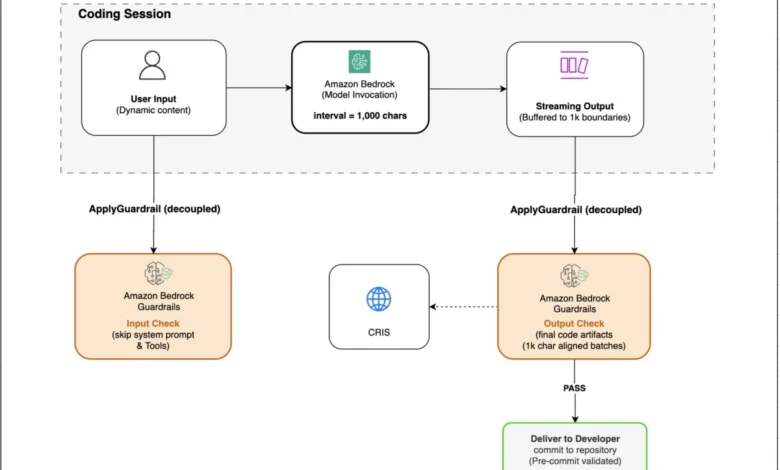
The core best practice is to shift from continuous inline scanning to selective validation at strategic checkpoints, analogous to a pre-commit hook in a Git workflow. Developers don’t run linters or security scanners after every line typed; they validate the finished result at the moment it matters. A pre-commit hook in Git runs automatically at the point of committing code, serving as the last gate before changes become part of the shared codebase. This balances thoroughness (every committed change is validated) with efficiency (validation only occurs when the risk profile changes).
Applying this to Amazon Bedrock Guardrails means identifying natural "commit points" in the code generation pipeline:
- User Input: Before the user’s prompt reaches the model.
- Final Code Artifact: When the generated code is complete and stable.
- Code Commit/File Write: Before the code is persisted to a file or repository.
Between these checkpoints, intermediate reasoning or ephemeral tokens do not cross a trust boundary, making continuous scanning redundant. The decoupled ApplyGuardrail API is key here, enabling evaluation of user inputs before model invocation and aggregated final code artifacts before persistence, rather than every intermediate reasoning token. For the highest-risk checkpoint—when AI-generated code is about to be written to a file or committed—comprehensive guardrail evaluation should be performed, acting as a direct pre-commit hook.
Architecture Pattern 2: Increase the Streaming Interval to 1,000 Characters
For scenarios requiring real-time streaming evaluation (e.g., interactive coding sessions where immediate halting of generation upon violation detection is crucial), optimizing the streaming interval is vital. The default guardrail interval of 50 characters generates excessive API calls. Increasing this to 1,000 characters can reduce API call volume by 20x. For example, a 5,000-character function would go from 100 evaluations to just 5, and a 50,000-character file from 1,000 to 50 evaluations. This simple configuration change dramatically impacts cost and performance.
# When using InvokeModelWithResponseStream with guardrails
response = bedrock_runtime.invoke_model_with_response_stream(
    modelId='anthropic.claude-sonnet-4-20250514',
    body=json.dumps(request_body),
    guardrailIdentifier='your-guardrail-id',
    guardrailVersion='1',
    # Key configuration: increase streaming interval
    streamingConfigurations=
        'guardrailStreamingInterval': 1000  # Default is 50!

)
Architecture Pattern 3: Use the Decoupled ApplyGuardrail API for Selective Evaluation
The standalone ApplyGuardrail API allows for evaluating text independently of foundation model invocation, offering granular control over when and what content is scanned.
-
Input-Only Validation with Unguarded Inference: When the primary concern is preventing prompt injection and blocking malicious inputs, validate only the dynamic user content before it reaches the model. The model is then invoked without inline guardrails. This is particularly efficient for coding workflows where static system prompts (often 2,000-5,000 characters of tool definitions and instructions) and growing conversation history are resent on every invocation. The decoupled approach evaluates only the new, typically much shorter, user message, avoiding redundant scans of static content.
-
Output-Only Validation at Completion: If user input is deemed benign (e.g., internal developer tools behind authentication), but generated code needs scanning for sensitive information (leaked credentials, hardcoded secrets), validate only the final, complete output after generation. This avoids the overhead of inline guardrails during the generation process itself.
-
Bidirectional Validation with Selective Scope: For maximum coverage, validate inputs for injection attacks and outputs for sensitive content, while still bypassing the overhead of continuous inline scanning. This combines the input-only and output-only patterns into a comprehensive, yet efficient, pipeline.
Architecture Pattern 4: Batch Output to Text Unit Aligned Boundaries
Since any chunk of text, even if shorter than 1,000 characters, still consumes one full text unit, it is crucial to batch output to multiples of 1,000 characters to avoid partial-unit waste. This ensures that each ApplyGuardrail API call processes the maximum possible content for a single text unit charge, optimizing cost efficiency. Implementing a GuardrailBatcher that accumulates streaming output and evaluates it precisely at 1,000-character boundaries is an effective strategy.
Architecture Pattern 5: Risk-Based Evaluation Depth
Not all generated code carries the same risk profile. Code dealing with IAM policies, secrets, or authentication warrants more rigorous scanning than UI layout code or test files. Implementing adaptive evaluation depth based on content signals allows for targeted application of guardrails:
- High-risk code: (e.g., IAM policy manipulation, credential handling, code execution commands, cryptographic keys) receives full evaluation with all safeguards active.
- Standard code: undergoes a lightweight evaluation (e.g., sensitive information filters only).
- Low-risk code: (e.g., UI components, styling, test files, documentation) might skip intermediate evaluation and defer validation entirely to the commit-time checkpoint.
This pattern, leveraging regular expressions or contextual metadata, ensures that guardrail resources are allocated most effectively, focusing intensive scrutiny where it is most needed, while minimizing overhead for less critical code.
Architecture Pattern 6: Multi-Stage Agent Pipeline
Agentic coding workflows, where an AI model uses tools, reasons over multiple steps, and produces intermediate outputs, demand a specialized evaluation strategy. In an agent loop, the model might undertake several reasoning steps (tool calls, observations, reflections) before generating final code. Evaluating every intermediate step is wasteful, as most contain internal reasoning that never reaches the user or the file system.
The strategy here involves:
- Input Validation: Validate the user request before the agent begins its work.
- Intermediate Steps: Skip chain-of-thought and benign tool-use reasoning.
- Tool Inputs: Validate only dangerous tool inputs (e.g., tools that write to disk, execute code, or interact with sensitive resources).
- Final Output: Validate the complete response shown to the user before it is presented.
This ensures that guardrails are applied at critical junctures where content transitions trust boundaries or interacts with the external environment, avoiding unnecessary evaluations of internal agent processes.
Broader Implications for Enterprise Development and AI Governance
The adoption of these architectural best practices for Amazon Bedrock Guardrails has significant implications for enterprises leveraging generative AI in software development:
- Enhanced Security Posture: By strategically implementing guardrails, organizations can significantly reduce the risk of introducing vulnerabilities, leaking sensitive data, or generating malicious code, thereby strengthening their overall security posture.
- Cost Optimization: The multiplicative nature of text units makes unoptimized guardrail usage prohibitively expensive at scale. These patterns ensure cost-effective operation by minimizing redundant evaluations and maximizing the value of each API call. Industry data suggests that careful optimization can lead to cost reductions of 70-90% in high-throughput scenarios, transforming the financial viability of large-scale AI adoption.
- Improved Developer Experience: By preventing throttling and reducing latency, developers experience smoother, more reliable AI assistance, fostering greater adoption and trust in these powerful tools. A frustrating experience with AI tools can severely impact developer morale and productivity.
- Compliance and Governance: Robust guardrail configurations aid in meeting regulatory compliance requirements and internal governance policies related to data privacy, intellectual property, and secure coding practices. As AI governance frameworks mature, demonstrating such proactive safety measures will become increasingly important.
- Scalability: These optimized patterns enable enterprises to scale their use of AI-powered code generation across hundreds or thousands of developers without encountering performance bottlenecks or runaway costs.
AWS continues to emphasize the importance of responsible AI development. As stated by an AWS spokesperson, "Our goal with Amazon Bedrock Guardrails is to empower customers to build and deploy generative AI applications with confidence, ensuring safety and compliance without sacrificing innovation. For complex workflows like code generation, a thoughtful architectural approach is not just a best practice, it’s a necessity for sustainable, scalable AI integration." Industry analysts, such as those at Gartner and Forrester, echo this sentiment, projecting that robust AI safety and governance frameworks will be critical differentiators for enterprises in the coming years, impacting market leadership and customer trust.
Conclusion
The transformative potential of AI-assisted code generation is undeniable, but realizing this potential at enterprise scale demands a sophisticated approach to AI safety. The best practices outlined in this article for optimizing Amazon Bedrock Guardrails for code generation workflows provide a comprehensive framework for achieving robust safety coverage while maintaining efficiency and cost-effectiveness. By understanding the unique characteristics of code generation, strategically applying the decoupled ApplyGuardrail API, optimizing streaming intervals, batching outputs, adopting risk-based evaluation, and designing for multi-stage agent pipelines, organizations can proactively mitigate risks and unlock the full power of generative AI in their software development lifecycle. These architectural patterns are not merely technical recommendations but strategic imperatives for any enterprise committed to building secure, scalable, and responsible AI applications in the era of intelligent coding.