The evolution of generative artificial intelligence has reached a critical juncture where the focus is shifting from simple text generation to the deployment of autonomous agents capable of executing complex, multi-step workflows. Abacus.AI has officially entered this space with the release of the Smaug model family, a suite of three open-weight models specifically optimized to overcome the inherent instability often observed in extended agentic operations. By applying a rigorous, consistent training methodology across diverse base architectures, the research team at Abacus.AI aims to address the “training challenge” of making state-of-the-art models function reliably in production environments where context retention and tool invocation are paramount.
The Problem: Beyond the Chatbot Paradigm
For many developers, the transition from building a static chatbot to an autonomous agent represents a significant technical hurdle. While a chatbot is designed to provide a single, isolated response, an agent must maintain state, interpret user intent, select appropriate tools, and execute sequential actions over an extended period. In practice, this often leads to “runaway” models—systems that deviate from their original goals, lose context as the workflow progresses, or fail to handle the complexities of interacting with external APIs and databases.

Abacus.AI encountered these limitations during its own internal operations. The company observed that complex agentic tasks, which required hours of compute and heavy context management, frequently ended in failure or exhaustion of the model’s logical thread. The core issue, according to the research team, is that current general-purpose language models are often pushed to their limits by prompting strategies that fail to account for the structural fragility of long-horizon tasks. Consequently, Abacus.AI posited that true reliability must be engineered into the model’s weights through fine-tuning, rather than merely incentivized through prompt engineering.
A Chronology of the Smaug Development
The development of the Smaug series began with a research-driven philosophy: identify the specific failure modes of existing open-weight models and apply a standardized, high-quality training regimen to address them. The methodology relies on a combination of human-curated agentic “traces” and synthetic data generated from challenging, edge-case scenarios.
The training process began by selecting three distinct base models, chosen to represent different points on the efficiency-to-capability spectrum: DeepSeek V4 Flash (304B parameters), Qwen3.8-27B (28B parameters), and Kimi K3 (2.8T parameters, Mixture of Experts). By applying the same rigorous fine-tuning recipe to these diverse architectures, Abacus.AI sought to demonstrate that their methodology is model-agnostic and capable of producing consistent, measurable improvements in agentic reasoning.
Performance Analysis and Model Taxonomy
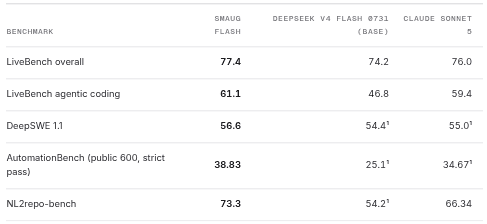
The Smaug family is divided into three tiers, each designed for specific enterprise and research applications. The performance metrics, validated through the LiveBench evaluation framework—a system designed to mitigate data contamination by using constantly refreshed, high-stakes content—provide a clear picture of where these models excel.
Smaug Flash: The Enterprise Workhorse
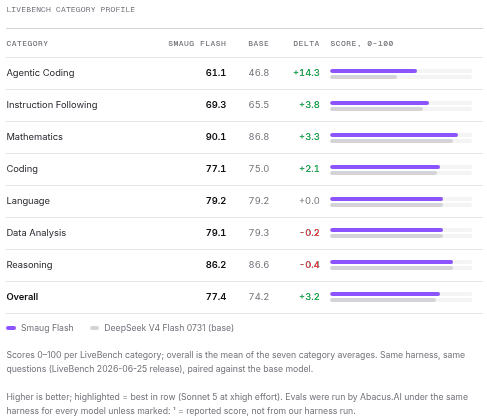
Targeted at always-on enterprise agents, Smaug Flash is an optimized version of the DeepSeek V4 Flash model. The primary goal for this model was to improve performance in long-context tool use. The results have been significant: Smaug Flash recorded a 14.3-point improvement in agentic coding (rising from 46.8 to 61.1) and a 19-point jump in NL2Repo-Bench scores. This suggests that the model is uniquely equipped for tasks requiring the frequent, accurate invocation of tools within long-running processes.
Smaug Mini: The Multimodal Specialist
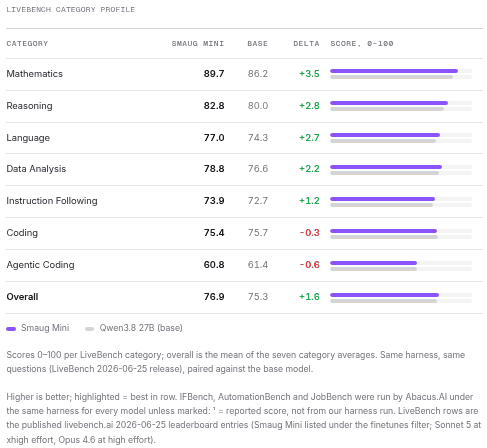
As the most compact member of the series, Smaug Mini (based on Qwen3.8-27B) serves as a proof-of-concept for efficiency. Despite its smaller parameter count, it has outperformed several larger, closed-source models in specific benchmarks. Notably, it achieved a 17.1-point gain in JobBench, demonstrating that for specific, one-off automation tasks, architectural size is less critical than the quality of the instruction-following fine-tuning.
Smaug Agentic: Frontier-Scale Stability
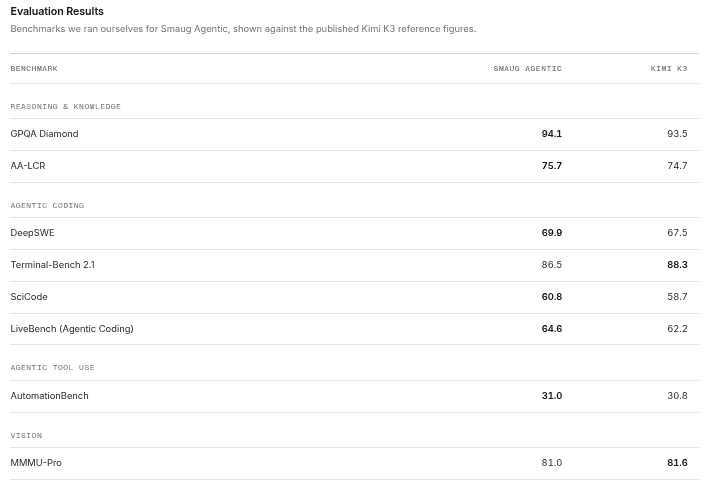
The largest model, Smaug Agentic (based on Kimi K3), represents the pinnacle of the series. Here, the focus shifted from raw benchmark scores to behavioral endurance. While the numerical gains over the base model appear modest in traditional tests, the real-world performance is striking: the model successfully completed 113 complex coding tasks, maintaining a median of 78 agent steps per task, with zero infrastructure errors or timeouts over a seven-hour continuous testing period. This highlights a shift in industry metrics—from static benchmarks to “operational uptime.”
Supporting Data and Benchmarking Context
To ensure the validity of these results, Abacus.AI utilized its LiveBench framework. Unlike traditional evaluation methods, which often rely on static datasets that models may have memorized during pre-training, LiveBench uses real-time data from sources such as competitive mathematics, recent academic abstracts, and coding repositories.
The following table summarizes the comparative gains across the Smaug series:

| Category / Benchmark | Smaug Flash | Smaug Mini | Smaug Agentic |
|---|---|---|---|
| LiveBench Agentic Coding | +14.3 | -0.6 | +2.4 |
| LiveBench Instruction Following | +3.8 | +1.2 | -0.4 |
| LiveBench Mathematics | +3.3 | +3.5 | -0.5 |
| AutomationBench (delta) | +13.7 | +4.5 | +0.2 |
It is essential to note that these improvements are not uniform. As the data suggests, the fine-tuning process is additive in nature, often closing gaps in the base model’s specific weaknesses rather than globally elevating every metric. For instance, while Smaug Mini shows a slight regression in agentic coding, it demonstrates superior instruction-following capabilities, reinforcing the conclusion that different models within the series are optimized for distinct operational needs.
Implications for the AI Ecosystem
The introduction of the Smaug series provides several key insights for the broader AI development community. First, it underscores the importance of “behavioral tuning” in the development of agentic AI. As enterprises move toward deploying autonomous systems that interact with databases and APIs, the risk of model-induced logic loops or failures becomes a significant cost factor. The stability shown by Smaug Agentic serves as a benchmark for what companies should demand from their LLM providers.
Second, the results challenge the industry’s reliance on “vendor-reported” benchmarks. Abacus.AI has explicitly categorized some competitive data as “vendor-reported,” urging the community to interpret such figures with caution. By providing open-weight models that have been tested against a standardized, rigorous harness, Abacus.AI is promoting a more transparent culture of benchmarking.
Finally, the Smaug project highlights the diminishing returns of scaling for the sake of scaling. By focusing on the “agentic trail” of a model—the actual path it takes to solve a problem—developers can achieve high-performance results with smaller, more efficient models like Smaug Mini. This has profound implications for cost, latency, and the feasibility of running sophisticated AI agents on edge hardware or within restricted private cloud environments.
The Path Forward
The Abacus.AI research team concludes that there is no “universal” model that excels at every task. Instead, the future of AI development lies in selecting the right architecture for the specific workflow. The Smaug series demonstrates that by carefully curating training data—prioritizing genuine problem-solving over mere format compliance—researchers can significantly enhance the reliability of current-generation models.
As businesses continue to experiment with agentic workflows, the metrics of success are evolving. The industry is moving away from basic accuracy scores toward more complex indicators of reliability: task completion ratios, latency under heavy context, cost per agent step, and, most importantly, operational reproducibility. The Smaug models represent an early, significant step toward that goal, proving that the gap between a promising prototype and a production-grade agent is often bridged not by more compute, but by more targeted, intelligent training.
For developers and researchers, the Smaug models are currently available on Hugging Face, inviting further scrutiny and integration into real-world agentic pipelines. As the field matures, the lessons learned from the Smaug series—particularly the necessity of focusing on long-horizon endurance—will likely inform the next generation of large language model development, setting a new standard for what it means for an AI to be truly “agentic.”