Worldwide Express Transforms Order-to-Cash Operations with Multi-Agentic AI on AWS, Unlocking Millions in Frozen Capital

The modern global logistics and freight sector operates on staggering scales of complexity, speed, and volume. For industry giants like Worldwide Express—operating under the umbrella of ShipStation Global—achieving an estimated $5 billion in systemwide revenue brings monumental operational challenges. With a vast network comprising more than 75 less-than-truckload (LTL) carriers and a dedicated customer base exceeding 130,000 accounts, the sheer volume of daily transactions generates a massive administrative footprint. However, this impressive market scale carried a hidden, persistent operational liability that drained company resources: every single month, approximately $15 million in free cash flow remained completely frozen, locked inside unresolved billing exceptions.
In the high-stakes environment of LTL freight shipping, discrepancies between quoted prices, carrier tariffs, and actual delivery charges are a frequent occurrence. Traditionally, these billing exceptions demanded arduous, manual intervention. Worldwide Express previously relied on outsourced teams working cases individually, manually placing calls to customers and carriers alike to untangle intricate billing disputes. Because every individual carrier operated under its own distinct tariff structures, compliance rules, and dispute workflows, the exception backlog compounded steadily. Cash remained trapped in administrative limbo, extending order-to-cash cycles and stretching the financial operations (FinOps) team’s bandwidth to its absolute limits.
The Path to Innovation: Designing a Multi-Agentic AI Framework
Recognizing that conventional rule-based process automation (RPA) lacked the contextual reasoning required to parse varied carrier policies, Worldwide Express initiated a transformative partnership with Amazon Web Services (AWS) and LTM. Their objective was to engineer a sophisticated, multi-agentic artificial intelligence solution that could integrate seamlessly into SpeedShip, the proprietary transportation management system (TMS) utilized by Worldwide Express.
The resulting architecture bypassed rigid automation limitations by leveraging Amazon Bedrock for advanced AI reasoning, while Amazon Elastic Compute Cloud (Amazon EC2) served as the high-performance computational engine. By deploying the framework directly on Amazon EC2, the engineering team maintained granular control over orchestration logic, decision boundaries, and open-source agent libraries. Crucially, this setup ensured that every automated decision made during a billing dispute remained completely transparent, explainable, and fully auditable—a non-negotiable requirement for financial governance.
Chronology of a Rapid Digital Transformation
The journey from initial assessment to full production deployment was remarkably swift, demonstrating the accelerating pace of enterprise artificial intelligence adoption in modern logistics.
In June 2025, Worldwide Express engaged the AWS Business Transformation & Value Advisory team to conduct a comprehensive operational audit. The objective was to identify high-impact automation opportunities across the entire Order-to-Cash lifecycle. Out of 19 potential areas reviewed, the team quickly prioritized exceptions automation due to its immediate impact on working capital and liquidity.
By prioritizing speed without compromising accuracy, Worldwide Express moved from the initial assessment phase to full production deployment in less than six months. Within six months of going live, the deployment expanded across more than 40 LTL carriers, fundamentally reshaping how the organization handles financial disputes and billing reconciliation.
Anatomy of the Solution: Specialized AI Agents and Carrier Knowledge Bases
At the core of the deployment are specialized AI agents engineered to handle distinct categories of billing disputes. When the system detects an invoice exception—which statistically affects roughly 14 percent of standard LTL invoices that fail the mandatory three-way match between purchase orders, goods receipts, and carrier invoices—it routes the case to the appropriate agent.
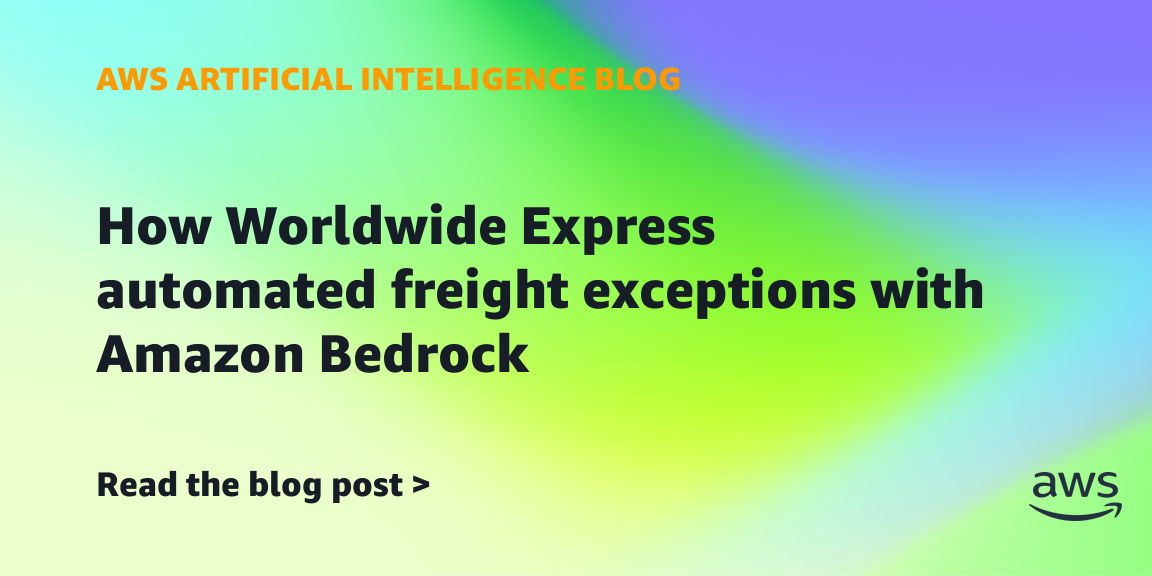
Each custom agent operates using a carefully defined instruction prompt that outlines its specific role, output format, and strict decision boundaries. Rather than relying on hardcoded carrier instructions, the agents dynamically query comprehensive carrier knowledge bases. These repositories store individual tariff rules, surcharge definitions, variance thresholds, and standard operating procedures (SOPs) for every partner carrier. When evaluating an exception, the agent references the specific carrier’s governing documentation before formulating a resolution, ensuring high contextual accuracy without requiring custom code for each shipping partner.
Once an agent evaluates the data—accessing the exact contract rates, shipment histories, and delivery proofs available to human analysts via SpeedShip APIs—it generates a comprehensive resolution report accompanied by a plain-language explanation of its findings.
During the initial rollout phase, Worldwide Express prioritized a human-in-the-loop governance model. Human reviewers utilized the familiar SpeedShip user interface to inspect and approve the AI-generated recommendations before finalization. As the system demonstrated exceptional reliability, exceeding a 99 percent accuracy rate, bulk approval mechanisms were introduced as the default workflow, freeing analysts to concentrate on complex, high-value disputes.
Measurable Financial Impact and Operational Results
The quantitative outcomes of the AWS-powered deployment exceeded initial enterprise projections across nearly every critical financial metric. Most notably, the backlog of active billing exceptions plummeted from $15 million in June 2025 down to just $4 million within six months—representing an immediate 75 percent reduction in locked capital.
This dramatic clearing of the backlog resulted in a one-time infusion of $10 million in freed-up free cash flow, alongside more than $1 million in recurring annual operational savings. Furthermore, the organization achieved a staggering 60-fold return on investment (ROI) in its first year, while cutting the overall time-to-cash cycle by four full weeks.
Nathanael Pearson, Vice President of FinOps at Worldwide Express, emphasized the transformative nature of the deployment: "With AWS, we’ve automated more than 40 percent of weekly billing exceptions, significantly reducing costs and accelerating billing cycles from days to minutes. Today, we release approximately $10 million more in customer billings each week at a speed that simply wasn’t possible before."
Broader Industry Implications and Future Outlook
The success achieved by Worldwide Express highlights a broader paradigm shift for the logistics and transportation sector. As supply chain organizations grapple with inflationary pressures, labor constraints, and rising operational overhead, traditional back-office bottlenecks are increasingly becoming competitive liabilities.
The deployment demonstrates that agentic AI, when paired with robust cloud infrastructure and rigorous governance frameworks, can effectively untangle complex administrative workflows that previously resisted automation. By shifting routine reconciliation tasks to intelligent agents, logistics providers can scale their operational capacity exponentially without a corresponding increase in administrative headcount.
Building on this initial success, Worldwide Express is actively expanding its multi-agentic automation framework into adjacent segments of the Order-to-Cash lifecycle. Industry observers and technology analysts note that the logistics sector at large is likely to take cues from this deployment, moving toward modular, agent-driven architectures that prioritize explainability, rapid time-to-market, and direct integration with legacy enterprise systems. For other logistics enterprises seeking similar transformations, industry experts recommend starting with highly repetitive, bounded workflows—such as invoice exception handling—to establish baseline accuracy before scaling automation enterprise-wide.