Unlocking Multi-Turn Reinforcement Learning on Amazon SageMaker AI: A Comprehensive Architecture and Implementation Guide for Agentic Workflows

Traditional fine-tuning methodologies for artificial intelligence have long been optimized for single-turn interactions. In a standard supervised fine-tuning paradigm, a foundational language model is trained to generate a superior, isolated answer to a single prompt. While effective for static classification, summarization, and basic question-answering tasks, this approach fundamentally breaks down when applied to complex, agentic workflows. Modern enterprise applications require autonomous agents capable of navigating long-horizon tasks—such as automated financial reconciliation, multi-step customer support ticket triage, and dynamic software debugging—where actions unfold sequentially, and each subsequent decision is strictly contingent upon the historical context of preceding steps.
In these advanced operational environments, there is rarely a single, canonical sequence of actions for a model to imitate. The only reliable metric of success is the terminal outcome of the entire execution sequence. Standard supervised fine-tuning lacks the structural capability to assign credit across multi-step trajectories without explicit intermediate labels, and conventional single-turn reinforcement learning remains incapable of attributing credit to a strategic decision made three or four turns prior to a final outcome. To bridge this critical capability gap, Amazon Web Services (AWS) has introduced Multi-Turn Reinforcement Learning (MTRL) on Amazon SageMaker AI, providing a robust, scalable framework designed to train language models directly on episodic rewards across extended decision-making trajectories.
The Mechanics of Multi-Turn Reinforcement Learning on SageMaker AI
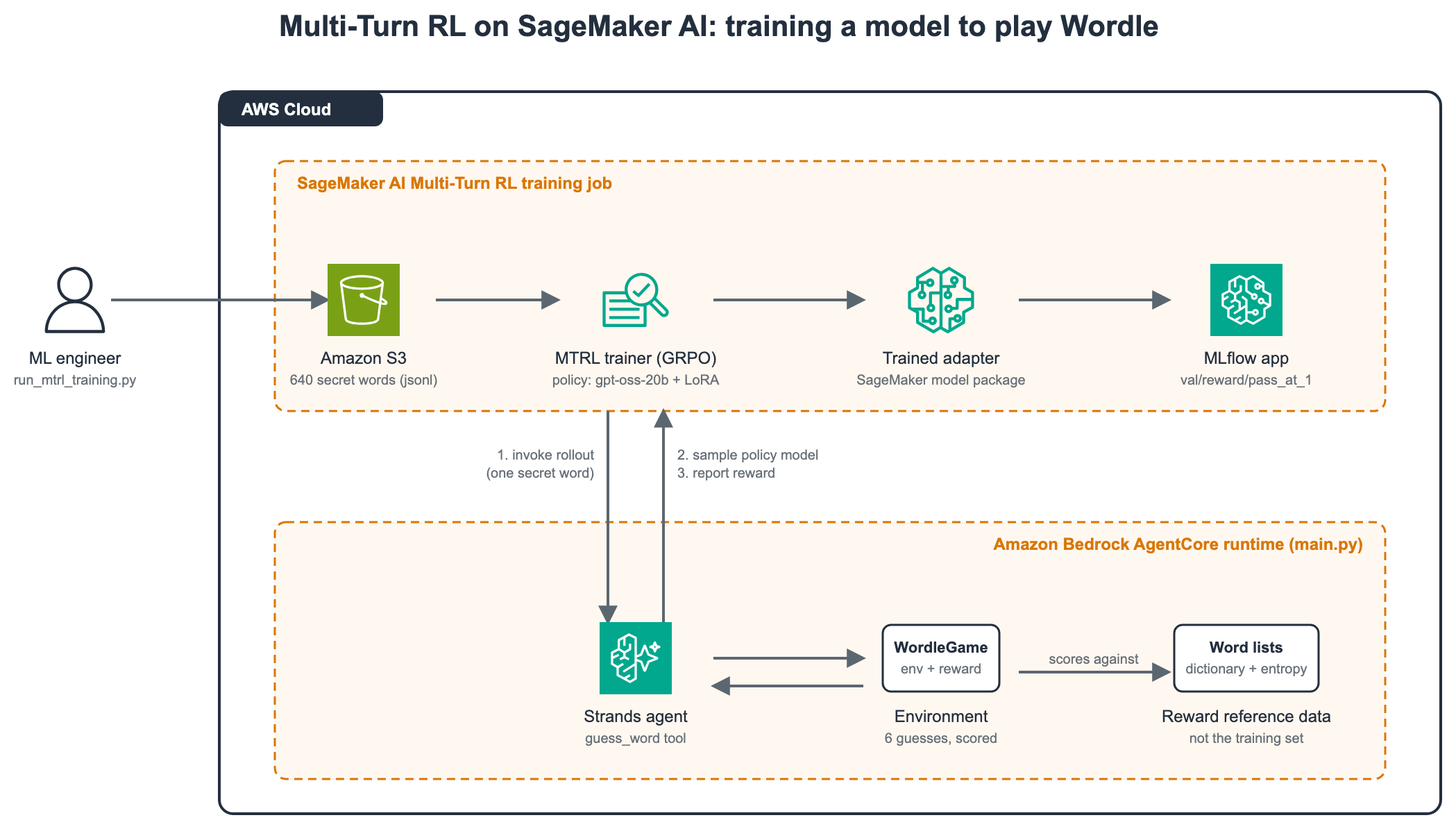
The MTRL framework shifts the optimization paradigm from static imitation to dynamic, outcome-driven policy refinement. At its core, the architecture decouples the training orchestration from the runtime environment execution. Amazon SageMaker AI manages the core training lifecycle, handling policy model updates, hyperparameter optimization, and integration with tracking frameworks such as MLflow. Concurrently, the operational environment—hosting the agent logic, custom tools, and domain-specific validation rules—is executed on Amazon Bedrock AgentCore, or alternatively on user-managed infrastructure such as Amazon Elastic Kubernetes Service (Amazon EKS), Amazon Elastic Compute Cloud (Amazon EC2), or AWS Fargate via an AWS Lambda forwarder.
During a training rollout, the MTRL service transmits a structured prompt containing a specific task instantiation to the agent runtime. The hosting agent, powered by the policy model under training via the SageMaker Job Runtime’s OpenAI-compatible endpoint, interacts dynamically with the environment over as many turns as required to accomplish the objective. Throughout this episodic execution, the model invokes specialized tools, evaluates intermediate feedback, and adjusts its behavioral strategy. Upon the termination of the episode—whether through successful completion or failure—the environment computes a singular, holistic reward score.
To optimize the policy model efficiently, the architecture leverages Group Relative Policy Optimization (GRPO). By evaluating the mathematical spread and relative distribution of rewards generated across multiple distinct rollouts of the exact same initial task, GRPO updates a Low-Rank Adaptation (LoRA) adapter attached to the base policy model. This algorithmic approach eliminates the necessity of maintaining a computationally expensive, separate critic network, thereby significantly reducing the memory overhead and infrastructure footprint required during reinforcement learning.
Economic Efficiency and Model Ecosystem Support
The serverless design of MTRL on SageMaker AI liberates machine learning engineers from the operational complexities of provisioning, sizing, and maintaining dedicated GPU clusters for reinforcement learning experiments. Organizations select a supported foundational base model, and the underlying service automatically provisions and scales the necessary sampling and training infrastructure.
At launch, the framework supports a curated selection of high-performance, open-weight foundational models, each optimized for reinforcement learning via LoRA adapters. These include Amazon Nova 2 Lite, GPT-OSS-20B, instruction-tuned Gemma 4 31B, and Qwen 3.6 27B. Among these options, GPT-OSS-20B has emerged as a favored choice for cost-sensitive enterprise deployments due to its highly competitive per-token pricing structure and its natively controllable reasoning effort parameter, which allows developers to dynamically modulate token consumption and generation depth per request.
The economic model of MTRL is structured around three distinct token dimensions billed per million units: prefill tokens, sample tokens, and train tokens. In benchmark training runs utilizing GPT-OSS-20B across a rigorous 100-step optimization cycle comprising over 105,000 distinct rollouts, total computational token consumption approached 1.3 billion tokens. Empirical cost accounting indicates that the training dimension—which scales directly in proportion to the average trajectory length of the agent episodes—dominates the overall expenditure. Consequently, optimizing agent tool efficiency, minimizing verbosity in intermediate reasoning steps, and designing concise task trajectories directly translate to lower operational expenditures. Furthermore, auxiliary infrastructure costs, such as the vCPU and memory resources utilized by the Amazon Bedrock AgentCore runtime, are billed transparently through standard cloud metric usage tracking.
End-to-End Implementation Workflow: The Wordle Benchmark Case Study

To demonstrate the practical application and efficacy of MTRL, AWS engineers implemented a comprehensive reference pipeline utilizing the classic word-guessing game Wordle. While frontier models already solve Wordle with high baseline accuracy, the game serves as an ideal pedagogical proxy for enterprise automation: it operates under strict, unambiguous rules, requires sequential reasoning where every guess is informed by immediate feedback, and possesses a mathematically objective scoring mechanism. In a production deployment, the exact same architectural pipeline is leveraged to instill multi-step workflow mastery into smaller, cost-effective models tailored exclusively to proprietary enterprise logic.
Step 1: IAM Role Configuration and Security Primitives
The deployment of an MTRL pipeline requires the precise provisioning of two distinct Identity and Access Management (IAM) roles. The agent runtime role, automatically provisioned by the agentcore deploy CLI utility, establishes a secure trust relationship with bedrock-agentcore.amazonaws.com and incorporates the AmazonSageMakerJobRuntimeAccess managed policy. This policy authorizes the hosting agent to query the active policy model endpoint and report computed rewards back to the training substrate.
Conversely, the training job role must be manually provisioned by the developer. It requires a specific trust relationship with the service principal job.sagemaker.amazonaws.com, authorizing both sts:AssumeRole and sts:TagSession actions, coupled with the AmazonSageMakerJobFullAccess managed policy. Industry practitioners must exercise caution during this phase: utilizing the generic sagemaker.amazonaws.com principal will inevitably cause job initialization failures with cryptic permission errors, as the service strictly demands the specialized job principal.
Step 2: Deploying Agent Logic to Amazon Bedrock AgentCore
Following role establishment, the agent logic—packaged as a Python application utilizing the Bedrock AgentCore framework—is deployed to the cloud runtime. The deployment utility compiles all native dependencies for the target Linux ARM64 runtime platform and executes a seamless AWS CloudFormation deployment. The agent entrypoint is decorated with @app.entrypoint to instantiate the underlying HTTP server and wrapped with the @sagemaker_rft_handler decorator to manage telemetry and reward transmission. Omitting the outermost HTTP server wrapper results in persistent 30-second timeout failures during runtime initialization.

Step 3: Rigorous Runtime Verification and Smoke Testing
Prior to allocating capital to GPU-intensive training jobs, developers must execute a systematic smoke test to validate authentication, payload parsing, and error-handling chains. By invoking the runtime endpoint with a simulated payload containing a synthetic job ARN, engineers can confirm that the agent successfully parses incoming prompts, authenticates against the SageMaker Job Runtime endpoint, and generates expected operational exceptions. Observing a structured error message confirming the absence of the fake training job serves as definitive proof that the underlying network architecture, IAM policies, and execution handlers are functioning correctly.
Step 4: Dataset Architecture and Preparation
Unlike supervised fine-tuning datasets, which require exhaustive target responses, conversational transcripts, or ground-truth completion labels, an MTRL dataset consists exclusively of discrete task instantiations. Each row represents an independent challenge for the autonomous agent to solve. The training pipeline ingests data formatted in JSON Lines (JSONL), Apache Parquet, or CSV formats and passes the raw string payload verbatim to the agent runtime. Developers can pack rich contextual data, dynamic tool configurations, and customized environment constraints directly into the prompt string without exposing sensitive enterprise IP to external model providers, as all datasets, agent runtimes, and trained model weights remain entirely secured within the customer’s AWS account boundaries.
Step 5: Launching and Monitoring the Training Job
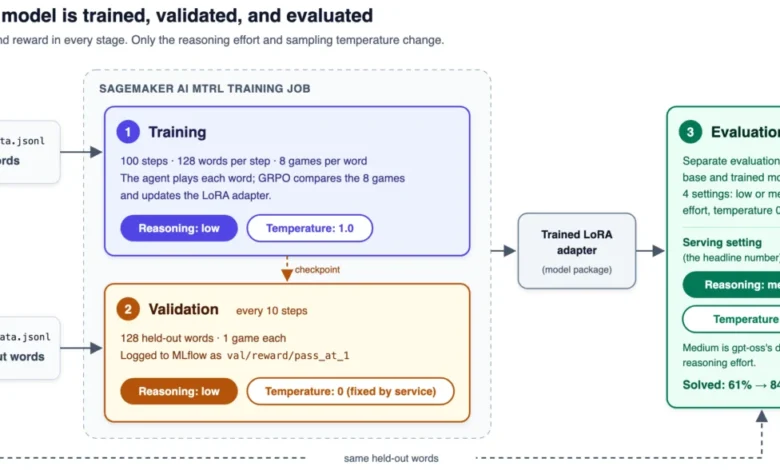
Training jobs are initialized using the MultiTurnRLTrainer class from the sagemaker-train SDK, linking the runtime ARN, IAM roles, dataset storage paths, and an active MLflow tracking application ARN. Hyperparameters such as sampling_max_tokens must be carefully calibrated; for instance, setting the maximum token limit to the service ceiling of 8,192 prevents complex reasoning models from prematurely truncating their internal thought processes prior to executing their first tool call.
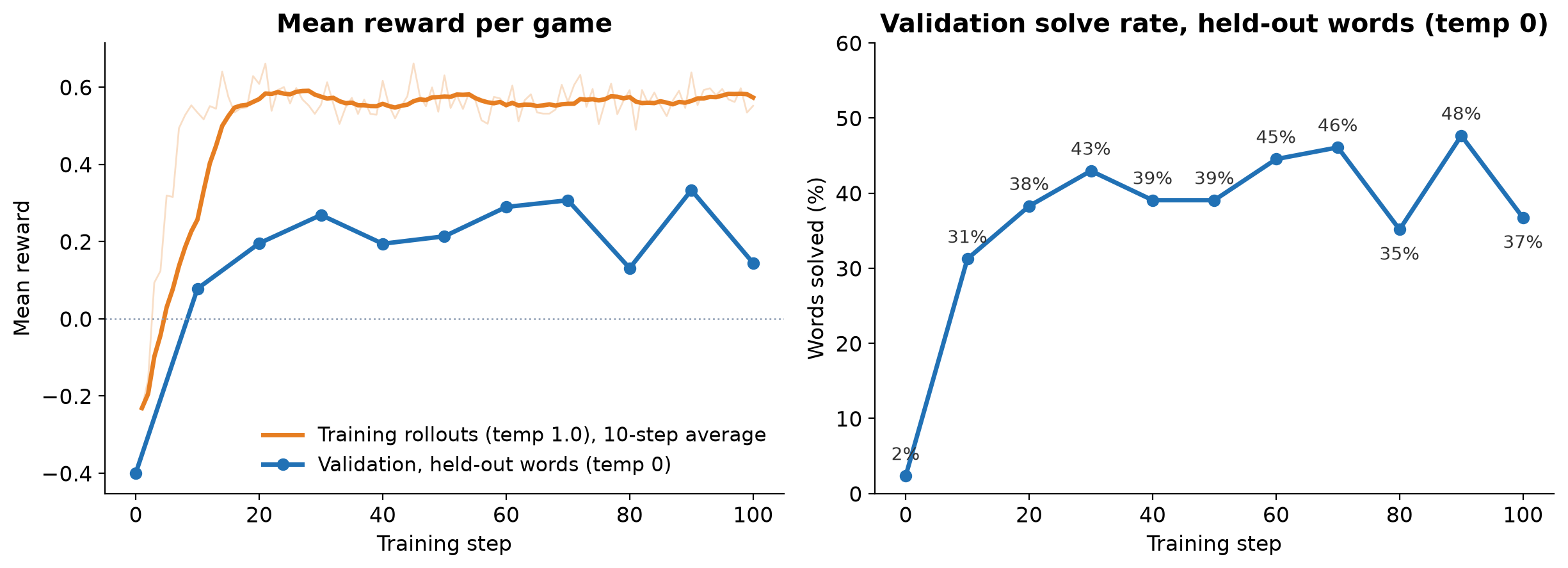
Throughout the optimization cycle, developers monitor training progression via MLflow dashboards. The primary metric of evaluation is val/reward/pass_at_1, which tracks the exact percentage of held-out evaluation tasks successfully solved by the agent. Crucially, engineering teams must avoid redeploying agent runtimes while an active training job is underway, as runtime restarts disrupt in-flight rollouts and cause the overarching optimization job to fail.
Empirical Performance Gains and Evaluation Insights
Rigorous empirical evaluation underscores the transformative power of Multi-Turn Reinforcement Learning. In benchmark runs utilizing the GPT-OSS-20B foundational model, baseline performance on held-out evaluation tasks sat at a 61 percent solve rate at default reasoning effort and 15 percent at low reasoning effort. Following the completion of a 100-step MTRL training run—costing approximately $339 in training tokens and $79 in runtime compute—performance on held-out tasks surged dramatically. At serving settings utilizing medium reasoning effort and temperature 1.0 sampling, the trained model achieved an 84 percent solve rate. When evaluated at low reasoning effort, performance jumped from 15 percent to 69 percent.
A vital engineering takeaway from the evaluation phase is the divergence between internal training validation metrics and real-world serving evaluations. Internal training curves, typically scored under greedy decoding (temperature 0) conditions for mathematical determinism, often underreport the true capability of the model. When evaluated at serving-grade sampling temperatures (such as temperature 1.0) with appropriate reasoning effort parameters enabled, the true generalization capacity of the LoRA adapter becomes fully apparent. Consequently, machine learning architects are strongly advised to execute evaluation jobs under the exact operational parameters intended for production deployment.
Strategic Implications and Enterprise Adoption

The commercial availability of Multi-Turn Reinforcement Learning on Amazon SageMaker AI marks a significant maturation point in enterprise generative artificial intelligence deployment. By enabling organizations to optimize open-weight foundational models against complex, multi-step, domain-specific reward functions without requiring massive labeled datasets or expensive proprietary architectures, AWS has lowered the barrier to entry for true agentic automation.
As enterprises increasingly transition from conversational chatbots to autonomous software agents capable of executing multi-stage business processes, frameworks that bridge the gap between static model weights and dynamic, outcome-based environmental feedback will become indispensable. The ability to instill robust strategic planning, tool-use proficiency, and error-correction capabilities into cost-effective models for less than the cost of a standard hardware server deployment signals a new era in application-specific artificial intelligence engineering.