Frontend Developer Weekly Round-Up: HTMX 4.0 Launch, Browser-Native Email Verification Proposals, and Modern CSS Innovations


The rapidly evolving landscape of frontend web development has experienced a significant surge of activity, highlighted by major architectural releases, experimental browser application programming interfaces (APIs), and deep dives into the foundational aesthetics of web design history. At the forefront of these developments is the official release of htmx 4.0.0, a milestone that continues to challenge traditional single-page application (SPA) paradigms by extending HTML’s hypermedia capabilities. Simultaneously, emerging proposals from the WICG (Web Incubator Community Group) are aiming to streamline user authentication friction directly within the browser, while developers explore advanced CSS capabilities and architectural considerations for custom text editors. This comprehensive overview examines the primary technical updates, community tutorials, innovative tooling resources, and historical reflections shaping the current trajectory of web engineering.
Architectural Milestones and Core Framework Updates
The release of htmx 4.0.0 marks a pivotal moment for developers advocating for hypermedia-driven applications over complex, JavaScript-heavy client-side frameworks. For engineers new to the ecosystem, the latest iteration emphasizes extreme simplicity, allowing developers to implement dynamic, asynchronous behaviors directly inside standard HTML markup within a few lines of code. By leveraging attributes to issue AJAX requests, trigger CSS transitions, and swap server-rendered HTML fragments, htmx continues to bridge the gap between classic multi-page application simplicity and modern, reactive user experiences.
Industry analysts note that the continuous growth of htmx reflects a broader developer sentiment favoring reduced dependency trees, faster initial page loads, and simplified server-side maintenance. Rather than managing complex state machines on the client side—a hallmark of contemporary JavaScript frameworks—htmx empowers backend architectures to remain the single source of truth, returning hypermedia fragments in response to standard HTTP verbs. The 4.0.0 release refines this philosophy, offering improved performance, enhanced extensibility, and tighter compliance with standard HTTP specifications, further cementing its position as a viable alternative for teams seeking architectural lean-ness.

Emerging Browser APIs and Streamlined Authentication
In the realm of browser standards, the WICG has introduced an experimental proposal addressing one of the most persistent friction points in modern web user experience: the email verification workflow. Historically, user registration requires a multi-step process wherein a user submits a form, leaves the web application to open an external email client, locates a verification message, and either clicks a link or copies a security token back into the application.
The proposed Browser Email Verification API aims to eliminate the "go and check your inbox" headache by establishing a secure, native communication channel between the browser and the user’s email provider. Under this framework, a secure token is passed directly through browser-to-provider integrations, allowing the server to verify the address automatically upon form submission. Currently operating within a Chrome origin trial and restricted exclusively to Gmail accounts, the initiative represents a promising step toward friction-less identity management. If standardized and adopted widely, this API could drastically reduce drop-off rates during user onboarding while enhancing security paradigms by minimizing manual token handling.
Modern CSS Advancements and Polyfill Strategies
Styling capabilities continue to expand across modern web browsers, yet fragmentation in feature implementation remains a persistent hurdle for frontend engineers. A prominent example is the random() function in CSS, which allows developers to introduce dynamic, calculated variability directly into stylesheets without relying on JavaScript injections. Currently, Apple’s Safari is the sole browser shipping native support for CSS random().
To mitigate this disparity, developers have turned to innovative polyfill strategies. Recent engineering tutorials highlight methodologies where random() calls are encapsulated within custom properties (CSS variables). Because non-supporting browsers ignore custom properties they cannot compute inline or natively parse for specific functional outputs, JavaScript can systematically intercept these values, compute the intended random states, and safely apply them to the DOM. This hybrid approach enables progressive enhancement, ensuring that users on Safari experience native performance while users on alternative browser engines still benefit from the visual dynamism intended by the author.

Parallel to functional utilities, developers are actively exploring layout innovations using CSS Grid. Recent design engineering case studies have successfully recreated modernist tile aesthetics reminiscent of mid-century graphic design purely through CSS Grid architecture. These implementations demonstrate the immense power of modern layout engines, proving that complex, asymmetrical, and artistically rich geometric structures can be achieved with remarkably lean, semantic CSS rather than convoluted absolute positioning or heavy graphic assets.
Engineering Trade-Offs in Browser-Based Text Editing
Building complex interactive components within the browser frequently forces developers to weigh performance against implementation complexity. A recent technical debate popularized within the developer community centers on the age-old dilemma: building a custom text editor from scratch. Developers generally evaluate three primary architectural approaches: the <canvas> element, the contenteditable attribute, and a plain, unstyled <textarea>.
Each approach carries distinct trade-offs:
- The
<canvas>Element: Offers absolute control over rendering, pixel-perfect performance, and uniform visual presentation across all operating systems. However, it requires developers to manually implement complex text-shaping, cursor rendering, selection management, and accessibility (a11y) trees from the ground up. contenteditable: Leverages the browser’s native text editing engine, natively supporting spellcheck, complex bi-directional text, selection, and accessibility out of the box. Nevertheless, it is notoriously difficult to normalize across different browsers due to divergent DOM mutation behaviors and unpredictable cursor handling.- Plain
<textarea>: Provides ultimate simplicity, predictability, and native form-submission handling, but severely limits custom styling, inline rich-text formatting, and advanced document layouts.
By contrasting these methodologies with interactive demonstrations, industry discourse continues to guide engineering teams in selecting the optimal architecture based on project scope, performance constraints, and maintenance overhead.

Tooling Ecosystem and Resource Discovery
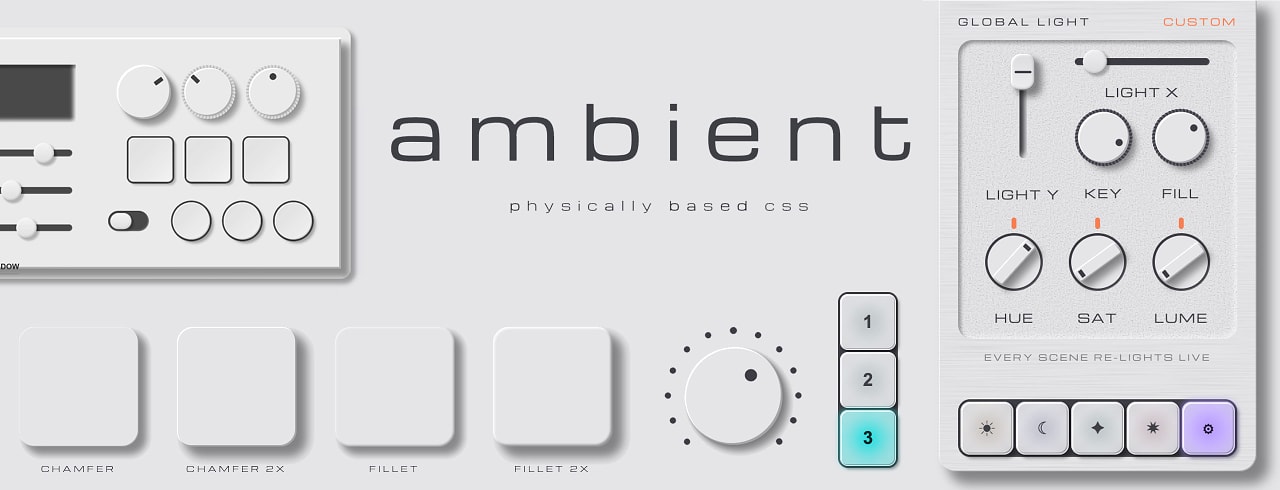
The contemporary developer ecosystem thrives on open-source contributions, utility libraries, and visual design resources. Recent curation highlights innovative tools such as Ambient CSS, a utility-focused resource designed to help developers implement subtle, atmospheric visual effects and lighting simulations using modern CSS properties. Such tools underscore a broader industry trend toward high-fidelity visual styling driven entirely by lightweight, hardware-accelerated stylesheet rules rather than heavy JavaScript animation libraries.
Historical Reflections and the Evolution of Web Design
As frontend engineering pushes the boundaries of native browser capabilities, the web community frequently pauses to reflect on its foundational origins. Archival explorations into early web design aesthetics offer critical context regarding how far the medium has advanced over the past three decades.
In a seminal 2010 retrospective essay titled Prof. Dr. Style: Top 10 Web Design Styles of 1993, design theorist Olia Lialina mapped out the nascent stages of digital publishing. During this era, web design was characterized by severe technical constraints: pages were structured with rudimentary HTML tags, typography was dictated entirely by the end user’s local operating system fonts, and visual flair was practically non-existent until the gradual introduction of table-based layouts, background color specifications, and the animated GIF.
To preserve this rich heritage, institutions such as the Web Design Museum maintain extensive archives documenting the visual evolution of websites across their first two decades. These historical repositories serve a vital function for modern developers, illustrating the rapid acceleration of human-computer interaction standards—transforming static, text-heavy academic documents into dynamic, multimedia-rich application platforms.
Broader Impact and Future Outlook
The convergence of architectural simplification via htmx, experimental UX improvements like the Browser Email Verification API, and continuous innovations in CSS layout and tooling signals a maturing frontend ecosystem. As the industry balances the push for hyper-responsive client-side applications with the counter-movement toward lean, server-rendered hypermedia, developers are equipped with a more diverse and powerful toolkit than ever before.
Ultimately, these developments point toward a web engineering landscape that prioritizes performance, accessibility, and architectural sustainability. Whether adopting cutting-edge browser standards or honoring the simplistic roots of 1993 web design, the frontend community continues to redefine the boundaries of what is possible within the universal runtime of the modern web browser.