The Mechanics of Semantic Search
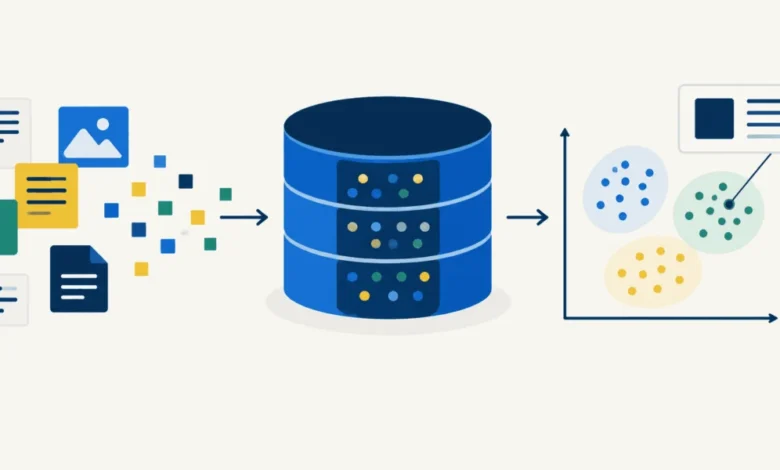
The core of a vector database is the translation of unstructured data, such as natural language text, into high-dimensional vectors. These vectors act as coordinates in a multi-dimensional space, where the proximity between two points corresponds to their semantic relevance. When a user submits a query, the system converts that input into a vector of identical dimensionality and calculates the distance—typically using cosine similarity—between the query vector and the existing corpus of document vectors.
This approach resolves a significant limitation in legacy information retrieval. In conventional database systems, a search for "energy production in a cell" might fail to retrieve a document describing "mitochondrial ATP generation" if the specific keywords do not overlap. A vector database, however, recognizes that these concepts reside in close proximity within the vector space, effectively "understanding" that the biological concepts are related regardless of the vocabulary employed.
Developing the Infrastructure
The process of constructing such a system can be distilled into ten logical steps, primarily utilizing the Python programming language and the NumPy library for efficient numerical computation. The journey begins with the establishment of a robust environment. By leveraging libraries such as sentence-transformers, developers can access pre-trained models that handle the heavy lifting of converting text to embeddings.
The initial phase requires the preparation of a corpus and a metadata schema. The index serves as the heart of the system; it acts as a structured repository where the numerical embeddings are stored alongside their original text and associated metadata. This architecture ensures that when a vector match is found, the system can instantly map that coordinate back to the human-readable document.
The Evolution of Vector Indexing
The evolution of vector databases has moved from simple, brute-force linear scans to sophisticated indexing structures. In the early stages of development, a linear search—comparing a query against every vector in the index—is sufficient for small datasets. However, as the volume of information grows into the millions or billions of records, this becomes computationally expensive.
Data scientists often look toward Approximate Nearest Neighbor (ANN) algorithms, such as HNSW (Hierarchical Navigable Small World) or IVF (Inverted File Index), to optimize retrieval. These structures allow the system to partition the vector space, enabling the search algorithm to prune irrelevant data points and focus on clusters likely to contain the best matches. This trade-off between absolute accuracy and search latency is the central challenge in scaling vector databases to enterprise levels.
Ensuring Data Integrity and Performance
A critical, often overlooked aspect of vector database development is the implementation of guard rails. Because these systems operate on complex numerical arrays, silent data corruption can occur if the alignment between the text, metadata, and the embedding is lost. Professional-grade implementations require rigorous input validation to ensure that every document, its associated metadata, and its vector representation remain in strict synchronization.
Performance metrics underscore the efficiency of this model. In a typical scenario, once a model has been loaded and the index is established, the time required for encoding is minimal, often measuring in milliseconds per document. The size of the index is determined not by the length of the source text, but by the dimensions of the embedding model. A model producing 384-dimensional vectors will result in a predictable, fixed-size index, making memory allocation and infrastructure planning significantly more straightforward for engineers.
Strategic Implementation and Scaling
When scaling from a prototype to a production environment, developers must consider the role of metadata filtering. Metadata allows for "pre-filtering," where the system restricts the search space to a subset of the corpus—such as filtering by a specific topic or publication date—before the vector similarity calculation begins. This ensures that the retrieved results are not only conceptually relevant but also contextually appropriate.
The scalability of the vector database is inherently linear in terms of memory and search time. As demonstrated in controlled tests with synthetic data, scanning 100,000 vectors remains a highly performant task, often completing in under 10 milliseconds. This predictability is precisely what has attracted major cloud providers and database companies to invest heavily in the vector space, as it provides a stable foundation for Retrieval-Augmented Generation (RAG) pipelines.
Broader Implications for AI Architecture
The shift toward vector-based retrieval marks a fundamental change in how software systems interact with information. By treating knowledge as a geometry of concepts rather than a collection of strings, we enable applications that can "reason" across disparate data sources. This technology is the backbone of modern LLM-based applications, allowing models to ground their responses in specific, private, or real-time data that was not present in their initial training set.
The implications for enterprise search are profound. Organizations that move from keyword-based search to vector-based semantic search report higher accuracy and improved user satisfaction, as the system consistently surfaces the intent behind a query rather than merely matching character strings. Furthermore, because vector databases are agnostic to the content type—provided it can be converted into a vector—the same architecture can be used to search images, audio, or video alongside text.
Future Perspectives
As the field matures, we are likely to see the emergence of hybrid search engines that combine the best of both worlds: the precision of traditional keyword-based Boolean logic with the intuitive, conceptual breadth of vector search. The transition from building these databases from scratch to utilizing managed services allows developers to focus on the high-level logic of their applications, but the fundamental lessons of the "ten-step" approach remain relevant. Understanding that a dot product, when properly normalized, serves as the engine of semantic relevance is the prerequisite for any engineer looking to build the next generation of intelligent software.
By moving beyond the black-box abstraction of commercial tools and understanding the underlying NumPy-based matrix multiplications, practitioners gain the ability to troubleshoot performance bottlenecks, optimize index sizes, and ultimately build more reliable, scalable, and intelligent systems. The simplicity of the vector database architecture is its greatest strength; it is a testament to the idea that some of the most powerful advancements in artificial intelligence are rooted in elegant, foundational mathematics.