The Evolution of Text Preprocessing Pipelines
Historically, text classification relied heavily on manual feature engineering or computationally expensive deep learning architectures. Traditional methods, such as Logistic Regression or Support Vector Machines (SVMs), perform remarkably well when fed clean, structured inputs. However, they frequently struggle with raw, noisy, or verbose text, where irrelevant information often masks the core signal. In the past, this necessitated complex, multi-stage data cleaning processes involving stop-word removal, lemmatization, and regex-heavy filtering.
The emergence of the Scikit-LLM library marks a transition in this paradigm. Instead of stripping away data through rigid filters, modern pipelines can now leverage LLMs to perform intelligent, context-aware distillation. By using an LLM to summarize long documents into "canonical" representations, the downstream model is provided with a condensed, high-signal version of the input, drastically improving performance while minimizing the computational overhead typically associated with large-scale transformer inference.
Bridging Generative AI and Classical Machine Learning
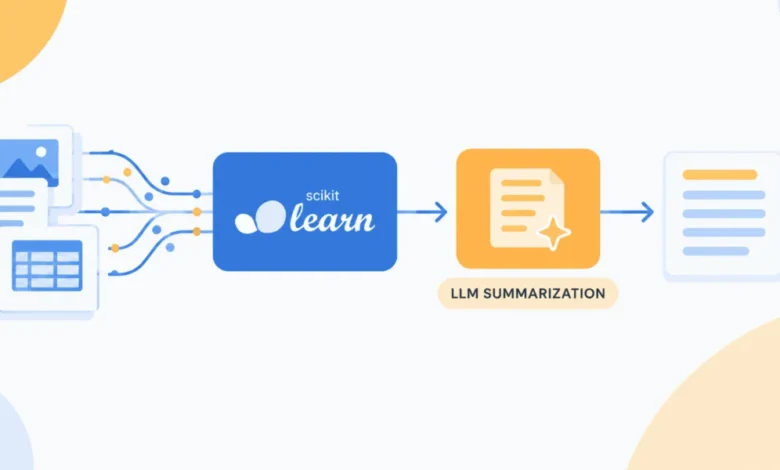
The integration of LLMs into scikit-learn pipelines is made possible through modular architectures that treat the LLM as a transformer-like object within a Scikit-Learn Pipeline. This approach utilizes the GPTSummarizer component, which allows for the seamless execution of LLM-based summarization tasks during the preprocessing phase of a pipeline.
The process involves a three-stage sequence:
- The Distillation Stage: The input text is passed to an LLM, such as those hosted on the Groq platform, which generates a concise summary. This step effectively removes noise and focuses on key themes.
- The Vectorization Stage: The summarized text is transformed into numerical data using Term Frequency-Inverse Document Frequency (TF-IDF), which calculates the importance of words within the document relative to a corpus.
- The Inference Stage: A lightweight classifier, such as Logistic Regression, interprets the vectorized data to assign a specific class label.
This synergy allows for "few-shot" or even "zero-shot" learning capabilities, where the model requires minimal training examples to achieve high accuracy. Because the LLM handles the semantic understanding and summarization, the downstream classifier merely needs to recognize the core patterns emerging from the distilled text, turning a complex classification problem into a streamlined keyword-matching task.
Operational Deployment and Infrastructure
For developers and organizations looking to implement this architecture, the use of efficient APIs is crucial to controlling operational costs. The Groq API, for instance, provides a high-throughput, low-latency interface that makes it feasible to run these pipelines in real-time or near-real-time environments.
To deploy this, a developer must:
- Configure the Scikit-LLM environment to interface with an OpenAI-compatible endpoint.
- Securely manage API credentials using environment variables or secret management tools like Google Colab’s "Secrets" feature.
- Define the pipeline structure to ensure that data flows sequentially from the summarizer to the classifier.
The technical requirement for this approach is relatively low, requiring only the installation of the scikit-llm library and a valid API key. This low barrier to entry is essential for democratizing access to LLM-powered tools, allowing smaller teams to build sophisticated pipelines that were previously reserved for organizations with massive compute budgets.
Empirical Performance and Analytical Implications
The efficacy of this hybrid approach can be observed through the analysis of the summaries produced. In comparative tests, the summaries effectively isolate the thematic intent of the source text—whether the subject is financial volatility, medical trial progress, or energy sector innovation.
Data indicates that by condensing input text to a fixed word count (e.g., 20-30 words), the dimensionality of the vector space is significantly reduced. This reduction in dimensionality helps mitigate the "curse of dimensionality" that often plagues traditional classifiers when dealing with high-entropy text data. Furthermore, because the LLM performs the heavy lifting, the logistic regression model—which is computationally inexpensive—can be trained in milliseconds on a CPU, avoiding the need for expensive GPU clusters during the final classification step.
Broader Impact on Enterprise Data Strategy
The integration of LLMs into established workflows has profound implications for the industry. Many organizations currently sit on vast archives of unstructured data, ranging from customer service transcripts to internal technical documentation. Traditionally, extracting value from these sources required substantial data labeling efforts and long-running GPU training cycles.
With the Scikit-LLM pipeline model, organizations can pivot toward a "distill-and-classify" strategy. This allows for:
- Reduced Training Latency: Because the classifier receives cleaner data, it converges faster and requires fewer training instances to reach parity with more complex models.
- Enhanced Interpretability: Unlike deep neural networks, which are often criticized for their "black box" nature, the output of this pipeline can be audited at every stage. One can inspect the summary generated by the LLM, verify the TF-IDF vectorization, and understand the weights assigned by the logistic regression model.
- Cost Efficiency: By shifting the bulk of the semantic processing to a summarizer and using a lightweight downstream model, companies can achieve higher throughput at a fraction of the cost associated with running massive LLMs for every classification request.
Looking Ahead: The Future of Hybrid Pipelines
As the AI ecosystem continues to mature, the trend toward hybrid pipelines is expected to accelerate. We are likely to see the emergence of specialized summarizers trained on specific domains—such as legal, medical, or financial literature—that can be swapped into these pipelines to improve classification accuracy for niche tasks.
Moreover, the modularity of the scikit-learn framework ensures that as new, more efficient models are released, they can be integrated into existing pipelines with minimal code changes. This "pluggable" architecture is a core pillar of sustainable AI development, allowing practitioners to keep pace with the rapid innovation in Large Language Models without having to re-architect their entire data infrastructure every few months.
In conclusion, the fusion of Scikit-LLM with classical machine learning provides a robust, scalable, and highly efficient framework for modern text classification. By leveraging the strengths of LLMs for distillation and the proven efficiency of scikit-learn for classification, developers can build systems that are not only high-performing but also manageable and transparent. This methodology represents a significant step forward in the quest to make powerful AI tools accessible, practical, and effective for a wide range of real-world business challenges.