The deployment of large language models (LLMs) has transformed the landscape of artificial intelligence, yet developers face a persistent, fundamental hurdle: the "autoregressive bottleneck." Every token generated by a modern LLM requires a full pass through billions of parameters, turning the process of human-computer interaction into a slow, sequential crawl. Speculative decoding has emerged as the industry-standard solution to this challenge, enabling models to generate text up to three times faster without sacrificing accuracy or requiring extensive retraining.
The Autoregressive Bottleneck: A Historical Context
Since the inception of the Transformer architecture in 2017, the industry has focused heavily on scaling model size. Larger models demonstrated superior reasoning and creative capabilities, but they also introduced a significant trade-off in inference latency. Because LLMs generate text one token at a time—where each new word depends on the sequence of words preceding it—the generation speed is bound by the time it takes to move model weights from GPU memory to the processor.
This creates a "memory-bandwidth bound" environment. Modern hardware, such as the NVIDIA H100 or A100 GPUs, is theoretically capable of performing trillions of operations per second, yet these units often sit idle while waiting for the next set of weights to be fetched from high-bandwidth memory (HBM). By 2022, as enterprise adoption of chatbots and coding assistants accelerated, the latency cost of these sequential memory reads became the single most significant obstacle to deploying real-time agents, leading researchers to seek a mechanism that could break the sequential generation cycle.
The Mechanics of Speculative Decoding
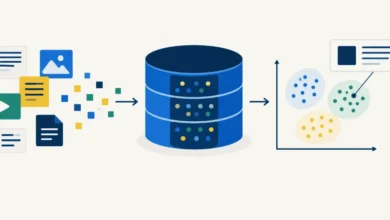
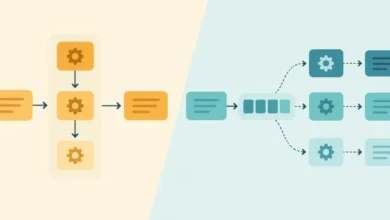
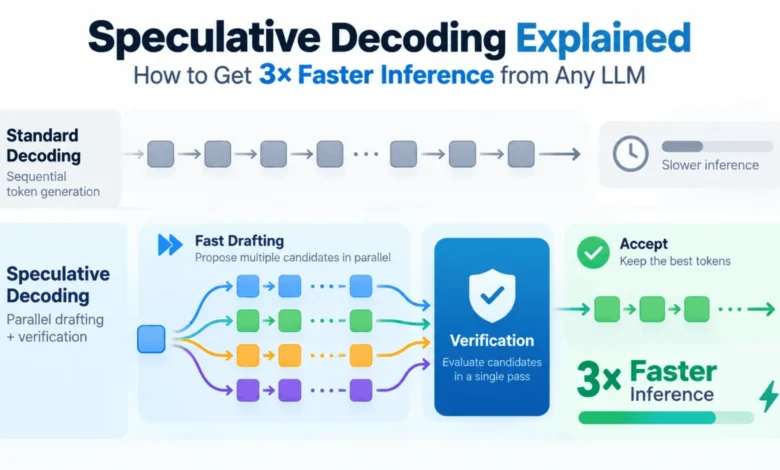
Speculative decoding shifts the paradigm from individual token generation to a "draft-and-verify" workflow. The core objective is to leverage the parallel processing power of modern GPUs, which are uniquely optimized to handle large batches of data simultaneously.
The process operates through two distinct components: a target model and a draft model. The draft model is a significantly smaller, lower-parameter version of the target model, engineered to prioritize speed over depth. During each generation step, the draft model "speculates" by generating a short sequence of tokens—typically four to eight—in a fraction of the time the target model would take to generate just one.
Once this "draft" is created, the target model performs a single, parallel forward pass over the entire sequence. It compares the draft tokens against its own internal probability distributions. If the draft matches the target model’s expected output, the entire batch is accepted, resulting in a dramatic increase in tokens per second. If a discrepancy is found, the target model rejects the incorrect token and samples from its own distribution, ensuring that the final output remains statistically identical to what would have been produced by the target model alone.
Supporting Data and Performance Metrics
Empirical evidence from early adopters and research institutions, including Google and Meta, indicates that when the draft model is well-aligned with the target model, the acceptance rate for tokens ranges from 70% to 80%.
In real-world benchmarking, this translates to a speedup of 2x to 3x. For instance, in coding scenarios where syntax is highly predictable, speculative decoding shows peak performance. In more chaotic or creative writing scenarios, where the target model’s path is less predictable, the acceptance rate may dip; however, the overhead remains negligible. Engineers have noted that the "worst-case" scenario—where every draft token is rejected—results in only a minor latency increase, making it a low-risk strategy for most production environments.
Evolution of the Technology: From Medusa to Prompt Lookup
While the two-model architecture is the foundational approach, the industry has rapidly evolved toward more efficient, integrated methods that remove the overhead of managing a separate draft model.
- Medusa (Multi-head Decoding): Introduced as a breakthrough in 2024, Medusa modifies the architecture of the target model by adding specialized "heads" to the final layer. These heads predict multiple future tokens simultaneously, allowing the model to draft its own candidates without an external partner.
- Eagle (Extrapolation Algorithm): This method refines the process by using the target model’s hidden states rather than its output tokens. By utilizing the richer, contextual information buried within the model’s internal layers, Eagle achieves higher acceptance rates for complex tasks.
- Prompt Lookup Decoding: A non-model-based approach, this method scans the user’s prompt for recurring phrases. If a user asks a question about a specific document, the system assumes the model will use terminology found in the prompt, effectively "guessing" tokens from the context window rather than a secondary model.
Industry Implications and Deployment
The shift toward speculative decoding is visible in the rapid adoption of the technique by major inference frameworks. Tools such as vLLM, Hugging Face’s text-generation-inference, and llama.cpp now support speculative decoding as a configuration parameter. For developers, this means that achieving significant performance gains no longer requires a research-heavy effort; it is increasingly becoming a "plug-and-play" feature.
However, analysts caution that speculative decoding is not a universal panacea. In high-throughput, multi-tenant environments—where a server is handling thousands of requests concurrently—the additional memory overhead required to maintain draft models can actually reduce the total capacity of the server. Consequently, architects are currently focused on optimizing the draft models themselves, aiming to make them so lightweight that they occupy virtually no additional memory, thereby preserving the benefits of high-throughput batching.
Broader Impact on AI Infrastructure
The development of speculative decoding represents a shift in how the AI industry approaches the physical constraints of hardware. Rather than waiting for the next generation of hardware to provide more memory bandwidth, software engineers are redesigning the flow of computation to work within existing limits.
This maturation of inference technology is critical for the next wave of AI applications. Real-time translation, complex coding environments, and interactive robotics demand low-latency responses that are currently impossible with standard autoregressive methods. By decoupling the speed of generation from the size of the model, speculative decoding ensures that as models become more powerful and complex, they remain viable for the high-speed, interactive experiences that users now expect. The trajectory of this technology suggests that within the next two years, speculative or parallelized decoding will be the standard, rather than an optional optimization, for all enterprise-grade LLM deployments.