The landscape of generative artificial intelligence is undergoing a significant architectural shift as researchers move beyond the traditional autoregressive paradigm that has dominated the industry since the inception of the Transformer model. While GPT-style architectures—which generate text token-by-token in a serial fashion—have achieved remarkable proficiency, they are increasingly constrained by the "serial dependency problem," which necessitates substantial computational overhead during inference. In response, a new wave of diffusion-based language models has emerged, promising to challenge the status quo by treating text generation as an iterative refinement process rather than a linear sequence of predictions.
The Architectural Divide: Autoregressive vs. Diffusion
To understand the fundamental divergence between these two approaches, one must first examine the mechanics of autoregressive models. In an autoregressive framework, the probability of a sequence is factorized into the product of conditional probabilities. Mathematically, for a sequence $x = (x_1, dots, xN)$, the model calculates $p(x) = prodi=1^N p(x_i mid x1, dots, xi-1)$. During the training phase, these models benefit from "teacher forcing," where all tokens are processed in parallel, allowing for efficient gradient updates. However, during inference, the model is strictly limited: it must generate the first token, append it to the context, and only then proceed to the next. This creates a computational bottleneck where the time required for generation scales linearly with the length of the output.
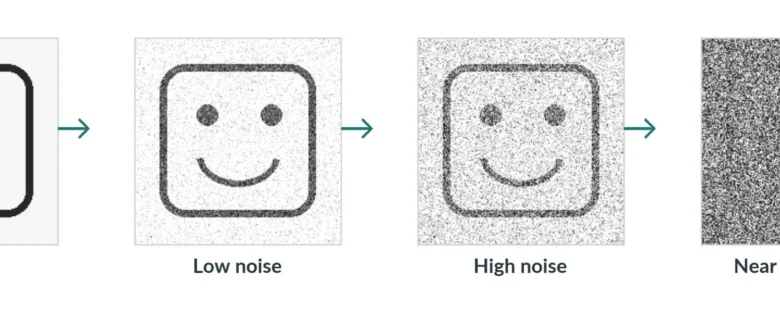
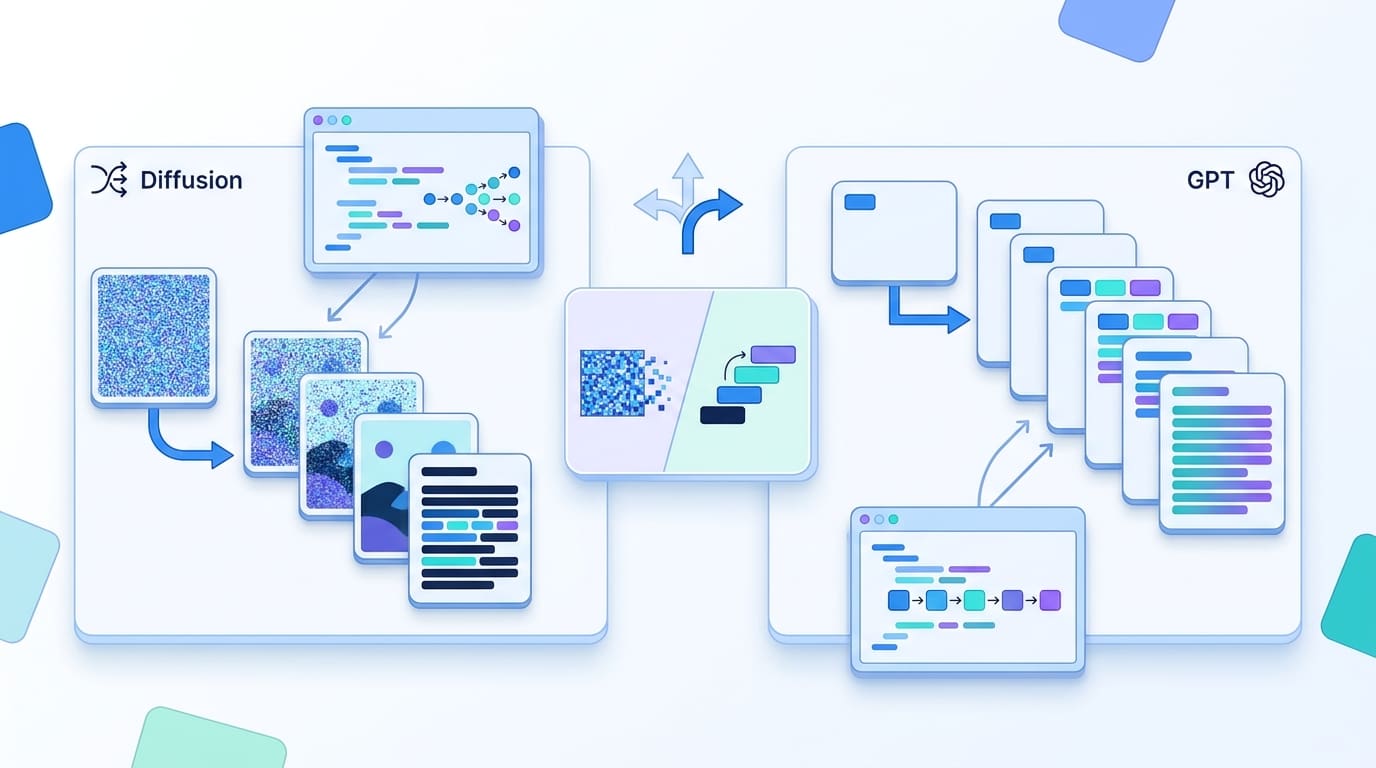
Diffusion models, by contrast, originate from the field of computer vision, specifically the landmark "Denoising Diffusion Probabilistic Models" paper, which demonstrated that meaningful data could be reconstructed from pure Gaussian noise. In the context of language, the challenge is distinct; while images are continuous values that can be subtly shifted by noise, text is composed of discrete token IDs. Simply adding noise to a token ID does not result in a "nearby" word. Consequently, language diffusion models utilize masking—the replacement of tokens with a placeholder—to simulate a noisy environment. Instead of predicting one token after another, a diffusion model initializes a sequence of masks and simultaneously predicts multiple tokens across the entire output canvas, refining those predictions over several iterative steps.
A Chronology of Emergence (2025–2026)
The shift toward diffusion language models has been rapid, driven by a series of high-profile research papers that have pushed the boundaries of what is possible with non-autoregressive architectures:
- Early 2025: The release of LLaDA (Large Language Diffusion Architecture) marked a turning point, demonstrating that a diffusion-based approach could achieve competitive performance while offering parallelized generation capabilities.
- Mid-2025: The publication of the Mercury architecture further refined the noise-scheduling techniques, providing a more stable framework for training models that do not rely on left-to-right generation.
- Late 2025: Google’s internal testing and subsequent documentation of Gemini Diffusion signaled that industry leaders were treating these models as viable production alternatives.
- 2026: The release of DiffusionGemma underscored the commitment of major AI labs to explore non-autoregressive paths, providing the community with a robust model for benchmarking the efficiency gains of diffusion against standard Gemma autoregressive models.
How Denoising Works in Language
The diffusion process for text operates through a cycle of forward and reverse stages. In the forward process, a clean sequence is progressively corrupted by masking tokens, essentially reducing the information density of the sentence until it reaches a state of high uncertainty. The neural network is then trained to reverse this process, learning to predict the original tokens given a partially masked input.
During the inference phase, the sampler initiates the process with a sequence of tokens that are entirely or mostly masked. In each iteration, the model evaluates the entire sequence, predicting the probability distribution for the vocabulary at each masked position. Through a confidence-based mechanism, the model commits to high-certainty tokens while leaving others masked for further refinement. This allows the model to "rethink" earlier parts of a sentence as the broader context becomes clearer, a process that is mathematically impossible in a standard left-to-right autoregressive model.
Comparative Efficiency and Performance Data
Preliminary studies suggest that diffusion models can significantly reduce the latency of generation tasks. While an autoregressive model requires $N$ forward passes to generate $N$ tokens, a diffusion model can theoretically generate a sentence in a fixed number of rounds, regardless of the sequence length.
Data from recent benchmarks indicate that while diffusion models may require more compute during the initial phases of training, the throughput during inference is significantly higher for specific applications. For instance, in tasks where the model must generate long-form structured data or fill in large blanks within a document, diffusion models have demonstrated the ability to maintain global coherence more effectively than autoregressive models, which can occasionally "drift" as they proceed through a long sequence.
Challenges and Limitations
Despite the excitement surrounding these developments, significant hurdles remain. One of the primary criticisms is that diffusion models often struggle with the "order-agnostic" nature of their training. Because they can generate any part of the sequence at any time, maintaining strict grammatical or logical order can be more difficult than in autoregressive models, which are inherently biased toward temporal sequences.
Furthermore, the "revision" process—where a model corrects its own previously committed tokens—can lead to instability if the confidence thresholds are not carefully tuned. Researchers are currently investigating "hybrid" architectures, which seek to combine the fast parallel generation of diffusion models for drafting with the precise, high-fidelity refinement capabilities of autoregressive models.
Broader Implications for the Industry
The emergence of diffusion language models poses a fundamental question: Do language models truly need to generate text one token at a time? If the industry can solve the stability issues inherent in non-autoregressive generation, we could see a paradigm shift in how AI is deployed in real-time applications.
Lower latency generation would allow for more fluid human-computer interaction, enabling voice assistants and real-time translation tools to operate with significantly reduced lag. Moreover, the ability to refine sequences iteratively opens the door to more sophisticated error-correction capabilities, as the model can evaluate the "global" quality of a response rather than just the next logical word.
While it is premature to declare the end of the autoregressive era, the rise of diffusion models represents a maturation of the field. It signals a move away from "brute force" scaling of next-token prediction toward more nuanced, iterative, and computationally efficient methods of information generation. As these models continue to evolve, they will likely become a core component of the next generation of AI infrastructure, potentially serving as the primary engines for high-speed, high-context generation tasks.