Finnegan Shannon reimagines gallery accessibility with a sushi-style conveyor belt installation at Pioneer Works in Brooklyn

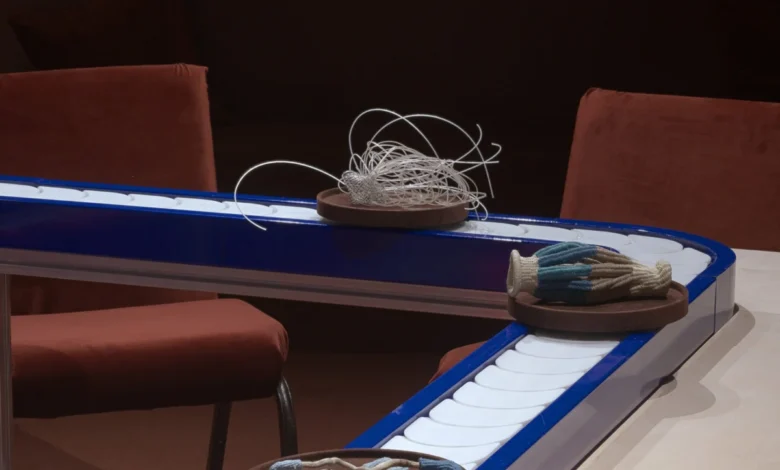
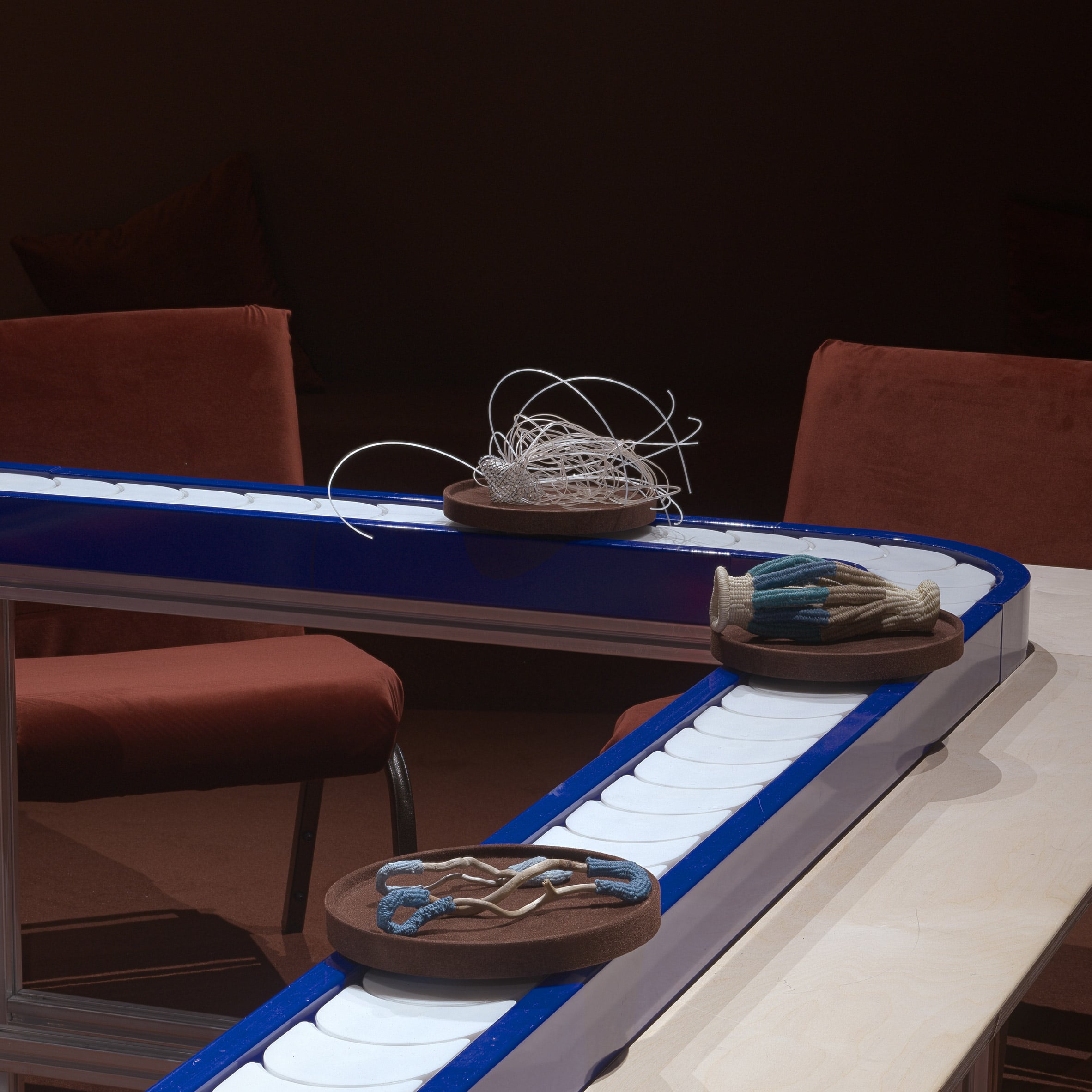
The conventional art exhibition space has long demanded a specific type of physical endurance from its visitors. Standing for hours, navigating crowded rooms, and bending down to read wall text or examine low-hanging works are unspoken prerequisites for engaging with contemporary art. For many disabled, chronically ill, or neurodivergent individuals, these architectural and spatial expectations translate into physical pain, fatigue, and systemic exclusion. Seeking to radically subvert this norm, New York City-based artist Finnegan Shannon has unveiled a transformative exhibition titled There’s No Me Without You at the Pioneer Works cultural center in Brooklyn, New York. Running from September 12 through December 20, the project centers around an unexpected centerpiece: a 12-foot-long closed-loop conveyor belt modeled after restaurant-style sushi delivery systems.
By adapting commercial infrastructure typically reserved for serving food, Shannon has engineered a space that places bodily comfort and ease of access at the forefront of the viewing experience. The installation surrounds the mechanical loop with carefully placed seating options, allowing visitors to remain seated while objects, archival materials, and portable media players pass by on a series of moving trays. Through this intervention, Shannon addresses not only the physical barriers inherent to traditional gallery designs but also broader cultural assumptions about how art should be encountered, contemplated, and shared.
A Longtime Fantasy Realized Through Industrial Adaptation
According to representatives at Pioneer Works, There’s No Me Without You brings to life Shannon’s longstanding fantasy of an exhibition venue fundamentally designed to meet their personal access needs. Diagnosed with cerebral palsy at birth, Shannon has continually utilized their multidisciplinary art practice to critique the lack of comprehensive infrastructure for disabled bodies in public and cultural spaces.
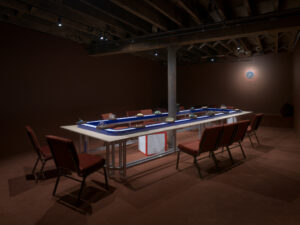
The mechanics of the installation are both ingenious and disarmingly simple. Borrowing directly from the retail and restaurant sectors, the 12-foot conveyor belt functions as a dynamic display case. Instead of forcing viewers to migrate across vast white-cube galleries, the artwork travels to the audience. Visitors can comfortably settle into the rich fabrics and built-in benches that line the perimeter of the upper-floor gallery space, engaging with the rotating artifacts at eye level.
“My conveyor belt, technically a retail and restaurant-style display system, is a tool for me to be in less pain when I’m experiencing art,” Shannon explained. “I notice I am a much more patient and curious visitor when I’m sitting down.”
This deliberate inversion of gallery dynamics directly challenges the standard model of viewing culture, where physical stamina is quietly rewarded and fatigue is penalized. Shannon’s design insists that comfort is not a luxury to be accommodated as an afterthought, but a foundational requirement for meaningful engagement.
Centering Interdependence and Disability Culture
The title, There’s No Me Without You, speaks directly to Shannon’s philosophical framework regarding interdependence, community reliance, and disability justice. Rather than framing accessibility as an individualized accommodation or a bureaucratic checklist, the exhibition frames it as a collective practice rooted in mutual aid.
“If disabled people were in charge, we would have a bunch of varied and deluxe options for sitting and lying down in exhibition spaces,” Shannon noted, highlighting the stark contrast between current institutional offerings and ideal design standards. “Instead we live in a world where this type of infrastructure is quite basic and sparse.”
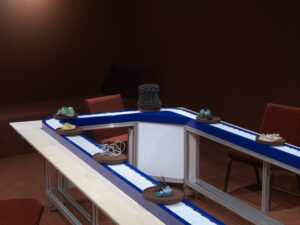
This ethos extends far beyond the physical seating arrangements. The exhibition environment itself has been curated with holistic safety and health in mind. Aesthetically vibrant air filtration units are positioned near the center of the conveyor loop to optimize indoor air quality, and the venue actively encourages masking among attendees to protect immunocompromised visitors. By integrating public health measures directly into the spatial design, Pioneer Works and Shannon have created a blueprint for how cultural institutions can responsibly host diverse communities during an ongoing public health landscape.
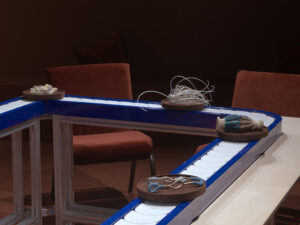
Furthermore, Shannon deliberately steps back from the traditional paradigm of the solitary artistic genius. The installation serves as a platform for new commissions by a cohort of disabled artists—Joselia Rebekah Hughes, Ariana Martinez, and Alex Dolores Salerno—whose work unfolds across three consecutive exhibitions. This programming allows visitors to interact with art through multifaceted sensory engagements involving touch, sight, and sound.
“We know that on some fundamental level, no solo exhibition is truly a solo endeavor,” Shannon reflected. “Putting together an exhibition takes immense collaboration and support—art handlers, facilities staff, curators, registrars, accountants, assistants—and that is all within the institution. You can trace that entanglement further: I’m dependent on workers, paid and unpaid care labor, and friendships, family, and more, both locally and across the globe. I never want someone to come away from an exhibition with my work feeling like they’ve experienced something that is mine. Instead I hope they have threads to follow to learn more about the vast world of knowledge that is disability culture.”
A Continuum of Access-Driven Artistic Practice
There’s No Me Without You is the latest milestone in Shannon’s influential career of challenging exclusionary design standards within the arts. Their previous projects have consistently interrogated how institutions communicate with and welcome the public. Notably, Alt Text as Poetry, created in collaboration with Bojana Coklyat, explores image descriptions as a creative, poetic medium rather than a mere technical requirement for screen readers. Another widely recognized project, Do You Want Us Here or Not, introduced a series of thoughtfully designed museum benches and cushions to cultural institutions, encouraging visitors to rest while directly confronting museums about their historical lack of seating.
Shannon’s work aligns with a broader, long-overdue reckoning within the design and museum sectors regarding spatial empathy. In recent years, institutions have faced mounting pressure from disability advocacy groups and artists to dismantle ableist traditions. Exhibitions such as Adapt/Evolve, showcased at The Fashion Institute of Technology in New York, have similarly highlighted how empathetic design can bridge the gap between aesthetics and functional utility, proving that accessibility enhances experiences for all demographic groups rather than a specialized subset.
Broader Implications and Industry Analysis
The implications of Shannon’s installation at Pioneer Works extend far beyond the borders of Brooklyn, offering critical lessons for curators, architects, and museum administrators worldwide. For decades, the dominant architectural paradigm of contemporary art galleries has prioritized cavernous empty spaces, minimalist aesthetics, and vast floor plans that require sustained physical exertion to navigate. This design philosophy inadvertently filters out individuals with mobility impairments, chronic pain conditions, and fatigue-related illnesses.
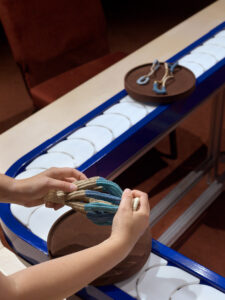
By demonstrating that commercial display systems can be ingeniously repurposed to foster equity, Shannon challenges cultural institutions to rethink their capital expenditures and spatial planning. Standard museum practices often treat accessibility as a retrofitted ramp or an emergency elevator tucked away in a back corridor. In contrast, There’s No Me Without You places access infrastructure at the literal and metaphorical center of the room.
Art critics and accessibility advocates point out that installations like Shannon’s redefine the standard of care expected from public institutions. As cultural organizations grapple with declining post-pandemic attendance and renewed calls for social equity, integrating radical hospitality into spatial design is no longer viewed merely as an ethical choice, but as an operational necessity for cultural relevance.
As There’s No Me Without You continues its run at Pioneer Works through December 20, it stands as a testament to the transformative power of disability-led design. By inviting audiences to slow down, sit side-by-side, and let the art come to them, Finnegan Shannon has not only alleviated the physical burdens of viewing art but has also opened a vital portal into the rich, interdependent world of disability culture.