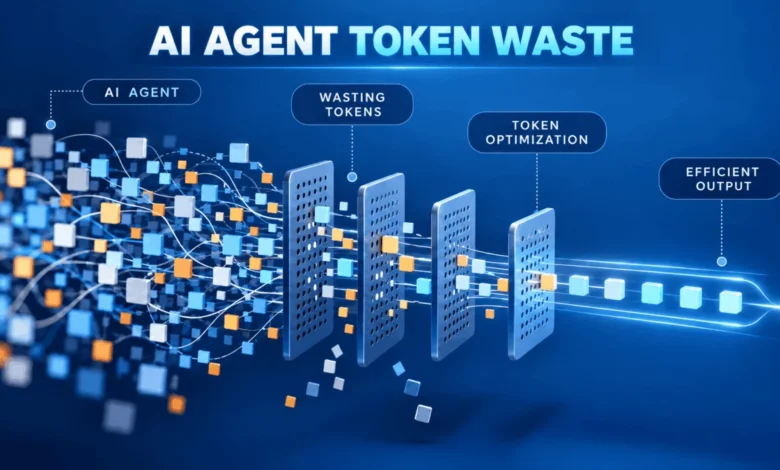
In the rapidly evolving landscape of generative artificial intelligence, the transition from a weekend-long prototype to a scalable, production-grade agent system often reveals a critical bottleneck: the spiraling cost of API token consumption. While many developers focus on model selection or prompt engineering, the underlying architectural choices—specifically how context windows are managed—frequently dictate the long-term economic viability of an application. As organizations move beyond initial proof-of-concepts, the naive approach of appending every interaction, observation, and internal thought to an endlessly growing array has become a primary driver of unsustainable cloud infrastructure bills and increased inference latency.
The root of this challenge lies in a fundamental architectural misunderstanding: the conflation of "context" with "state." Context is the ephemeral, high-cost payload transmitted to a model for a single inference request, whereas state represents the durable, serialized history of an agent’s progress. When these two concepts are treated as one, the system effectively forces the agent to re-read and pay for its entire historical record with every single input, leading to a quadratic increase in operational overhead.
The Financial and Technical Burden of Context Window Accumulation
The most pervasive issue in current AI agent design is the "Append-Only Trap." By treating the prompt array as a system of record, engineers inadvertently force the model to process redundant information. By the twentieth turn of a conversation, the agent is burdened with re-processing nineteen previous turns of user messages, tool outputs, and reasoning steps. This does not merely inflate costs; it degrades performance. Models often suffer from "lost in the middle" phenomena, where relevant instructions or data become buried under the sheer volume of redundant context.
The architectural solution requires the implementation of a sliding context window coupled with semantic rolling summarization. By retaining only the most recent N turns of a conversation verbatim and compressing earlier interactions into a dense, summary-level background, developers can significantly reduce token expenditure. For critical, non-negotiable data—such as cryptographic keys or specific identifiers—engineers should rely on deterministic key-value stores like Redis or SQLite rather than attempting to keep such information within the volatile prompt context.
Inefficient Data Ingestion and Tool Utilization
Beyond conversational history, agents frequently hemorrhage tokens through uncompressed tool result ingestion. When an agent interacts with enterprise-grade APIs, such as Stripe, Jira, or AWS, the returned JSON payloads are often massive, designed for machine-to-machine communication rather than human or LLM consumption. Injecting these raw, verbose payloads directly into the observation context is an avoidable tax.
The industry-standard fix involves a middleware transformation layer. By stripping null values, filtering non-essential metadata, and reformatting deep JSON structures into dense YAML or Markdown, developers can reduce token usage by upwards of 60% per tool call. However, this necessitates caution; aggressive data pruning can inadvertently strip away essential pagination cursors or environment variables, potentially breaking complex retrieval loops.
The Pitfalls of Naive Retrieval and Grep-and-Dump Architectures
In the domain of coding assistants and RAG-heavy systems, a common practice known as "Grep-and-Dump" retrieval involves pulling entire files into the context window simply because they contain one relevant function. This is highly inefficient. The solution lies in Abstract Syntax Tree (AST)-aware retrieval. By parsing code into a structural call graph during the indexing phase, systems can return only the necessary function signatures, docstrings, and immediate dependencies. This approach reduces the token load from thousands of words to a few hundred, though it requires a sophisticated, asynchronous indexing pipeline to ensure the vector store does not fall behind the actual codebase.
Dynamic Tool Registry and State-Based Pruning
Many agent frameworks suffer from "Static Tool Schema Bloat." By injecting the definitions of 30 or 50 available tools into every prompt, the model is forced to interpret thousands of tokens of schema data, regardless of whether those tools are relevant to the current task phase. Implementing a finite state machine to govern which tools are visible at any given time—for instance, showing search tools only during "discovery" phases—can reclaim significant context space. While this creates a conflict with prompt caching mechanisms, which rely on static prefixes to function, the trade-off is often necessary for high-volume, tool-intensive agents.
Circuit Breakers for Autonomous Reasoning Loops
The rise of autonomous agents has introduced a new class of risk: the "Unbounded Chain-of-Thought Loop." If an agent encounters a persistent failure, it may attempt to retry the task indefinitely, generating massive volumes of reasoning and error logs. In a production environment, this is not just a performance issue; it is a direct fiscal liability. Implementing an orchestrator-level circuit breaker—which enforces hard limits on retry counts and output token budgets—is a mandatory guardrail for any system operating at scale.
Optimizing Through Prompt Caching and Model Routing
Modern LLM providers, including OpenAI and Anthropic, have introduced prompt caching to reduce the latency and cost of re-processing large static prefixes. To leverage this, developers must structure requests with a strict static-to-dynamic gradient. By placing persistent system prompts and organizational guidelines at the top of the request, and appending volatile variables only at the end, engineers can ensure that the majority of the token payload remains in the cached state.
Furthermore, the "Monolithic Routing" fallacy—the practice of using a frontier-class model (such as GPT-4o or Claude 3.5 Sonnet) for every trivial task—is rapidly losing favor. By adopting a cascaded LLM router, developers can offload simple intent classification and data extraction to lightweight models like GPT-4o-mini or Gemini Flash, reserving expensive frontier models only for complex, multi-step reasoning tasks.
Implications for Long-Term Data Quality
As organizations push into their third and fourth months of production, token optimization transitions from a billing concern to a data quality imperative. Stale information, accumulated in vector databases and episodic memory, can lead to hallucinations where the agent attempts to reconcile outdated API documentation with live production environments.
The evidence suggests that architectural decisions made in the initial weeks of development compound over time. A clean, modular, and optimized architecture is not merely a cost-saving measure; it is a prerequisite for system stability. By treating context management with the same rigor as database design, developers can build agents that remain performant, reliable, and economically sustainable as they scale across the enterprise. The ultimate goal is to move away from the "black box" of infinite context toward a deterministic, state-aware system where every token served serves a clear, functional purpose.