AWS Enhances Data Mesh Automation with SDK Support for Multi-Dialect Glue Data Catalog Views

The integration of complex data architectures within enterprise environments has reached a new milestone as AWS Glue introduces AWS SDK support for creating and updating the ATHENA dialect of Glue Data Catalog views. This technical advancement allows data engineers and architects to programmatically manage multi-dialect views—specifically supporting both ATHENA and SPARK dialects—simultaneously through a cross-account IAM definer role. By enabling this functionality, AWS is addressing a critical bottleneck in the automation of data governance, allowing for more streamlined Continuous Integration and Continuous Deployment (CI/CD) pipelines within decentralized data mesh frameworks.
The Evolution of Multi-Dialect Data Access
AWS Glue Data Catalog views represent a sophisticated layer of abstraction in the modern data stack. These views are designed to be multi-dialect, meaning they can be queried across a variety of SQL engines, including Amazon Athena, Amazon Redshift Spectrum, and Apache Spark running on Amazon EMR or AWS Glue. Traditionally, managing these views required a bifurcated approach: while certain dialects could be managed via API, others often required manual intervention through management consoles or specific query editors.
The core utility of a Data Catalog view lies in its ability to present a subset of data to consumers without exposing the underlying base tables. This is achieved through the "definer role" mechanism. A definer role is an AWS Identity and Access Management (IAM) entity that possesses the necessary permissions (specifically the SELECT privilege) on the raw base tables. When a consumer queries the view, the Data Catalog assumes this definer role to validate and execute the request, effectively masking the complexity and security requirements of the source data.
Before this latest update, the process of creating multi-dialect views was partially manual. Engineers could use the CreateTable() and UpdateTable() APIs to handle SPARK dialects, but adding or updating the ATHENA dialect frequently necessitated the use of the Athena query editor. The introduction of SDK support for the ATHENA dialect completes the automation loop, allowing for a fully programmatic lifecycle for Glue views across different accounts and engines.
Strengthening the Data Mesh Architecture
The significance of this update is most visible within the context of the "Data Mesh." In a data mesh architecture, an organization treats data as a product, with various business units acting as "producers" and "consumers." Central governance is maintained in a primary account—often referred to as the governance or mesh-catalog account—while the actual data and the pipelines that manage it reside in distributed producer accounts.
Cross-account definer roles are the glue that holds this decentralized structure together. By allowing a producer account to manage view definitions in a central catalog via an IAM role, organizations can ensure that individual teams maintain autonomy over their data products while adhering to centralized security standards. This update ensures that CI/CD pipelines, which are essential for maintaining the agility of a data mesh, can now handle the creation and modification of multi-dialect views without manual "human-in-the-loop" steps.
Technical Chronology and Workflow Integration
The path to this programmatic milestone has been a multi-stage rollout by AWS. Initially, AWS Glue Data Catalog views were introduced to provide a unified metadata layer. This was followed by the introduction of cross-account definer roles, which allowed the SPARK dialect to be managed via SDK. The current release, which adds ATHENA dialect support to the CreateTable and UpdateTable APIs, represents the maturation of this feature set.
To implement this new functionality, a specific technical workflow must be followed:
- Validation Connection: In the producer account, a Glue connection must be established. This connection is a prerequisite for the ATHENA dialect validation process. It ensures that the SQL syntax provided in the view definition is compatible with the Athena engine before the view is finalized in the catalog.
- API Execution: Using the AWS SDK (such as Boto3 for Python), engineers call the
CreateTableAPI. TheViewDefinitionparameter now accepts an array ofRepresentations, where bothATHENAandSPARKdialects can be defined in a single call. - Definer Role Assumption: The Data Catalog uses the specified IAM definer role to check permissions on the base tables. Because this role can exist in a different account than the Data Catalog itself, it facilitates seamless cross-account resource management.
- Verification and Error Handling: AWS has also enhanced the transparency of this process. If a view creation fails due to dialect-specific syntax errors, the
get-tableCLI command, when used with the--include-status-detailsflag, provides specific error messages to help engineers debug the SQL definition.
Supporting Data and Industry Implications
The move toward programmatic governance comes at a time when data volumes and the complexity of data privacy regulations are at an all-time high. According to industry analysis, organizations that implement automated data governance are 40% more likely to meet their data democratization goals. By removing manual steps from the creation of data views, AWS is reducing the "time-to-insight" for data consumers.
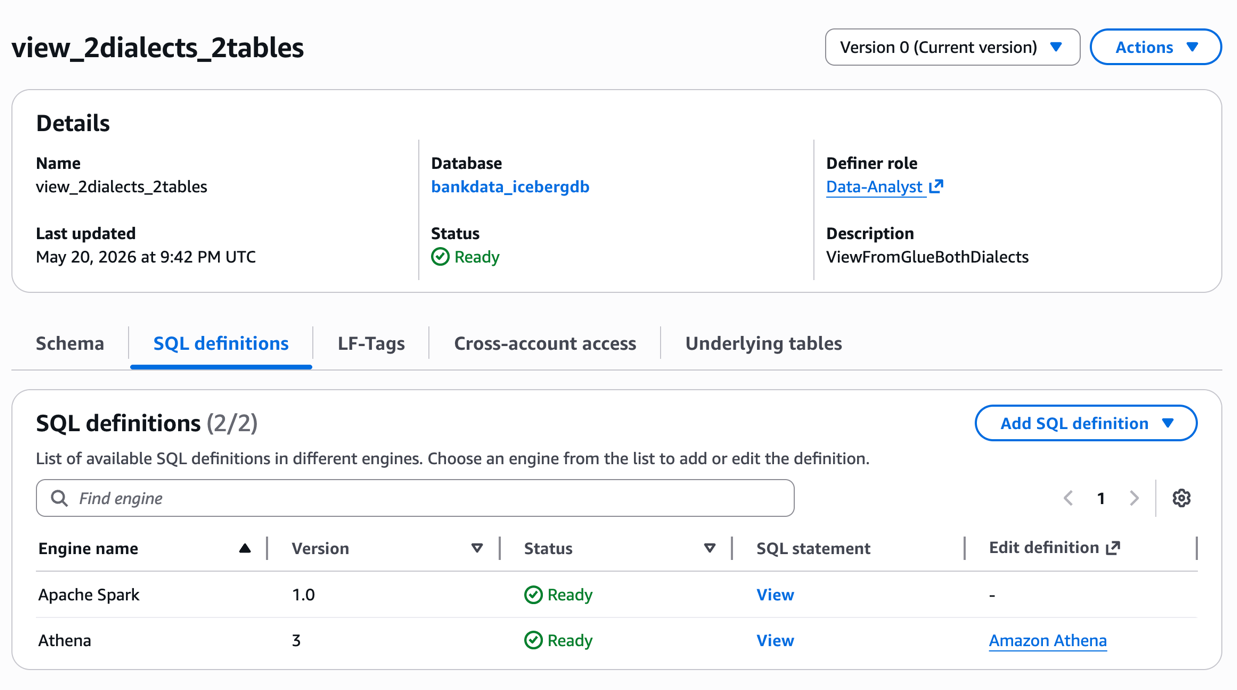
Furthermore, the ability to update existing views using the ViewUpdateAction: "REPLACE" or "ADD" parameters provides a level of flexibility previously unavailable. For instance, if a data producer needs to add a new column to a view to satisfy a consumer request, they can now trigger an automated script that updates both the Spark and Athena representations simultaneously. This ensures consistency across different query engines, preventing a scenario where an Athena user sees different data than a Spark user querying the same view.
Security and Governance Analysis
From a security perspective, this update reinforces the principle of least privilege. In many legacy systems, to allow a user to query a subset of data, administrators had to grant read access to the entire underlying table or create physical copies of the data (data silos).
With Glue Data Catalog views and cross-account definer roles:
- Zero Data Replication: No physical data is moved or copied.
- Fine-Grained Access: Access is controlled at the view level through AWS Lake Formation.
- Credential Isolation: The consumer never needs to know the location or credentials of the underlying S3 buckets.
The implementation of Lake Formation Tags (LF-Tags) further enriches this ecosystem. Views can be tagged with attributes like "Sensitivity: Public" or "Department: Finance," and access can be granted based on these tags. This creates a scalable permission model that grows with the organization, rather than a brittle list of individual user permissions.
Expert Reactions and Practical Application
Data architects have noted that this update specifically benefits large-scale migrations to the cloud. When moving from on-premises Hadoop clusters to AWS, teams often struggle with the transition from Hive-based views to cloud-native formats. The ability to programmatically define these views in both Spark and Athena dialects simplifies the transition, allowing legacy Spark jobs and modern Athena dashboards to coexist on the same metadata.
The inclusion of support for Iceberg, Hudi, and Delta Lake table formats within these views also points to AWS’s commitment to "Open Data Lakehouse" architectures. By supporting these formats, Glue views become a critical component for organizations looking to combine the performance of a data warehouse with the flexibility of a data lake.
Conclusion and Future Outlook
The addition of SDK support for ATHENA dialects in AWS Glue views is more than a simple feature update; it is a fundamental shift toward the "Infrastructure as Code" (IaC) philosophy for data governance. By enabling the simultaneous creation of multi-engine views via cross-account IAM roles, AWS is providing the tools necessary for enterprises to build robust, automated, and secure data meshes.
As organizations continue to decentralize their data operations, the reliance on programmatic interfaces like the Glue CreateTable and UpdateTable APIs will only increase. This development sets the stage for future enhancements, potentially including even more SQL dialects and deeper integration with automated data quality tools. For now, data engineers can leverage these new capabilities to eliminate manual overhead, reduce configuration errors, and ensure that data is delivered to consumers safely and efficiently, regardless of the analytical engine they choose to use.