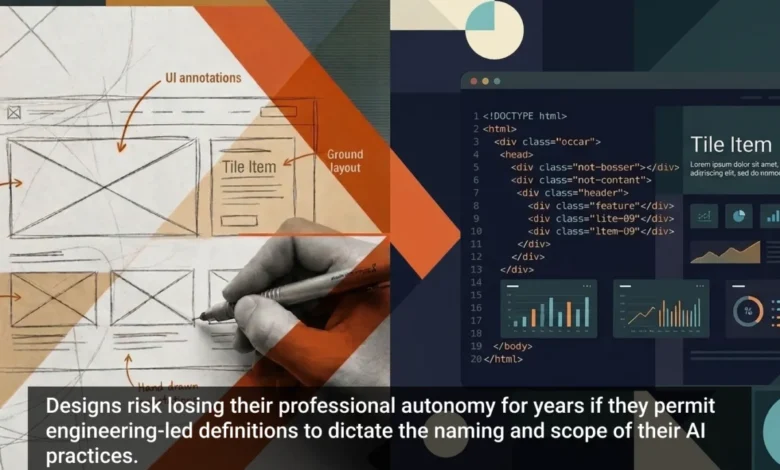
The emergence of generative artificial intelligence has ignited a fervent debate within the design community, centering on how professionals are interacting with these powerful new tools. A key point of contention revolves around the term "vibe coding," a label that, according to industry observers, risks diminishing the intellectual rigor and authorship inherent in advanced AI-assisted design practices. Designers who fail to challenge this simplistic descriptor are, in effect, relinquishing ownership of their professional methodology. "Vibe coding" was initially conceived to describe a low-accountability approach characterized by vague prompts and passive acceptance of AI outputs, a far cry from the intentionality and leadership required for effective design. The fundamental divergence lies not in the adoption of AI, but in the locus of authority within the design process, with directed generation prioritizing human judgment from the outset.
The Genesis and Migration of "Vibe Coding"
The term "vibe coding" gained traction in early 2025, attributed to AI researcher Andrej Karpathy. He used it to accurately describe a specific, low-accountability behavior: loosely describing a desired outcome, accepting whatever the AI generates with minimal critical evaluation, and largely disregarding the intricacies of the output. This initial characterization was precise for the phenomenon Karpathy observed. However, like many nascent terms in rapidly evolving fields, "vibe coding" soon migrated beyond its original scope. It began to be applied to more sophisticated design workflows, leading to misunderstandings and mischaracterizations of the actual work being performed by designers.
This linguistic drift has not gone unnoticed. Many designers have found their own deliberate and strategic use of AI being casually labeled as "vibe coding." The reluctance of some to push back against this inaccurate terminology has allowed a reductive narrative to take hold. This erosion of precise language is problematic, as it obscures the nuanced craft, critical judgment, and intentionality that underpin serious AI-assisted design.
The power of jargon, as noted by linguists and social commentators, lies in its ability to shape perception and understanding. George Orwell, in his seminal essays on language, argued that the "sloveliness of language makes it easier to have foolish thoughts." Conversely, precise language fosters precise thinking. When an imprecise term like "vibe coding" colonizes an emerging practice, it does more than just misdescribe the work; it pre-emptively shapes how that work is understood, how designers are hired, and how their contributions are valued, often before the practice itself has been adequately defined. This is particularly relevant now, as the vocabulary surrounding AI-assisted design is still very much in formation. Much of this nascent terminology originates from engineering cultures, which often carry an inherent assumption that the human role in AI interaction is primarily supervisory or even passive, rather than one of active authorship and direction.
The Emerging Divide: Authority in AI-Assisted Design
A significant schism is now becoming apparent within the design landscape, and it is not defined by who has adopted AI tools. The vast majority of designers are now engaging with AI in some capacity. Instead, the crucial distinction lies in where the authority resides within the design process.
One approach, which aligns with the "vibe coding" descriptor, is characterized by generation driving decisions. In this model, a prompt is issued, the AI’s output is accepted with minimal revision, and adjustments are made only at the margins before the work is shipped. This can be summarized as: prompt, accept, adjust, ship.
In stark contrast, a more intentional and advanced approach places judgment first. Here, the AI serves as a responsive tool, answering to the designer’s specific intent and curated inputs. This is not a passive interaction; it is a guarded and deliberate collaboration where the designer maintains ultimate control. This newer methodology is more challenging to encapsulate with a simple moniker, which is precisely why "vibe coding" has been allowed to fill the linguistic vacuum. However, this more deliberate approach is increasingly becoming the engine for high-speed, impactful design work and bears little resemblance to passive acceptance.
The Mechanics of Directed Generation
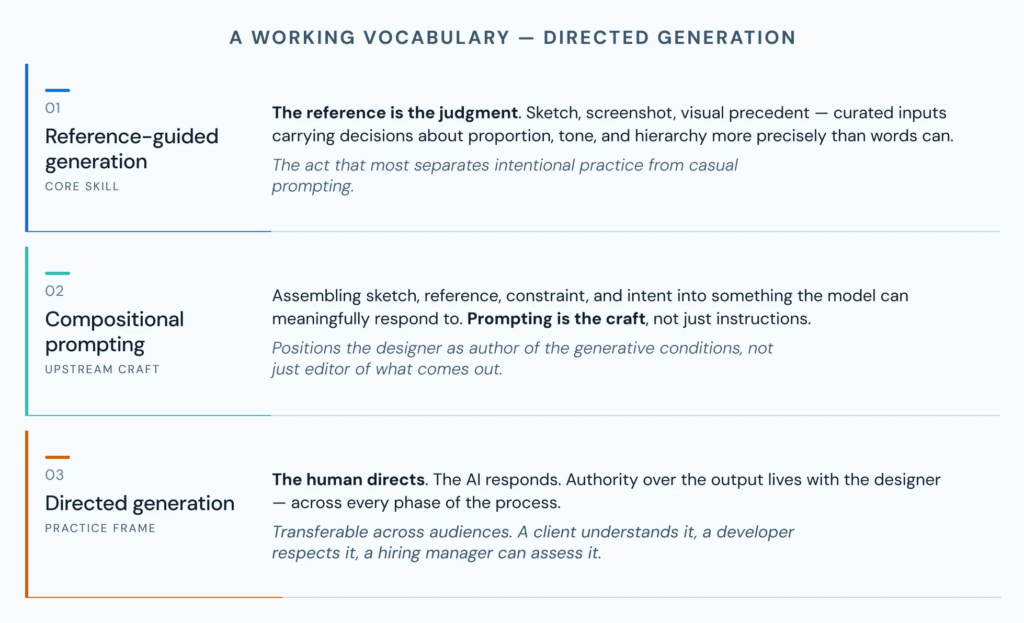
The sophisticated use of AI in design begins not with a generic prompt, but with a carefully curated reference. This reference is not a text-based instruction in the traditional chatbot sense; it is a deliberate input that carries significant design decisions. It might be a sketch, a screenshot of a visual precedent, or a combination of elements. This reference is the judgment. It encapsulates decisions regarding proportion, tone, hierarchy, and intent that would be laborious and less precise to articulate in words. Designers have always operated with this level of visual and conceptual understanding; the advent of AI simply provides a tool capable of receiving and responding to visual intent with unprecedented fidelity and at the level of code.
Following the initial reference, the design process progresses through distinct phases. The true skill lies in recognizing when to transition between these phases. This is a dynamic and iterative process, not a linear one. The infographic, "Directed Generation Phases," visually outlines this progression, highlighting the strategic shifts designers make throughout their workflow. The initial phase often involves defining the core concept or mood through a curated input. Subsequent phases might involve iterative refinement, exploration of variations, and the application of specific constraints. The designer’s expertise is in orchestrating these transitions, leveraging AI’s generative capabilities while maintaining precise control over the creative direction.
The Outcome: Scalable Design Without Stagnation
The implications of this intentional approach to AI-assisted design extend far beyond individual projects. It suggests that many current conversations about AI in design have not yet caught up to the evolving capabilities and methodologies. When human judgment operates at the level of a design pattern rather than a single pixel, a fundamental shift occurs in how design systems can be conceived and implemented.
The traditional model of design systems treats patterns as fixed artifacts – meticulously defined, exhaustively documented, and rigidly applied. Consistency is achieved through sheer replication. While this model ensures predictability, it often sacrifices flexibility. Any deviation from the established pattern requires manual intervention, leading to a potential bottleneck and a freezing of creative evolution.
Directed generation fundamentally challenges these constraints. When a machine can comprehend a design pattern at an abstract enough level to recompose it contextually – not merely copy it, but interpret it – the pattern transforms. It evolves from a static component into a dynamic set of spatial, typographic, and behavioral relationships. These relationships can then be fluidly molded across surfaces the system has never encountered before, adapting seamlessly to all devices and contexts.
In this paradigm, the designer’s role shifts from painstakingly specifying every individual instance to defining the conditions under which high-quality instances will reliably emerge. This is the essence of non-deterministic design. The precise output is not fully predictable, but this unpredictability is not a flaw; it is an intentional feature of the system. The craft is elevated, moving upstream to the quality of the foundational elements, the precision of the references provided, and the rigor of the constraints established.
The logical endpoint of this trajectory is agentic delivery. This refers to systems that not only respond to design direction but also autonomously carry it forward, generating coherent outputs across vast scales and diverse contexts without losing the authoring intent embedded in the original primitives. This represents systematic design generation, rather than merely systematic design documentation. The designer authors the grammar of the design language, and the system speaks it fluently.
This is the direction in which this practice is evolving. Directed generation is not a workaround for the limitations of current AI tools; it is the foundational framework for their future development and application.
Towards Precision: Re-naming the Practice
The process of naming an emerging practice is inherently messy. Like any system component, a label applied too early can calcify before the practice has fully matured. Conversely, waiting too long risks allowing someone else’s term to become entrenched. The field of AI-assisted design appears to be in a "late-early" stage, where tools have advanced sufficiently to foster genuine methodologies, but the vocabulary is still largely borrowed. Much of this borrowed terminology originates from engineering, product management, or the sensationalized coverage of generative AI, which often emphasizes the output as the ultimate achievement rather than a means to a broader design objective.
Several terms warrant consideration, not as a definitive taxonomy, but as conceptual handles for this evolving work. These suggestions aim to capture the intentionality and leadership inherent in the process:
- Reference-Guided Practice: This emphasizes the foundational role of curated inputs in directing the AI.
- Compositional Prompting: This highlights the designer’s active role in constructing prompts that go beyond simple requests to create complex, layered instructions.
- Intentional Generation: This underscores the deliberate and goal-oriented nature of the AI interaction.
- Pattern-Based Synthesis: This focuses on the AI’s ability to understand and recompose design patterns rather than just individual elements.
- Designer-Authored Generativity: This directly asserts the designer’s authorship over the AI’s generative capabilities.
These are not mandates, but rather suggestions intended to spark a conversation. The objective is not to win a naming debate, but to cultivate language that is precise enough for critical thinking and effective communication of value to stakeholders. Ultimately, designers who actively define and articulate their practice will wield greater authority than those who passively accept externally imposed labels.
Owning the Practice, Owning the Description
A common and reasonable objection to discussions about terminology is pragmatic: "Does it really matter what we call it? The work gets done regardless. Clients see the output, not the methodology." This perspective, while understandable given the practical demands of design, overlooks the crucial moments where precise language makes a significant difference.
These moments include portfolio reviews, where a clear articulation of one’s process is essential for demonstrating expertise. They are critical during client kickoffs, where establishing the unique value of a particular methodology justifies the proposed rates. They are vital in team discussions, particularly when junior designers are seeking to understand what intentional craft looks like in a new technological landscape. In all these scenarios, having language that is precise, confident, and owned by the designer provides essential professional clarity.
The design profession has navigated similar inflection points before. When User Experience (UX) design emerged as a distinct discipline, practitioners who named and defined their work – establishing fields like interaction design and information architecture – shaped how the discipline was valued for an entire generation. Those who allowed adjacent fields to define them often spent years striving to reclaim their professional identity and value.
AI-assisted design is at a comparable juncture. The technology itself is no longer novel; it has become normalized. However, the practice of integrating AI into design workflows is still being defined. The definitions that ultimately take hold will originate from somewhere: from engineers describing their deployed systems, from journalists reporting on what is visible, or from designers articulating what they actually do.
The traditional, deterministic methodology, which emphasizes precise outputs and predictable handoffs, remains the most accurate and understandable accounting for clients, teams, and emerging designers. It provides a clear model of intentional design practice in an era of powerful tools.
However, this does not demand a wholesale abandonment of other approaches. In many production environments, deterministic outputs—fixed components, documented patterns, and predictable integration—remain the most appropriate tools for specific contexts. The true value of directed generation and non-deterministic design lies not in replacing existing systems but in expanding their capabilities. Generative wireframing, rapid concept exploration, and cross-surface pattern interpretation are areas where non-deterministic approaches yield disproportionately high returns.
Production-ready components may still require explicit specification, review, and finalization. A hybrid approach, acknowledging that different phases of design work carry varying risk tolerances, represents a mature practice. This approach intelligently selects the appropriate mode for each stage of the design process.
"Vibe coding" describes one method of working with AI, and it is not inherently a criticism of that mode. For certain contexts, low-accountability generation might indeed be the most effective tool. However, it has never accurately described design leadership. The sooner this distinction is clearly established, the sooner the work itself will receive the recognition and framing it truly deserves. Whether termed "directed generation," "reference-guided practice," or "compositional prompting," finding precise language is crucial. Or, designers can forge their own terms that authentically reflect the specifics of their unique methodologies. The critical takeaway is that by owning the description of their practice, designers assert their authority and shape the future value of their work in this rapidly evolving technological landscape.