Amazon Web Services Delivers 13 Major Inference Capabilities Across SageMaker AI to Streamline Production Generative Models

Operating generative artificial intelligence models in production environments presents a uniquely complex set of infrastructure challenges. Unlike traditional software services, modern foundation models frequently span tens to hundreds of gigabytes in size, demanding strict latency profiles measured in precise tokens per second. Organizations deploying these systems often encounter prolonged cold-start intervals lasting multiple minutes while massive container images and parameter weights transfer across the network. Furthermore, persistent constraints on global graphics processing unit (GPU) capacity and the traditional opacity of legacy monitoring frameworks—which typically fail to expose critical token-level telemetry—have historically complicated large-scale enterprise deployments.
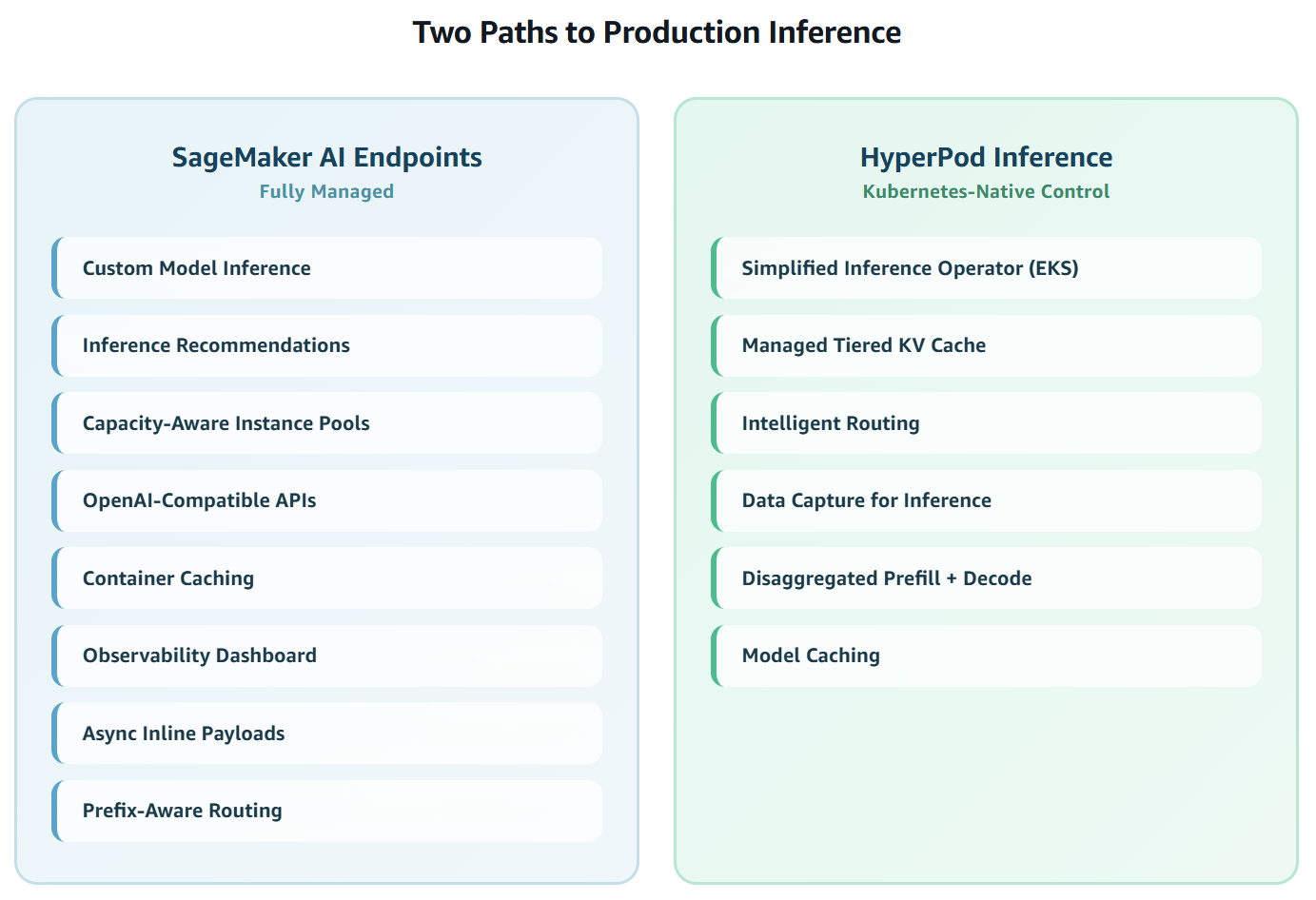
To mitigate these operational hurdles, Amazon Web Services (AWS) has rolled out a comprehensive suite of 13 major capabilities across Amazon SageMaker AI. Aimed at enterprises, startups, and public sector organizations alike, these updates span the platform’s two core deployment pathways: fully managed inference endpoints for teams preferring a hands-off operational model, and Amazon SageMaker HyperPod Inference for organizations requiring fine-grained, Kubernetes-native orchestration over dedicated GPU clusters. By bridging the gap between infrastructure management and high-throughput model serving, these enhancements seek to reduce time-to-market and improve price-performance ratios across the generative AI ecosystem.
Choosing the Right Deployment Path for Enterprise Workloads
The expansion of Amazon SageMaker AI highlights a strategic bifurcation in how modern engineering teams consume GPU compute. Rather than forcing a singular architectural paradigm upon developers, AWS continues to refine two distinct operational methodologies: managed endpoints and Kubernetes-native HyperPod clusters.
Managed SageMaker inference endpoints are explicitly designed for organizations seeking minimal operational overhead. In this paradigm, AWS assumes full responsibility for underlying infrastructure provisioning, hardware scaling, and operational health monitoring. Teams simply supply their model artifacts and target performance metrics, allowing the platform to manage the lifecycle. Conversely, Amazon SageMaker HyperPod Inference targets sophisticated machine learning operations (MLOps) groups that demand deep control over their serving architecture. Operating on a managed Kubernetes stack, HyperPod allows engineers to interface via standard tools like kubectl, Terraform, and the AWS command-line interface, granting node-level access, custom Amazon Machine Images (AMIs), and flexible multi-cloud or hybrid-cloud deployment topologies.
This dual-track approach ensures that organizations ranging from agile software startups to heavily regulated financial institutions can select the operational granularity that aligns with their internal engineering capabilities and governance requirements.
Streamlining Managed Endpoints: From Model to Production in Hours
Managed SageMaker inference endpoints received seven key updates designed to accelerate deployment velocities, optimize capacity utilization, and enhance operational visibility.
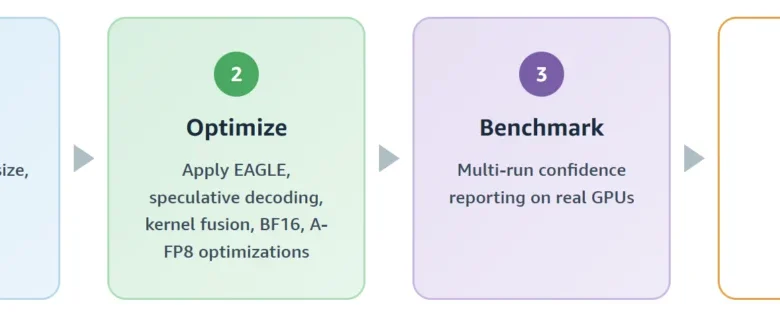
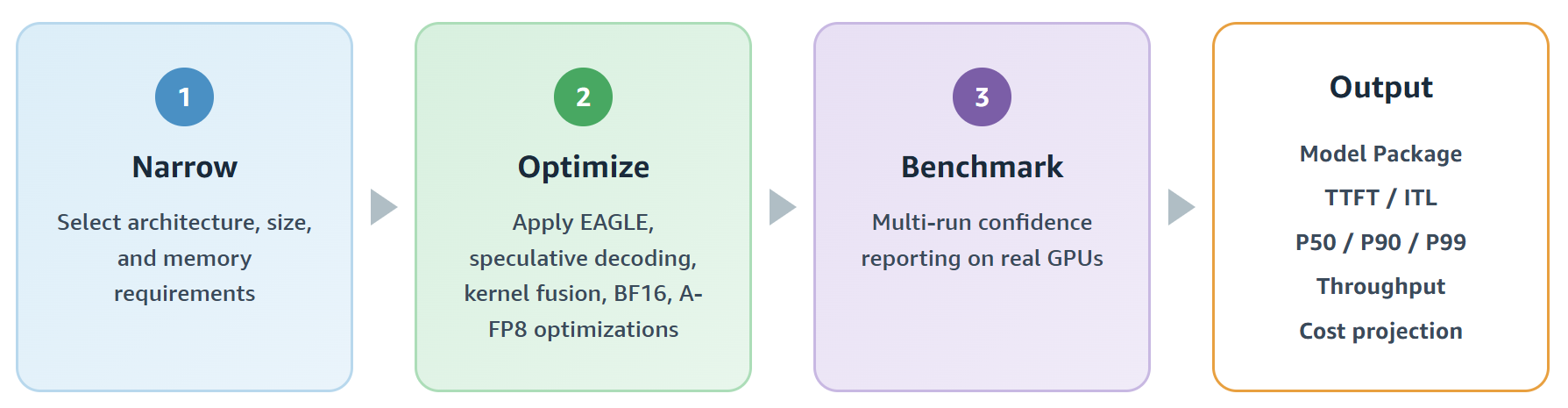
Historically, selecting the optimal instance type, serving container framework, and quantization setting for a large language model required weeks of exhaustive, manual benchmarking across more than a thousand possible configurations—a level of domain expertise scarce in many organizations. The introduction of automated inference recommendations in April addresses this friction. By accepting a target model and a primary performance constraint—such as cost minimization, latency reduction, or throughput maximization—SageMaker executes an automated three-step evaluation process. The output is a deployment-ready model package complete with validated metrics, including time to first token (TTFT), inter-token latency (ITL), P50, P90, and P99 latency percentiles, alongside projected operational costs. AWS reports that benchmarking exercises on models like GPT-OSS-20B have successfully doubled tokens per second without increasing request latency.
To mitigate infrastructure bottlenecks, AWS introduced capacity-aware instance pools in May. Previously, if an endpoint relied on a single GPU instance type and that specific hardware experienced a regional shortage, the endpoint would fail outright before processing requests. The new instance pool architecture allows developers to define a prioritized fallback list of up to five distinct instance types. SageMaker automatically traverses this list during initial creation, scale-out, and scale-in events, ensuring high availability even during periods of tight hardware supply.
Integration barriers have similarly fallen with the rollout of OpenAI-compatible API support. Applications originally constructed around the OpenAI software development kit, LangChain, or agentic frameworks can now target SageMaker endpoints by modifying only the endpoint URL. Supported by deep learning containers running vLLM or SGLang, this capability eliminates the need for complex custom client adapters or manual AWS Signature Version 4 request signing, relying instead on bearer tokens valid for up to 12 hours.
Addressing Scale-Out Latency and Deep Observability
Container initialization overhead has long plagued rapid auto-scaling events. When traffic surges forced the creation of new instances, containers exceeding 10 gigabytes had to be pulled dynamically from Amazon Elastic Container Registry (ECR), introducing minutes of latency before traffic could be served. Container caching, introduced in June, preemptively pulls and stores images locally on supported accelerator instances. For models such as Qwen3-8B running on ml.g6.2xlarge instances, end-to-end startup latency dropped by 51%, falling from 525 seconds down to 258 seconds.
To complement faster scaling, AWS launched native OpenTelemetry-based inference observability paired with pre-built Amazon CloudWatch insights dashboards. Rather than forcing engineers to manually correlate disparate infrastructure metrics after users experience degraded performance, the platform surfaces over 100 detailed generative AI metrics within minutes of endpoint activation. These metrics track GPU memory consumption, KV cache pressure, and token throughput, and are fully queryable via PromQL-compatible tools such as Amazon Managed Grafana.
Additional endpoint enhancements include asynchronous inference inline payloads, which eliminate the mandatory requirement to pre-stage request data in Amazon S3 for prompts up to 128,000 bytes, thereby reducing network round-trips and storage overhead. Furthermore, prefix-aware routing intelligently directs incoming requests sharing common prompt prefixes—such as system instructions or retrieval-augmented generation (RAG) context—to the same GPU instance. By maximizing KV cache hit rates, prefix-aware routing has been shown to reduce long-context P90 TTFT by up to 37% while dramatically cutting redundant memory computations.
HyperPod Inference: Production-Grade Control on Kubernetes
For organizations requiring deep cluster-level orchestration, Amazon SageMaker HyperPod Inference delivered six major updates designed to elevate Kubernetes-native generative AI operations.
Released in April, the Simplified Inference Operator on Amazon Elastic Kubernetes Service (EKS) cuts through the traditional complexity of managing LLMs on Kubernetes. Instead of manually maintaining intricate combinations of Deployments, Services, ConfigMaps, and Horizontal Pod Autoscalers for every model, infrastructure engineers can deploy and manage workloads using a single custom resource definition.
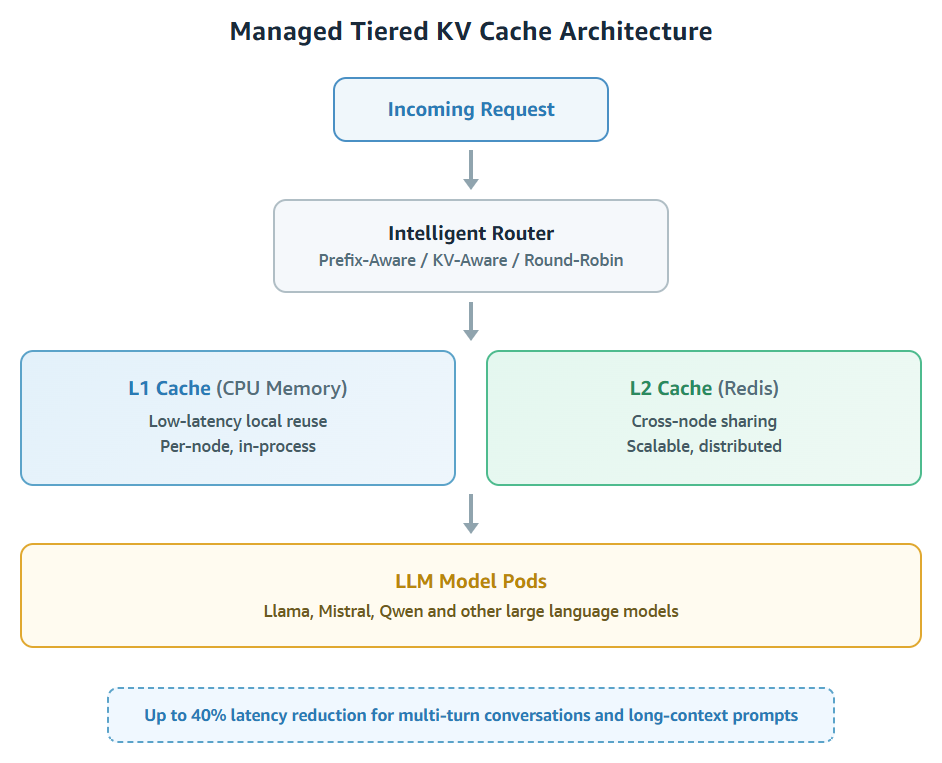
To address the memory overhead of multi-turn conversations and long-context documents, HyperPod introduced a managed tiered KV cache architecture. This system establishes an L1 cache in node-local CPU memory for rapid access, paired with an L2 Redis-backed tier for cross-node sharing. Combined with intelligent request routing, this architecture yields up to a 40% reduction in latency for complex conversational workflows.
Compliance and auditing requirements for regulated industries are met via HyperPod data capture capabilities, which log requests and response payloads at the application boundary, application load balancer, and model container level without requiring custom sidecar logging daemons. Captured data flows directly to Amazon S3, ensuring tamper-evident audit trails for drift monitoring and compliance verification.
Disaggregated Prefill and Decode (DPD), introduced in July via Inference Operator version v3.2, solves a fundamental resource contention issue in LLM serving. In traditional setups, long prompt processing phases (prefill) block token generation (decode) for concurrent users on the same GPU. DPD separates these phases onto dedicated GPU pools, transferring the KV cache instantly via Elastic Fabric Adapter (EFA) and GPU-Direct RDMA. This segregation ensures highly predictable latency distributions even under heavy, mixed production traffic.
Rounding out the HyperPod updates are Hugging Face Hub integration for direct weight deployment, local NVMe model loading to accelerate scale-from-zero events, Amazon Route 53 automated DNS management, and model caching capabilities that pre-download model weights and images to local storage nodes, achieving approximately 60% faster scale-out times for models scaling up to 145 gigabytes.
Implications for the Broader AI Landscape
The simultaneous delivery of 13 targeted features across managed and Kubernetes-native inference stacks underscores a broader maturation phase in the generative AI market. Industry analysts note that as foundational model architectures stabilize, competitive advantage is shifting decisively away from raw model selection toward operational efficiency and infrastructure cost-optimization.
By democratizing advanced optimization techniques—such as disaggregated prefill and decode, prefix-aware routing, and automated benchmarking—AWS is significantly lowering the technical barrier to entry for enterprises deploying proprietary and open-weights models at scale. Programs like the AWS Experience-Based Acceleration initiative further assist organizations in translating these technical capabilities into tangible production efficiencies. As enterprises demand predictable SLAs, strict compliance, and controlled unit economics, the ability to fine-tune every layer of the inference stack will likely define the next generation of enterprise AI adoption.