Integrating Decision Models into Amazon Bedrock AgentCore Evaluations for Precision Agent Assessment

The landscape of artificial intelligence governance is shifting rapidly as enterprises demand greater precision, reliability, and cost-efficiency when deploying autonomous agents into production environments. Within the Amazon Bedrock AgentCore ecosystem, a significant architectural advancement has been introduced: the integration of specialized decision models—specifically TypeSafe’s Jev and the open-source Strands Decider 2B—into the AgentCore Evaluations framework via code-based evaluators. This development addresses a long-standing challenge in generative artificial intelligence operations, known as MLOps: the friction between free-form text evaluation and deterministic, probability-calibrated thresholding.
Background Context of the Evaluation Paradigm
Evaluating autonomous agents traditionally relies on large language models acting as judges. While general-purpose LLMs excel at nuanced reasoning, qualitative critique, and generating comprehensive rationales, their confidence scores can drift across runs, and their latency and computational costs can become prohibitive at scale. Conversely, binary code-based checks are deterministic and fast, but they often lack the contextual understanding required to evaluate complex semantic interactions, such as policy adherence or response groundedness.
To bridge this gap, developers are increasingly turning to decision models—compact, specialized neural networks trained to evaluate a structured state against a fixed set of permissible answers, outputting a reliable, calibrated probability distribution. By bringing decision models into Amazon Bedrock AgentCore Evaluations, AWS provides engineering teams with a hybrid pipeline that combines the broad exploratory reasoning of LLM-as-a-judge evaluators with the mathematically sound, low-latency screening capabilities of specialized deciders.
Chronology and Architectural Integration of the Solution
The technical implementation of this hybrid evaluation pipeline is demonstrated through an end-to-end reference architecture featuring a mock HR Assistant agent. Built using Strands Agents and hosted on the AgentCore runtime, the assistant processes employee inquiries spanning paid time off balances, HR policies, benefits, and payroll stubs via deterministic mock APIs.
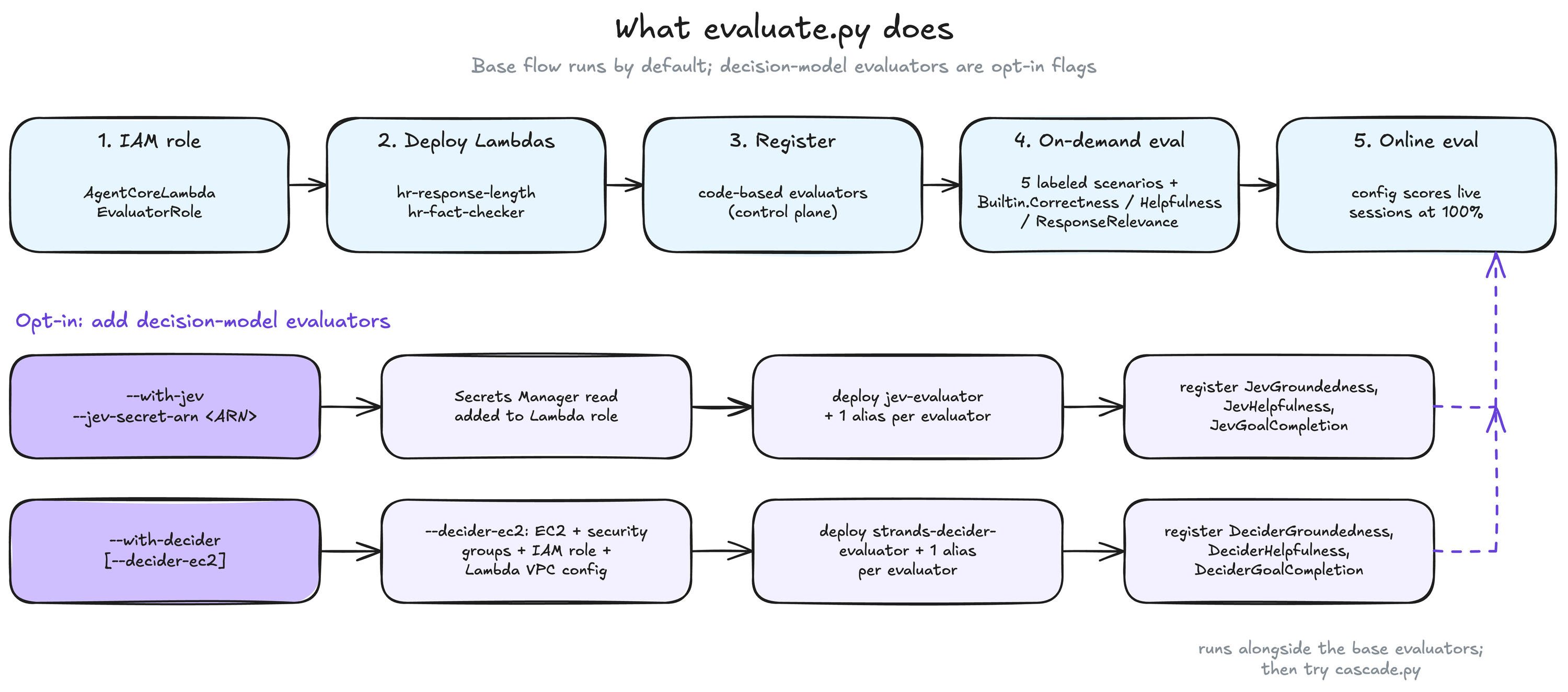
The evaluation framework operates across three distinct phases of an agent’s lifecycle: on-demand development checks, batch evaluations against historical sessions, and online monitoring of live production traffic. The pipeline incorporates a multi-tiered evaluation structure:
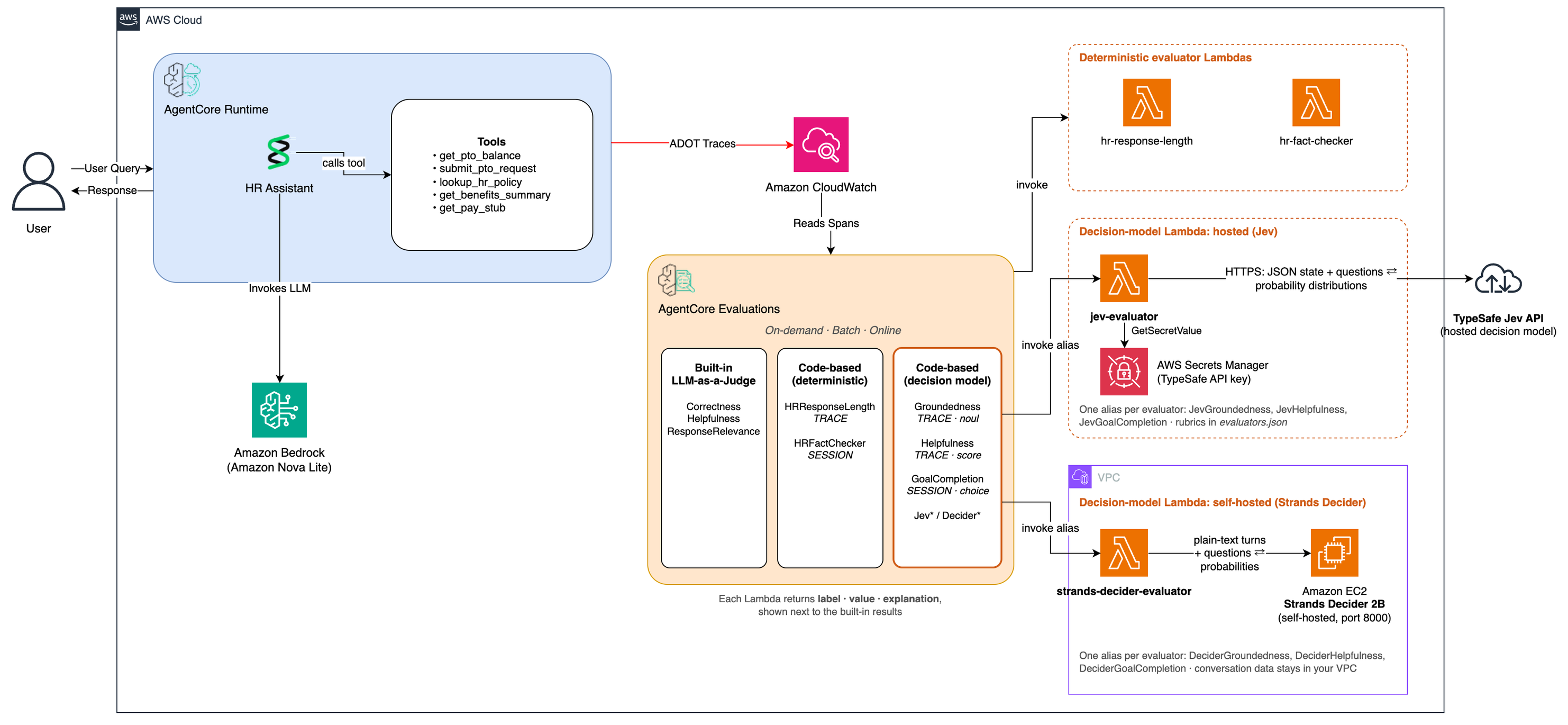
- Deterministic code checks verify exact structural constraints and basic logic.
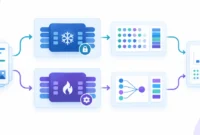
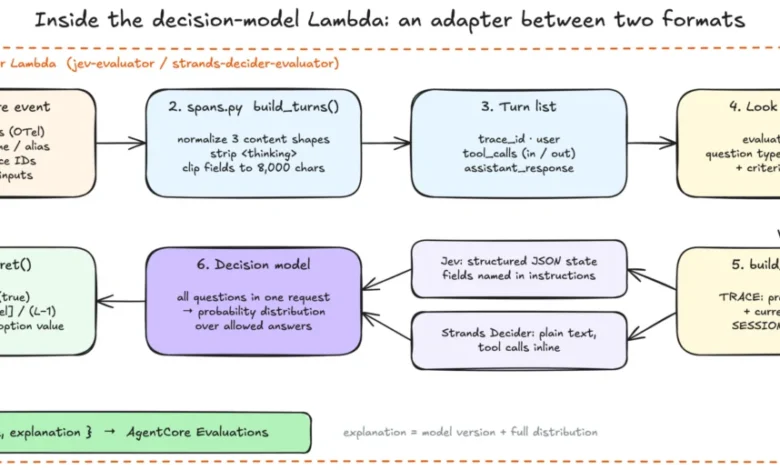
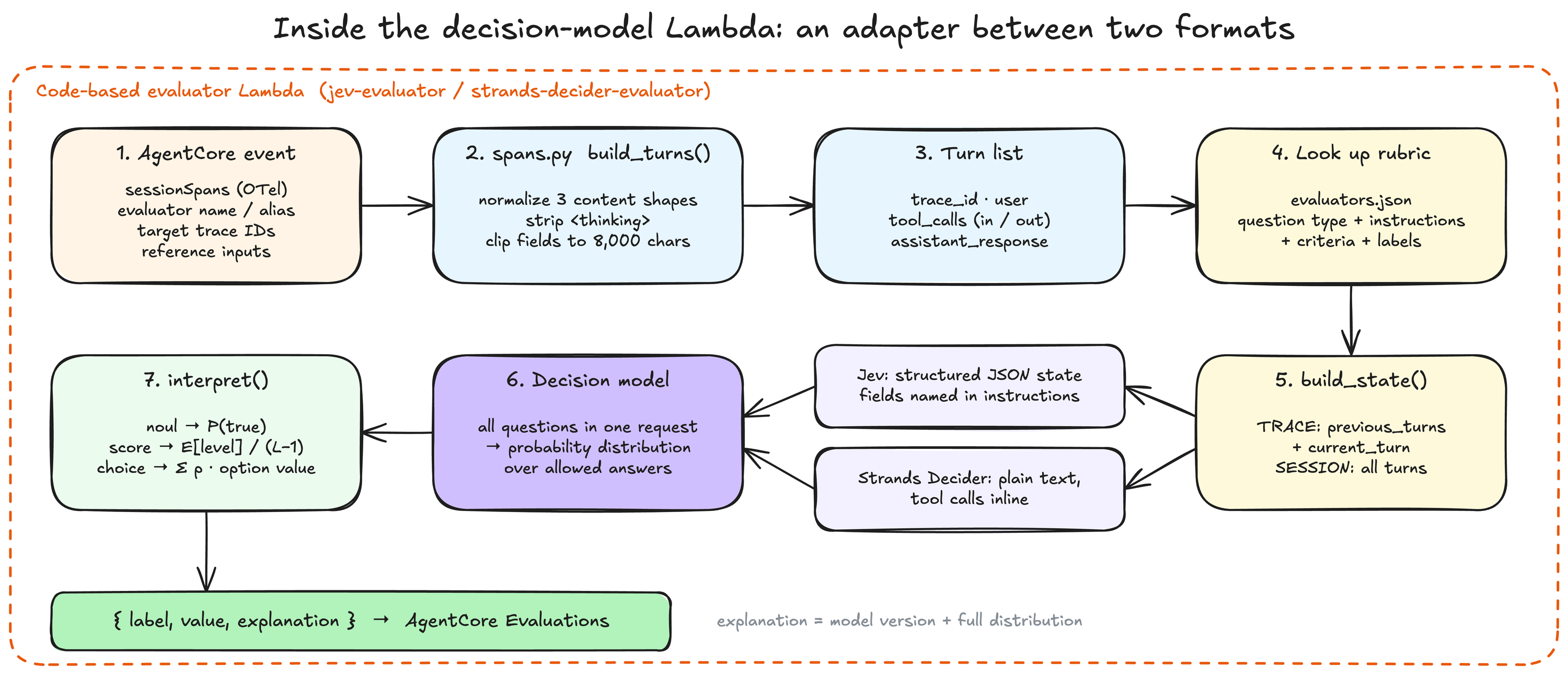
- Decision-model evaluators act as a high-speed screening layer, analyzing OpenTelemetry spans normalized by a custom AWS Lambda function.
- Built-in LLM-as-a-judge evaluators provide deep qualitative assessments and explanations, selectively invoked when low-confidence signals trigger a cascade escalation.
Supporting Data and Technical Specifications
The decision-model backends—TypeSafe Jev and Strands Decider 2B—handle three primary question categories, translating semantic assessments into actionable quantitative metrics:
- Noul questions: Binary yes/no inquiries that yield a probability distribution between 0 and 1, ideal for checking policy adherence or grounding against retrieved tool contexts.
- Choice questions: Multi-class classifications supporting up to 255 discrete options, returning the most probable outcome alongside a weighted probability distribution.
-
Score questions: Scaled assessments spanning 2 to 10 ordered levels, transforming qualitative rubrics into normalized numerical values scaled
from 0 to 1.
Comparative analysis between traditional LLM judges and decision models highlights distinct operational tradeoffs. While LLM judges require 2 to 10 seconds per inference and return descriptive text with variable confidence, decision models operate within hundreds of milliseconds (limited primarily by network overhead) and output strict probability vectors suitable for automated thresholding and programmatic alerting.
Validation Methodology and Rigorous Traffic Testing
Introducing a decision model into an evaluation pipeline is fundamentally a change in measurement methodology, requiring rigorous validation against real-world traffic. Industry experts recommend a five-step validation procedure before gating production software releases on a decision-model evaluator:
First, engineering teams must curate a representative sample of historical sessions that adequately captures edge cases and failure modes, rather than solely focusing on successful paths. Second, human reference labels must be established using majority votes from multiple independent annotators, paying close attention to split-vote turns that expose underlying rubric ambiguities. Third, both the decision-model evaluator and the baseline evaluator must execute against identical inputs to ensure a true apples-to-apples comparison. Fourth, results must be analyzed across accuracy, calibration, and operational thresholds. Finally, validation must be treated as a continuous, repeatable process rather than a static gate, repeated whenever rubrics are modified or underlying model weights are updated.
Broader Impact and Enterprise Implications
The ability to deploy the cascade pattern—where a lightweight, highly calibrated decision model screens 100% of agent turns at minimal latency and cost, escalating only ambiguous or low-confidence interactions to a heavy LLM judge—represents a major economic and technical optimization for enterprise AI deployment. By significantly reducing compute overhead while increasing the reliability of safety and compliance gates, this methodology empowers organizations to scale autonomous agent deployments with unprecedented confidence.
Developers can access the complete implementation details, deployment scripts, and architectural templates through the official Amazon Bedrock AgentCore sample repository on GitHub, accompanied by cleanup utilities to manage cloud resource expenditures effectively. As generative AI systems mature from experimental novelties into critical business infrastructure, tooling that harmonizes statistical precision with operational efficiency will remain foundational to successful enterprise adoption.