Optimizing Serverless Data Pipelines Using DuckDB and AWS Glue 6.0 for Cost-Effective ETL

The evolution of modern data engineering is increasingly defined by the ability to balance compute power with operational efficiency. As organizations grapple with escalating volumes of structured data, the demand for high-performance, cost-effective extract, transform, and load (ETL) processes has never been higher. With the recent release of AWS Glue 6.0, developers now have access to a modernized runtime that facilitates the integration of DuckDB—an in-process, vectorized analytical SQL engine—directly within serverless ETL workflows. This development offers a significant shift for teams managing SQL-centric data transformations, allowing them to optimize for both speed and expense without the overhead of managing complex, separate infrastructure.
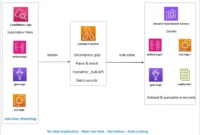
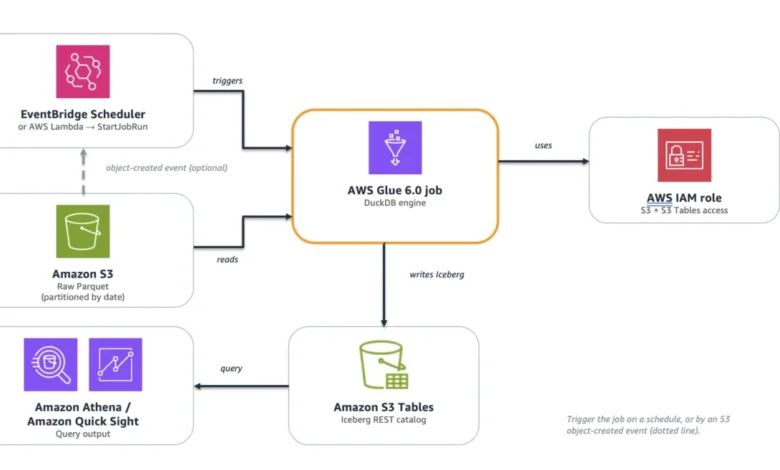
The core of this architectural shift lies in the compatibility provided by the AWS Glue 6.0 runtime. By moving to Amazon Linux 2023, the platform now supports glibc 2.34 and Python 3.13, creating a seamless environment for running DuckDB 1.5.x and its native C++ extensions. This integration allows data engineers to read Parquet files from Amazon Simple Storage Service (S3) and commit Apache Iceberg tables directly to Amazon S3 Tables, effectively bypassing the need for separate catalog synchronization.
The Shift in ETL Strategy: DuckDB vs. Apache Spark
Traditionally, Apache Spark has been the industry standard for distributed data processing on AWS Glue. While Spark remains an unparalleled choice for massive, petabyte-scale datasets requiring horizontal scaling across large clusters, it is not always the most efficient tool for smaller, frequent SQL transformations. Many enterprise data integration tasks involve routine filtering, joining, and aggregation of daily or hourly datasets. For these specific shapes of work, the overhead of managing a distributed Spark cluster can lead to unnecessary costs and slower job startup times.
The introduction of DuckDB into the AWS Glue ecosystem acts as a strategic complement rather than a replacement for Spark. When a workload is SQL-centric and fits within the memory of a single AWS Glue worker—such as a G.1X instance with 16 GB of memory—DuckDB offers a lightweight, high-speed alternative. Because DuckDB runs as an in-process engine, it eliminates the latency associated with cluster coordination and data shuffling across nodes, which are inherent to distributed systems.
Chronology of the Modernized Runtime
The path to this capability was paved by continuous improvements in the AWS Glue runtime environment. Early versions of Glue were focused on enabling robust Python and Spark execution, but the shift toward Amazon Linux 2023 in the 6.0 release marked a turning point. By modernizing the underlying OS, AWS provided the necessary binary compatibility for advanced C++-based libraries.
In October 2026, the release of AWS Glue 6.0 brought a 30 percent reduction in pricing compared to its predecessors, alongside full Apache Iceberg v3 support. This version provided the stability required for the 1.5.1 version of DuckDB to load its httpfs, aws, and iceberg extensions natively. This evolution has empowered engineers to move away from rigid, one-size-fits-all architectures toward a more modular approach, where the processing engine is selected based on the specific requirements of the data job.
Data-Driven Performance Analysis
The economic implications of this new pattern are substantial. In a controlled test comparing DuckDB and Apache Spark on the same AWS Glue 6.0 runtime, both engines processed 8.4 million rows of eCommerce transaction data across 12 Parquet files. The dataset, totaling roughly 1.2 GB in memory, provided a clear benchmark for performance and cost.
The results, verified through Amazon Athena, showed that the DuckDB-based job completed in approximately 56 seconds, whereas the Spark job required 117 seconds. Because AWS Glue bills in 1-second increments with a 1-minute minimum, the DuckDB job was billed for one minute of compute time, compared to two minutes for the Spark job. At the current AWS Glue 6.0 rate of $0.308 per DPU-hour, the cost per run for DuckDB was $0.0103, while the Spark job cost $0.0205.
For an organization running such a job 20 times per day, the annual savings are projected to reach roughly $75 per job. While this may seem modest for a single pipeline, the aggregate savings for an enterprise managing hundreds of daily incremental loads and aggregation jobs represent a significant reduction in operational expenditure.
Technical Implementation and Workflow
Implementing DuckDB within an AWS Glue job requires a precise configuration of the environment. Because the AWS Glue filesystem is read-only outside of the /tmp directory, developers must redirect DuckDB’s extension cache and spill files to this location. Failure to do so results in permission errors, as the engine attempts to write to restricted system paths.
The integration process involves several key steps:
- Environment Setup: Installing DuckDB via the
--additional-python-modulesparameter in the Glue job configuration. - Credential Resolution: Utilizing the
CREDENTIAL_CHAINprovider, which allows DuckDB to leverage the IAM role assigned to the AWS Glue job, ensuring that no sensitive keys or secrets are hardcoded into the scripts. - Data Transformation: Using the
read_parquet()function to ingest data from S3, followed by standard SQL queries to filter, aggregate, and enrich the data. - Targeted Commitment: Writing the processed data into Amazon S3 Tables as an Iceberg table, ensuring that the output is immediately available for analytical engines like Amazon Athena and Amazon Redshift.
Implications for Data Architecture
The ability to switch between DuckDB and PySpark within the same infrastructure—using the same IAM roles, triggers, and job definitions—offers a high degree of agility. When a data pipeline grows in volume or complexity beyond the capabilities of a single worker, a developer can simply update the job script to use PySpark, without having to re-architect the surrounding infrastructure.
This flexibility reflects a broader trend in data engineering toward "engine-agnostic" pipelines. By decoupling the transformation logic from the underlying hardware-management layer, organizations can ensure that their data platforms are both future-proof and cost-optimized.
Operational Challenges and Best Practices
Despite the clear benefits, integrating DuckDB into production environments requires careful consideration of error handling and monitoring. Because DuckDB performs operations in-process, it is essential to size the AWS Glue worker appropriately for the dataset. For instance, the G.1X worker provides 16 GB of memory, which is sufficient for many medium-scale aggregations, but larger workloads may necessitate the G.2X or G.4X types to prevent memory exhaustion and excessive disk spilling.
Furthermore, developers must account for the non-atomic nature of DELETE and INSERT operations in the current Iceberg integration. If a job fails mid-process, it could leave a partition empty. Production-grade pipelines should include robust logging and, where necessary, state-management wrappers to ensure idempotency and recovery. Structured logging via Amazon CloudWatch is recommended to track the number of rows processed and the timing of each stage, providing the observability required to maintain high service-level agreements (SLAs).
Broader Industry Context
The rise of embedded analytical engines like DuckDB is changing how developers approach data processing. Rather than forcing all data through a massive distributed engine, the industry is moving toward a tiered approach where simple, high-velocity tasks are handled by leaner, localized compute resources. This trend aligns with the ongoing maturation of the Apache Iceberg ecosystem, which has become the de facto standard for open table formats.
As Amazon S3 Tables and AWS Glue continue to evolve, the barrier to entry for high-performance data engineering is lowering. By providing a managed, serverless platform that supports both specialized SQL engines and distributed processing, AWS is effectively enabling a "best-of-both-worlds" architecture. Organizations that adopt these patterns are not only reducing their cloud infrastructure costs but are also gaining the ability to iterate faster, allowing data teams to focus on delivering business insights rather than managing the complexities of their compute clusters.
In conclusion, the integration of DuckDB into AWS Glue 6.0 represents a significant advancement for data engineering teams. By matching the processing engine to the specific needs of the job, companies can achieve higher efficiency, lower costs, and greater operational flexibility. As data volumes continue to climb, this hybrid approach to compute will likely become a foundational element of modern data architectures, bridging the gap between small-scale agility and large-scale performance.