Amazon Bedrock Managed Knowledge Base Expands Retrieval Capabilities with Flexible Single-Shot RAG and Agentic Stream Controls

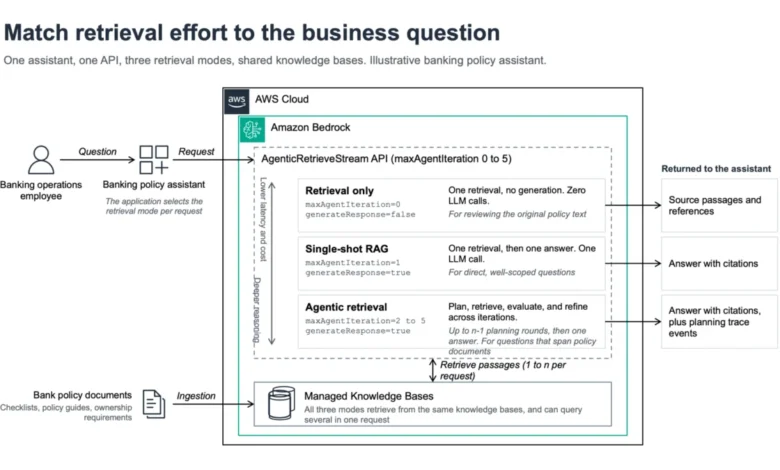
The landscape of enterprise artificial intelligence is undergoing a significant architectural shift as organizations demand greater precision, lower latency, and cost-efficiency from their internal generative tools. Amazon Web Services (AWS) has officially announced a powerful update to Amazon Bedrock Managed Knowledge Base, introducing flexible configuration options through the AgenticRetrieveStream API. This latest enhancement bridges a critical gap in enterprise application design, allowing developers to seamlessly switch between single-shot Retrieval-Augmented Generation (RAG), traditional multi-step agentic workflows, and retrieval-only operations using a single unified API endpoint.
For enterprise architects and development teams, this release addresses a persistent architectural bottleneck. Previously, applications requiring both rapid, direct lookups and deep, exploratory cross-document analysis were forced to construct, maintain, and integrate separate code paths and APIs. With the expansion of the maxAgentIteration parameter to a range of 0 through 5, engineers can now dynamically tailor retrieval depth and large language model (LLM) utilization on a per-request basis. This optimization significantly reduces computational overhead and latency for straightforward queries while preserving the sophisticated reasoning capabilities required for complex, multi-part inquiries.
The Evolution of Enterprise RAG Architecture
The integration of retrieval-augmented generation has become a cornerstone of modern enterprise software, enabling employees and customers alike to query vast repositories of unstructured data using natural language. However, a "one-size-fits-all" approach to retrieval often introduces unnecessary friction. Simple inquiries—such as checking a basic procedural requirement or a definition—suffer from the computational latency and financial cost of multi-step agentic loops, where a foundational model repeatedly rewrites queries and evaluates intermediate search results. Conversely, complex, cross-domain comparisons routinely fail when restricted to a single, rigid retrieval pass.
Recognizing these operational realities, AWS has re-engineered the AgenticRetrieveStream framework to provide granular control over the retrieval lifecycle. By adjusting the maxAgentIteration parameter, developers can dictate precisely how much cognitive planning an assistant performs before generating a response. This development reflects a broader industry movement away from monolithic AI models and toward highly orchestrated, modular pipelines that optimize every token and computational cycle.
Decoding the New Iteration Modes and Operational Mechanics
To fully appreciate the impact of this update, developers and technical decision-makers must understand how retrieval iterations are counted and executed within the Amazon Bedrock ecosystem.
One iteration equates strictly to a single foundation model call. The operational loop invariably culminates in a final answer-generation phase. Consequently, configuring the maxAgentIteration parameter to a value of $n$ permits up to $n – 1$ agentic planning rounds, reserving the ultimate iteration for response synthesis. Each planning round involves a strategic query rewrite paired with a targeted knowledge base retrieval. Higher iteration values empower the system to thoroughly decompose difficult, multi-faceted questions, whereas lower values prioritize speed and predictability.
It is equally vital to note that speculative retrieval—the preliminary search executed prior to the first formal planning step—does not count against the maxAgentIteration limit. This foundational search runs transparently to accelerate the response pipeline without consuming valuable iteration budget.
Within this updated framework, three distinct operational modes emerge:
MaxAgentIteration = 1: Basic Single-Shot RAG
Tailored for direct, well-scoped questions, this mode performs exactly one retrieval operation followed immediately by one answer-generation call. Crucially, it bypasses agentic planning and query rewriting entirely. When paired with generateResponse=true, the system delivers a grounded, highly accurate response with minimal latency. Industry analysts note that this mode is expected to become the default setting for the vast majority of standard enterprise search and retrieval traffic, drastically cutting unnecessary LLM compute costs.
MaxAgentIteration = 0: Passages Only, Zero LLM Calls
Operating as a direct equivalent to the classic Retrieve API, this setting executes a single guaranteed retrieval while invoking zero foundation models. Because no language model is engaged, response generation is disabled; attempting to set generateResponse=true at this threshold results in a validation error. This mode is explicitly designed for applications and workflows already standardized around the AgenticRetrieveStream infrastructure that require raw source text rather than summarized outputs, allowing developers to retrieve deduplicated passages without incurring generative token expenses.
MaxAgentIteration = 2 to 5: Advanced Agentic Mode
Retaining its core robust functionality, the multi-step agentic mode enables a foundation model to autonomously deconstruct complicated queries into focused sub-questions. The system executes iterative searches across single or multiple knowledge bases, evaluates the harvested evidence in real time, and dynamically refines subsequent searches if evidentiary gaps are detected. This mode remains the gold standard for comparative, exploratory, and multi-part inquiries that transcend the boundaries of a single document.
maxAgentIteration Value |
Operational Output | Optimal Enterprise Use Case |
|---|---|---|
| 0 | Single retrieval, zero LLM calls, no generation | Raw passage extraction for users who prefer reviewing source documentation directly. |
| 1 | Single retrieval plus one generated response | Direct, well-scoped informational queries requiring rapid turnaround. |
| 2 to 5 | Up to $n-1$ planning rounds followed by generation | Multi-part, comparative, and cross-document exploratory research. |
Practical Application in Regulated Industries
While these technical adjustments apply broadly across all sectors, highly regulated industries such as banking, finance, and healthcare stand to benefit immensely from this architectural flexibility. Consider a financial institution deploying an internal operations assistant backed by a comprehensive knowledge base of account-opening procedures, compliance guidelines, and entity-specific regulatory frameworks.
In a standard morning workflow, a banking employee might require a quick procedural verification: “What documents are required to open a business checking account for a sole proprietor?” Because this information resides within a singular, well-defined checklist, routing the query through maxAgentIteration=1 yields an instantaneous, grounded response without wasting computational resources on iterative planning.
Later in the day, the same employee might tackle a far more complex cross-policy compliance inquiry: “How do account-opening requirements differ for sole proprietors and LLCs, and what additional checks, if any, apply to nonresident owners under our policy?” Here, the answer is scattered across distinct governance guides and ownership-verification protocols. By dynamically escalating the parameter to maxAgentIteration=4, the application empowers the internal assistant to perform multiple planning rounds, decompose the prompt into discrete sub-queries, gather exhaustive evidence from disparate knowledge bases, and synthesize a comprehensive comparative report complete with citations.
Furthermore, if an auditor or compliance officer prefers to review the raw regulatory text rather than relying on an AI-generated summary, the system can instantly pivot to maxAgentIteration=0, streaming clean, deduplicated source passages directly to the interface without triggering a single language model invocation.
Strategic Implications and Industry Analysis
From an enterprise software perspective, the introduction of these granular controls reflects a maturing cloud-AI market. Early implementations of generative AI frequently prioritized capability over efficiency, leading to inflated operational expenditures and unpredictable latency profiles. By granting developers precise, parameter-driven control over retrieval depth, AWS is empowering organizations to fine-tune their economic models alongside their performance metrics.
Industry analysts emphasize that this capability shifts the burden of query routing from complex, probabilistic external orchestrators down to deterministic application logic. Software engineers can now programmatically analyze incoming user intent—using simple heuristics, regex, or lightweight classification models—and instantly assign the appropriate maxAgentIteration value. This ensures that trivial tasks execute at maximum speed and minimum cost, while genuinely intricate research queries receive the full cognitive power of agentic decomposition.
Moreover, security and governance teams will welcome the transparency afforded by the retrieval-only mode. In environments where hallucination risks must be mitigated entirely, providing human reviewers with direct, unmediated access to source text passages via the same streaming architecture ensures strict adherence to institutional compliance standards.
Implementation Roadmap for Development Teams
Organizations looking to adopt these newly expanded retrieval modes within their existing Amazon Bedrock deployments are advised to follow a structured evaluation methodology:
- Benchmark Representative Traffic: Compile a diverse test suite of historical queries from internal users, ranging from straightforward factual lookups to complex, multi-document comparisons.
- Cost and Latency Profiling: Compare the performance of single-shot RAG (
maxAgentIteration=1) against traditional agentic configurations across identical knowledge bases to measure tangible reductions in latency and token consumption. - Quality and Grounding Audits: Validate that faster single-shot responses do not compromise factual accuracy or sacrifice essential context, particularly when handling edge cases or incomplete documentation.
- Gradual Parameter Tuning: Implement application-level logic to dynamically assign the lowest viable iteration limit for each specific workflow, reserving higher iterations strictly for exploratory and comparative tasks.
By integrating these features through the AgenticRetrieveStream API, enterprises can future-proof their generative applications, ensuring that performance, accuracy, and operational expenditure remain perfectly balanced as their data ecosystems scale.