Fine-Tuning vs. Frozen Embeddings: A Comparative Analysis of Large Language Model Domain Adaptation Strategies

In the rapidly evolving landscape of artificial intelligence, developers and data scientists frequently face a critical architectural decision: how to effectively adapt a pre-trained Large Language Model (LLM) to a specific domain without incurring prohibitive costs or sacrificing predictive accuracy. The traditional gold standard for this task has long been full-parameter fine-tuning; however, the emergence of lightweight parameter-efficient methods and the continued utility of classical machine learning pipelines have sparked a necessary debate. Is it always advantageous to retrain the weights of a massive model, or can practitioners achieve comparable results by utilizing frozen embeddings as inputs for downstream classifiers?
The answer to this question involves a complex trade-off between computational overhead, latency, and model performance. By comparing the efficacy of Low-Rank Adaptation (LoRA) against the implementation of Scikit-Learn classifiers on frozen model outputs, organizations can make data-driven decisions that balance the requirements of production environments with the realities of budget constraints and hardware availability.
Context and Evolution of LLM Adaptation
To understand the shift in methodology, one must consider the historical trajectory of Natural Language Processing (NLP). Before the proliferation of Transformers, domain adaptation was often achieved through the training of specialized architectures from scratch or via feature engineering on static word embeddings like Word2Vec or GloVe. The advent of models such as BERT and later GPT-4 transformed this paradigm, providing massive, pre-trained "backbones" that captured general linguistic nuances.
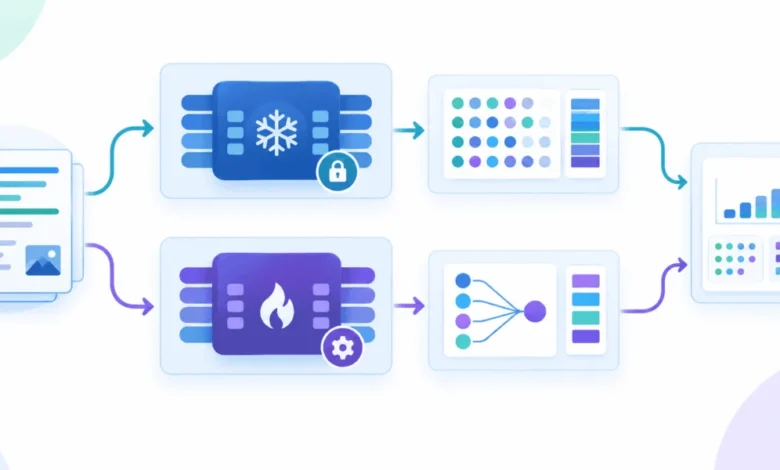
When these models are applied to niche tasks—such as medical record classification, financial sentiment analysis, or legal document categorization—the pre-trained knowledge must be aligned with the target distribution. Fine-tuning, the act of updating the model’s internal weights on a smaller, curated dataset, has become the primary mechanism for this alignment. However, as models grow to billions of parameters, the energy consumption, time, and GPU memory required for fine-tuning have skyrocketed. This has led to the popularity of Parameter-Efficient Fine-Tuning (PEFT) methods, most notably LoRA, which freezes the pre-trained weights and introduces small, trainable adapter matrices.
The Mechanism of Frozen Embeddings
The alternative approach, which treats the LLM purely as a feature extractor, offers a starkly different workflow. In this strategy, the LLM is kept in a "frozen" state, meaning its internal weights remain immutable. Instead of updating the model, the user feeds raw text into the model to extract high-dimensional hidden state vectors. These vectors serve as a mathematical representation of the input text’s semantic content.
Once these embeddings are generated, the LLM’s role is complete. The resulting data—often thousands of dimensions wide—is then fed into a traditional, lightweight statistical model, such as a Random Forest, Support Vector Machine (SVM), or Logistic Regression, provided by libraries like Scikit-Learn. This methodology is particularly attractive for organizations that operate on a strict budget, as it requires only a single pass through the LLM during the embedding extraction phase, followed by rapid, CPU-bound training of the downstream classifier.
Comparative Performance: A Controlled Analysis
In a controlled environment, such as the classification of the AG News dataset—a standard benchmark consisting of news headlines categorized into four distinct classes (World, Sports, Business, and Sci/Tech)—empirical data highlights the variance between these two methods.
When using a model like the Qwen/Qwen2.5-1.5B, the frozen embedding approach requires an initial investment in inference time to generate the vector representations. For a sample size of 800 training documents and 200 test documents, the extraction phase may take approximately 96 seconds on a T4 GPU. The subsequent training of a Random Forest classifier is near-instantaneous, typically completing in under three seconds. This approach yields an accuracy rate of approximately 82%.
Conversely, implementing LoRA fine-tuning—which involves injecting adapter layers and updating them over three epochs—requires a more significant temporal investment. In the same test environment, the fine-tuning process requires roughly 300 seconds. While this represents a three-fold increase in training time compared to the frozen embedding method, it results in an accuracy gain of 5 percentage points, reaching 87%.
Chronology of the Decision-Making Process
For engineering teams, the decision of which path to pursue typically follows a specific lifecycle:
- Baseline Assessment: Developers begin by running the frozen embedding strategy. Because this requires no training of the LLM, it serves as a "quick and dirty" baseline to understand if the LLM’s inherent representations are sufficient for the task at hand.
- Performance Review: If the accuracy of the frozen embedding model meets the project’s Key Performance Indicators (KPIs), the development cycle ends, and the model is deployed. This is the "fast-track" to production.
- Iterative Optimization: If the performance gap is unacceptable, teams then move to LoRA. By this stage, the team has already validated their dataset, making the transition to fine-tuning a seamless next step rather than a speculative experiment.
- Production Deployment: Finally, the choice is solidified based on the inference latency requirements. If the application requires real-time results, the memory overhead of the adapter-augmented model must be weighed against the simplicity of the frozen model.
Economic and Technical Implications
The implications for industry are profound. For startups or small research teams, the cost of GPU cloud instances can be a significant barrier. Using frozen embeddings essentially allows these entities to "rent" the intelligence of a massive model once, extract the features, and then perform all subsequent experimentation on low-cost hardware. This democratizes access to sophisticated NLP tools by removing the need for massive, sustained GPU clusters during the training phase.
Furthermore, the risk of "catastrophic forgetting"—a phenomenon where a model loses its general reasoning capabilities after being fine-tuned on a narrow dataset—is entirely mitigated when using frozen embeddings. Since the model weights never change, the core "intelligence" of the model remains intact, ensuring that it can still perform its general-purpose tasks alongside the domain-specific classification.
Official Perspectives and Best Practices
Leading practitioners in the field, including researchers at Hugging Face and various academic institutions, often emphasize that the choice is rarely binary. In many enterprise architectures, the "best" approach is a hybrid one. Some teams use a frozen embedding strategy for initial deployment to get a service running, then collect user feedback and "hard" cases, and eventually transition to a fine-tuned model once enough high-quality, domain-specific training data has been curated.
Industry analysts suggest that the trend toward "model-as-a-service" architectures will likely favor the frozen embedding approach for standard tasks, while specialized tasks requiring deep domain knowledge (such as interpreting nuanced medical jargon) will continue to drive the demand for fine-tuning.
Future Outlook
As LLMs continue to grow in size and complexity, the computational cost of full-parameter fine-tuning will continue to be a primary inhibitor to widespread adoption. Methods like QLoRA and its successors have helped bridge the gap, but the fundamental trade-off remains: the more the model "learns" from the specific domain, the more it costs in terms of time, energy, and hardware.
Ultimately, the choice between frozen embeddings and LoRA is a matter of business logic. If the primary objective is to build a cost-effective, maintainable, and stable classification pipeline, frozen embeddings are an often-overlooked and highly efficient choice. If the objective is to capture the subtle, high-dimensional patterns that distinguish elite performance from standard results, the extra compute time required for LoRA is a necessary investment. By understanding the interplay between these two strategies, developers can better navigate the complexities of the modern AI landscape, ensuring that their applications are not only intelligent but also economically and operationally viable for the long term.