Beyond Vibe Coding: The Strategic Evolution of Directed Generation in Professional Design

The rapid integration of generative artificial intelligence into creative workflows has prompted a significant identity crisis within the design industry, centered on the rise of the colloquial term vibe coding. Coined in early 2025 by prominent software engineer Andrej Karpathy, the term was originally intended to describe a specific, low-accountability mode of software development where a user provides loose, informal prompts to an AI and accepts the output without rigorous verification. However, as the terminology migrated from engineering circles into the domain of professional design, it has begun to mischaracterize the sophisticated, intentional methodologies employed by senior practitioners. This shift has ignited a debate over professional authorship, the necessity of precise nomenclature, and the fundamental role of human judgment in an era of machine-augmented creation.
The Etymology of a Misnomer and its Market Consequences
The emergence of vibe coding as a label coincided with the release of several powerful multi-modal generative models capable of producing front-end code and visual interface layouts. In its infancy, the term accurately described a form of speculative prototyping. Yet, its application to professional design work is viewed by many industry leaders as a degradation of the designer’s role. George Orwell’s observation that the slovenliness of language facilitates foolish thoughts serves as the backdrop for this concern: when a field adopts a label that implies passivity—waiting for a machine to provide a solution—it inadvertently signals to clients and stakeholders that the design process is an automated output rather than a deliberate, intellectual service.
Market analysts note that the vocabulary surrounding AI-assisted design is currently dominated by engineering culture. This bias toward efficiency often assumes that the human’s role is that of a supervisor or a curator of automated artifacts, rather than an architect of systems. As design firms compete for contracts in an increasingly AI-fluent market, the language used to describe these processes significantly influences perceived value. If a design firm markets its work as vibe coding, it risks being commoditized as a group of prompt-engineers. Conversely, those who reframe their process as directed generation—a methodology defined by rigorous input and constraint-based outputs—position themselves as strategic partners.
The Chronology of the Shift
The timeline of this shift began in late 2024, when early-adopter designers started experimenting with Large Language Models (LLMs) and diffusion-based image generators to accelerate wireframing and component creation. By early 2025, the release of advanced reasoning models allowed for more complex, multi-step generation, leading to the coining of the term vibe coding by Karpathy. By the third quarter of 2025, the term had proliferated across social media and professional design blogs, often being used interchangeably with "AI-assisted design."
By mid-2026, a growing cohort of design agencies began to publicly push back, arguing that the term ignored the "upstream" labor of these processes. This movement seeks to distinguish between "prompt-and-accept" workflows—which are indeed low-accountability—and "reference-guided" workflows, where the designer’s judgment remains the primary driver of the final product.
Data and Industry Impact
Current industry surveys indicate that while 78% of creative agencies have integrated AI tools into their pipelines, the methodology of that integration varies wildly. According to recent data from the Design Systems Collective, agencies that utilize "directed generation" report a 40% reduction in initial prototyping time while maintaining higher consistency across multi-platform deployments. Unlike traditional, static documentation, which often struggles with the entropy of large-scale, multi-surface design systems, directed generation allows designers to encode their intent into the system’s primitives.
The technical implications are profound. Traditional design systems treat patterns as fixed artifacts—a button, a card, or a navigation bar—that must be manually updated to maintain consistency. Directed generation treats these patterns as sets of spatial, typographic, and behavioral relationships. When a designer defines these relationships, the AI does not simply "copy" a component; it interprets the intent across new contexts, allowing for a form of non-deterministic, yet highly consistent, design scaling. This shift represents a move away from systematic documentation toward systematic generation.
Defining the New Methodology: Directed Generation
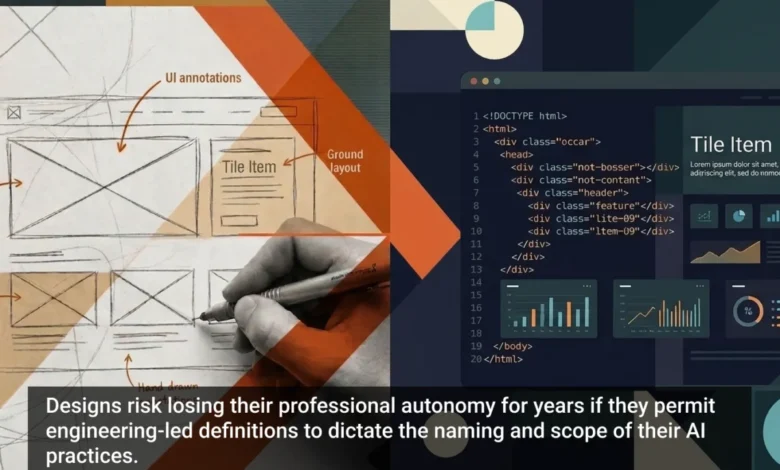
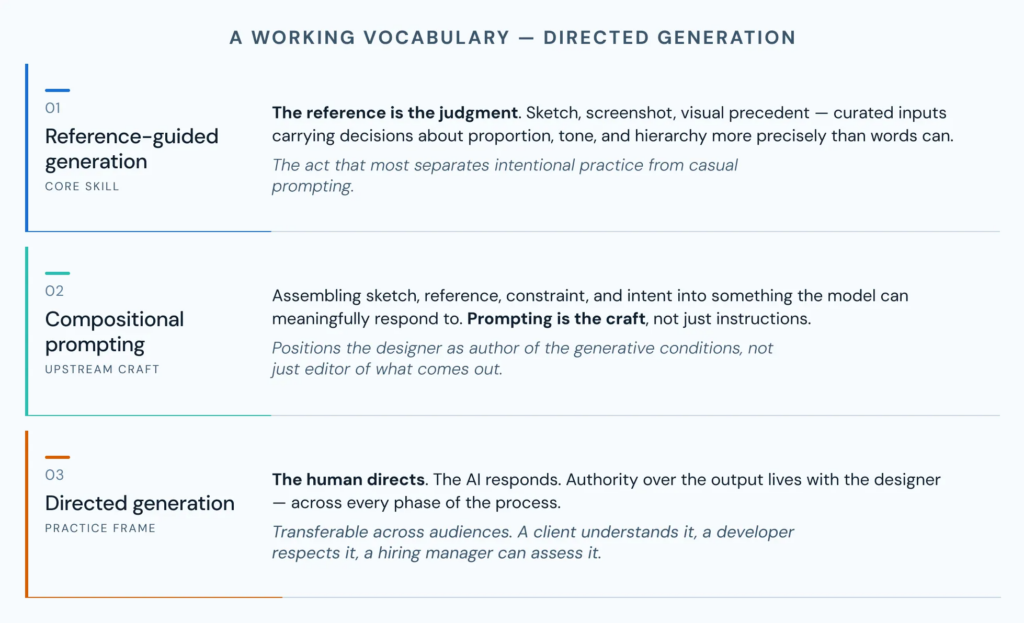
The core of the "directed generation" approach lies in the inversion of the standard prompting workflow. Instead of asking a model to "create a dashboard," the designer provides a curated input: a hand-drawn sketch, a specific visual precedent, or a set of strict, coded constraints. This reference acts as the primary decision-making vehicle. In this model, the designer acts as the author of the grammar, while the system functions as the orator.
The following framework distinguishes this from traditional generative approaches:
- The Reference Phase: The designer establishes the visual and logical intent through high-fidelity inputs.
- The Constraint Phase: The designer sets parameters for the AI’s output, ensuring that the machine operates within specific brand or functional guidelines.
- The Iterative Synthesis: The designer evaluates the machine-generated options against the initial references, applying professional judgment to refine the output.
- The Delivery Phase: The system produces output that is contextually aware, capable of scaling across devices without human intervention for every minor adjustment.
Broader Implications for the Creative Economy
The professionalization of AI-assisted design is reminiscent of the emergence of User Experience (UX) design as a distinct discipline two decades ago. At that time, practitioners who clearly defined their roles—as interaction designers, information architects, or UX researchers—were able to shape the market’s understanding of their value. Those who allowed adjacent fields to define them often found themselves marginalized in the organizational hierarchy.
Industry observers suggest that the current inflection point regarding AI nomenclature is critical. If designers fail to articulate their value, the definition of "design" in an AI-dominated world will be dictated by those who hold the most power in the development cycle, typically software engineers or product managers. This could lead to a devaluation of the very skills that AI was meant to augment: empathy, critical judgment, and long-term brand stewardship.
Strategic Recommendations for Design Leadership
To maintain professional authority, design leaders are encouraged to adopt more precise language. Terms such as "reference-guided practice" or "compositional prompting" provide a more accurate representation of the intentionality involved in using modern design tools. Furthermore, organizations should distinguish between phases of work. There are contexts where low-accountability generation (vibe coding) is appropriate—such as rapid, exploratory ideation where speed is the primary constraint. However, in production-ready environments, a "hybrid approach" is necessary, acknowledging that different phases of a project require different levels of human oversight and rigor.
The adoption of these methodologies does not mean abandoning the traditional design system. Instead, it suggests that the design system is evolving into a more flexible, agentic framework. By moving the designer’s craft upstream into the creation of primitives and constraints, the industry can leverage the speed of generative AI without sacrificing the intentionality that defines high-quality design.
In conclusion, the debate over terminology is not merely a semantic dispute. It is a fundamental struggle for the future of design authorship. As AI tools continue to mature, the distinction between a passive user of AI and an intentional designer of systems will become increasingly blurred to the untrained eye. For the industry to maintain its professional standing, it must aggressively define its own methodologies, ensuring that the "judgment" in the design process remains firmly in human hands, supported—but not replaced—by the generative capabilities of the machine. The future of design lies not in the tools themselves, but in the precision with which they are directed.