Processing individual tasks sequentially in Small Language Model (SLM) pipelines represents a critical bottleneck that undermines the efficiency of automated workflows. In the context of narrow automation—where specialized models like Qwen2.5-0.5B-Instruct are deployed for repetitive tasks such as support ticket classification—the industry standard has often relied on a "one-at-a-time" inference loop. However, rigorous benchmarking on consumer hardware, such as the M2 Macbook Air, demonstrates that this approach forces hardware to operate in a memory-bandwidth-bound state, leaving arithmetic units significantly underutilized. By shifting to a length-bucketed batching strategy, developers can dramatically improve throughput without sacrificing the accuracy of model outputs.
The Problem of Sequential Inference
The primary inefficiency in current SLM deployment patterns is the reliance on single-pass forward propagation. In a standard pipeline, each ticket is processed as a batch of one. Because the model must load its entire weight set from memory into the processor to handle a single sequence, the hardware spends a disproportionate amount of time moving data rather than performing calculations. When the operation is complete, the weights are cleared or ignored, and the cycle repeats for the next item.
This architectural mismatch is particularly severe on CPUs and integrated hardware, where the memory-to-compute ratio is not as favorable as it is on high-end enterprise GPUs. Consequently, the arithmetic units—the components responsible for the actual "intelligence" or matrix multiplications—remain idle for the vast majority of the execution time.
Furthermore, naive attempts to resolve this via batching often fail due to the nature of natural language data. If a dataset contains a high variance in text length, a standard batching implementation forces all items in a batch to be padded to the length of the longest sequence. In many real-world scenarios, where a few long tickets exist alongside a majority of short ones, this leads to a "long tail" effect. The model ends up processing a massive amount of empty "padding" tokens, effectively wasting compute cycles on data that carries no semantic information.
Chronology of Optimization Strategies
This shift toward length-bucketed batching is the third pillar in a broader effort to optimize narrow automation. The progression of these techniques follows a logical evolution in resource management:
- Constraining Output Space: The first phase involved limiting the model’s vocabulary and potential output tokens to a predefined set, such as specific categories like "billing," "technical," or "account." By narrowing the search space, the model performs fewer computations, reducing latency.
- Key-Value (KV) Cache Reuse: The second phase focused on architecture-level efficiency, specifically reusing the prompt prefix. By caching the KV states of static system instructions, the system avoids redundant computations for prompts that share identical headers.
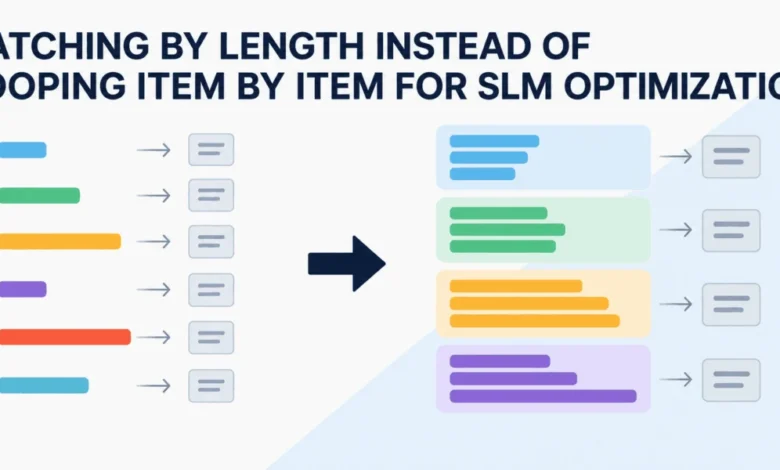
- Length-Bucketed Batching: The current phase addresses the scheduling of the inference workload itself. By grouping inputs of similar lengths, the system minimizes the padding requirement per batch, ensuring that the model spends the maximum possible percentage of its time on real, non-padded tokens.
Data-Driven Performance Analysis
Benchmarks conducted using the Qwen2.5-0.5B-Instruct model highlight the stark difference between sequential processing and optimized batching. In a test involving 600 support tickets with a length distribution ranging from 48 to 449 tokens, the sequential "item-by-item" approach required approximately 144 seconds, achieving a throughput of roughly 4.2 items per second.
When applying length-bucketed batching—where tickets are sorted by length and grouped into batches of 32—the processing time dropped to approximately 79 seconds, effectively increasing throughput to 7.5 items per second. This represents a near-doubling of efficiency. Crucially, the "padding overhead" was reduced to only 7.6%. Had the system used a global maximum padding strategy, it would have processed 3.7 times more tokens than necessary, drastically inflating the compute cost for no added value.
Technical Implications and Implementation
Implementing length-bucketed batching requires a methodical approach to data preprocessing. Developers must first tokenize the entire dataset and record the lengths of each sequence. By sorting the indices of these sequences, the system can partition the data into batches that are internally homogeneous in terms of length.
From an engineering perspective, the implementation involves:
- Tokenization: Calculating the length of each prompt in the dataset.
- Sorting: Arranging the dataset so that similar lengths are adjacent.
- Padding: Applying padding only to the local maximum of each specific batch, rather than the global maximum of the entire dataset.
- Verification: Running comparison tests against the unbatched baseline to ensure that the padding does not introduce positional biases or logical errors in the model’s output.
Engineers must exercise caution when combining these optimizations. For instance, prefix caching and batching are not inherently compatible without careful management. Because a KV cache typically assumes a batch size of one, developers must manually expand the cache tensors to match the batch dimension, ensuring that the cache is properly cropped and aligned after each pass.
Broader Impact on AI Operations (AIOps)
The move toward more efficient inference is a critical development for organizations looking to scale AI without exponential cost growth. As AI models become more integrated into customer service, technical support, and logistics, the ability to process thousands of requests per minute on standard hardware becomes a financial imperative.
The "narrow automation" model—where small, highly efficient models are used for specific, high-frequency tasks—is proving to be a more sustainable architecture than relying on massive, general-purpose models for every minor query. By squeezing maximum performance out of these SLMs through software-level optimizations, businesses can maintain high responsiveness while keeping infrastructure costs within a manageable, predictable range.
Moreover, this approach reinforces the principle of data-centric optimization. The efficiency gains observed are not the result of a more complex model or a larger training dataset, but rather the result of a more intelligent scheduling algorithm. This confirms that for many AI practitioners, the path to superior performance lies as much in how the data is fed into the model as it does in the architecture of the model itself.
Conclusion and Future Outlook
The transition from item-by-item loops to length-bucketed batching marks a maturation point in the deployment of small language models. The empirical evidence confirms that hardware utilization is frequently the bottleneck for modern AI applications, rather than raw model capability. By treating the data pipeline as an engineering challenge—focusing on memory bandwidth, padding minimization, and cache alignment—developers can achieve significant performance gains that translate directly into cost savings and improved user experiences.
As the industry continues to refine these techniques, the focus will likely shift toward dynamic batching, where batches are formed on-the-fly as requests arrive. However, the foundational principle remains clear: the most effective optimization is often the one that removes unnecessary work. Whether it is through constraining output spaces, reusing prompt prefixes, or optimizing batch geometry, the goal remains the same: to deliver the required intelligence with the least possible computational footprint. In an era where AI compute resources are in high demand, these "surgical" optimizations are not just beneficial—they are essential for the long-term viability of automated systems.