Arup Designs Demountable Pilen Viewpoint in Denmark to Showcase Historic Fehmarnbelt Tunnel Construction

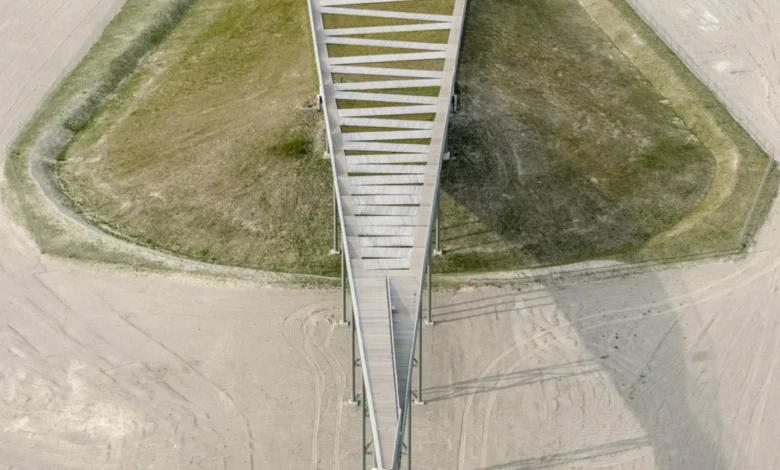
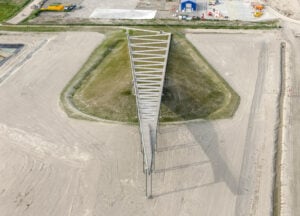
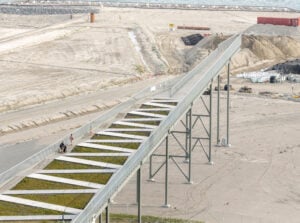
Engineering and architecture firm Arup has unveiled Pilen, a striking demountable viewpoint in Rødbyhavn, Denmark, designed to offer the public an unprecedented look at the construction of the monumental Fehmarnbelt Tunnel. Translating to "the arrow" in Danish, the structure serves as both an interactive public amenity and a monumental physical scale reference for one of Europe’s largest ongoing infrastructure endeavors. Positioned near the tunnel’s northern portal, the 217-meter-long ramped structure allows visitors to safely observe complex maritime and civil engineering works while offering sweeping views of the surrounding coastal landscape.
The Fehmarnbelt Tunnel itself represents a historic engineering milestone. Spanning 18 kilometers beneath the Baltic Sea, the underwater road-and-rail link will connect Rødbyhavn on the Danish island of Lolland with Puttgarden in northern Germany. Once operational, the subterranean corridor is projected to dramatically transform regional connectivity between Scandinavia and continental Europe. Commissioned by Femern A/S—the state-owned enterprise overseeing the construction—Pilen was conceptualized to bridge the gap between heavy industrial construction and the local community, fostering public engagement and transparency throughout the multi-year timeline.
Engineering Concept and Architectural Symbolism
The architectural and structural design of Pilen is rich in both functional purpose and symbolic meaning. Arup conceived the viewpoint to mirror the physical dimensions and directional orientation of the mega-project it surveys. Rising progressively on a zigzagging path to an elevation of 24 meters above sea level, the walkway provides panoramic vistas of the vast industrial assembly yards, dry docks, and portal works.
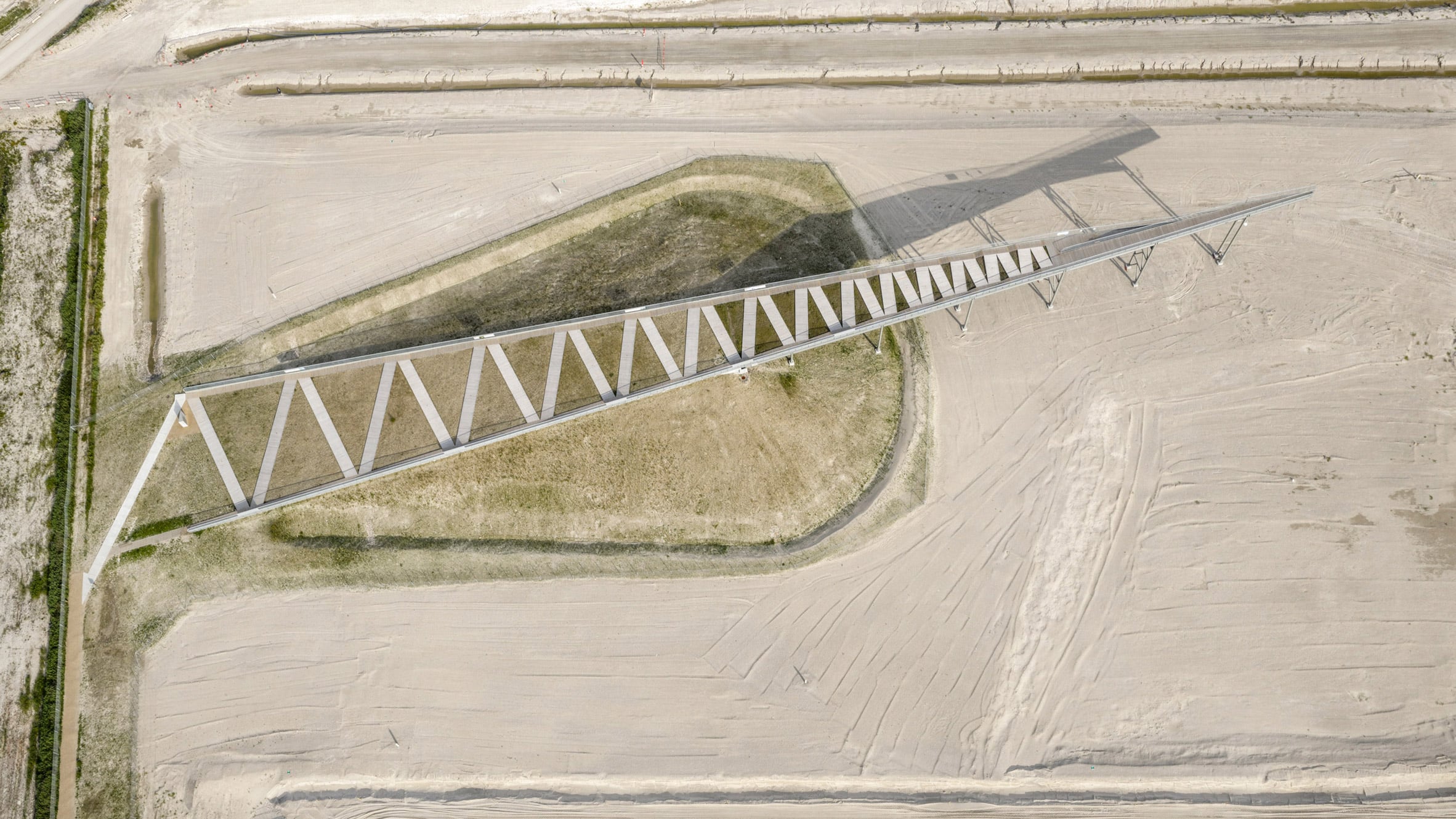
The choice of an arrow or compass needle configuration is deliberate. Project architect Kristian Winther explained that the structure’s linear geometry points directly toward the destination where the tunnel surfaces on the German side. This serves as a physical orientation device for visitors, mentally connecting the two nations separated by the Fehmarnbelt. Furthermore, the total length of the viewpoint—precisely 217 meters—was engineered to match the exact length of a single prefabricated concrete element destined to form the tunnel. By walking the length of Pilen, visitors physically experience the scale of the massive structural segments that will eventually be submerged on the seabed.
Sustainable Materiality and Circular Design
In alignment with modern environmental standards and the rigorous sustainability goals of Nordic infrastructure projects, Arup engineered Pilen with a strong focus on circularity and material reuse. Because the viewpoint is a temporary installation intended to serve only for the duration of the tunnel’s construction phase, traditional permanent construction methods were rejected.
The primary structural deck is constructed from locally sourced landfill timber and robust steel framing. The undulating walkway is flanked by natural greenery and indigenous coastal vegetation, seamlessly integrating the industrial viewing platform into the surrounding topography. Crucially, every component of the installation—including the foundations—has been designed to be fully demountable. When the Fehmarnbelt Tunnel project concludes, the materials will be dismantled and repurposed for other regional construction projects, minimizing waste and giving the structural components a functional life cycle well beyond the lifespan of the viewpoint itself.
Chronology and Progress of the Fehmarnbelt Tunnel Project
The unveiling of Pilen arrives at a crucial juncture in the chronology of the broader Fehmarnbelt fixed-link program. Conceptual discussions and preliminary feasibility studies for a permanent crossing between Denmark and Germany began decades ago, evolving into a formal state treaty signed by Denmark and Germany in 2008. Following extensive environmental impact assessments, legal challenges, and planning approvals—particularly in Germany—actual construction commenced in earnest in the early 2020s.
The construction methodology relies heavily on prefabrication. Workers are currently manufacturing 89 massive hollow concrete elements in a specially constructed factory near Rødbyhavn. These elements are systematically towed out to sea and lowered into a dredged trench across the seabed, where they are joined together to form the world’s longest immersed road and rail tunnel.
Parallel to marine works, massive land reclamation efforts have been undertaken to accommodate the support infrastructure, portal facilities, and newly created natural habitats. Just months prior to Pilen’s opening, planners announced the completion of a substantial 300,000-square-meter land reclamation scheme nearby, engineered to feature ecological ponds and native plantings, balancing industrial expansion with environmental restoration.
Economic and Geopolitical Implications
The completion of the Fehmarnbelt Tunnel, officially scheduled for 2029, carries profound economic and logistical implications for Northern Europe. Currently, travel between Hamburg, Germany, and Copenhagen, Denmark, requires either a ferry crossing or a lengthy detour via the Great Belt fixed link further north. The new corridor is expected to slash transit times dramatically, reducing the train journey between the two major metropolitan hubs to just two and a half hours, while road transit times will be cut to mere minutes.
Logistics operators, freight companies, and passenger rail networks anticipate that the fixed link will significantly boost cross-border trade, tourism, and labor mobility. By replacing maritime ferry services with a continuous, weather-independent rail and motorway connection, the project promises to reduce carbon emissions associated with long-distance freight transit, aligning with the European Union’s broader goals for sustainable Trans-European Transport Networks (TEN-T).
Community Engagement and Public Perception
Mega-infrastructure projects of this magnitude frequently encounter public skepticism, logistical friction, and concerns regarding local disruption. By commissioning installations like Pilen, Femern A/S and Arup have demonstrated a proactive approach to public relations and civic inclusion. By turning the construction zone into an accessible destination, the developers have demystified the engineering processes involved, transforming a potentially disruptive industrial site into an educational and recreational asset for the local community and international tourists alike.
Photographed extensively by architectural photographer Rasmus Hjortshøj, Pilen has already drawn widespread acclaim for its sensitive integration into the coastal landscape. As construction on the seabed advances toward its 2029 deadline, the viewpoint stands as a temporary architectural monument to human ingenuity, offering a front-row seat to one of the most ambitious civil engineering achievements of the 21st century.
Related posts: