Cloudflare Announces General Availability of Python Workers, Merging Pyodide and WebAssembly to Bring Serverless Python to the Global Edge

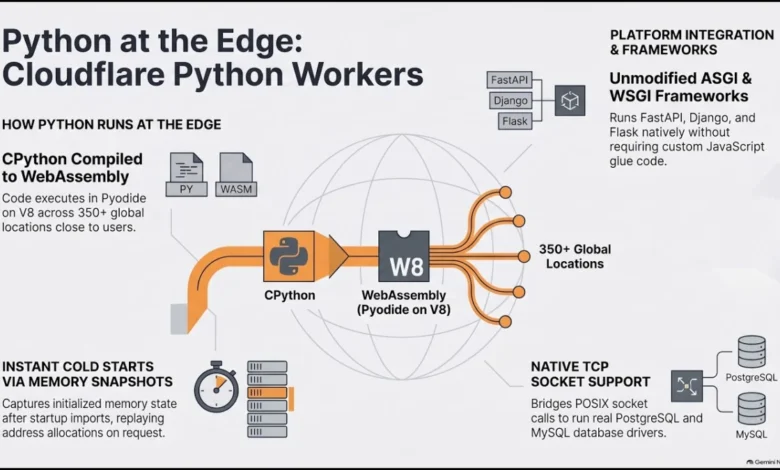
The modern architecture of web development has long wrestled with a fundamental dichotomy regarding code execution geography. Developers have traditionally been forced to choose between centralized servers located in specific availability zones—such as Virginia or Frankfurt—and client-side browser execution. Cloudflare has fundamentally altered this calculus with the general availability of Python Workers, a development that seamlessly merges the Pyodide project’s WebAssembly-compiled CPython interpreter with Cloudflare’s distributed serverless infrastructure.
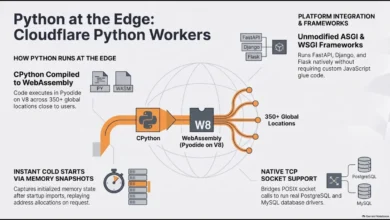
This milestone enables developers to deploy standard Python applications, including frameworks like FastAPI, Flask, and Django, directly to more than 350 cities worldwide. Instead of packaging applications within heavy Docker containers or deploying them to monolithic regional cloud instances, Python code now ships as plain files, compiled to WebAssembly, and executed inside V8 isolates directly at the network edge.
The Technological Convergence: Pyodide Meets the Edge
The genesis of Python Workers lies in the convergence of two distinct technological leaps: bringing Python into the browser via Pyodide, and bringing browser-grade V8 isolation technology into server infrastructure via Cloudflare Workers. Pyodide, initially developed at Mozilla, relies on Emscripten—a complete compiler toolchain built on Clang—to compile CPython and a host of scientific libraries into WebAssembly (Wasm).
Historically, running Python via WebAssembly was largely confined to client-side browsers or localized environments. However, Cloudflare’s architectural breakthrough, spearheaded by engineers and maintainers such as Hood Chatham, Gyeongjae (Jay) Choi, and Dominik Picheta, recontextualized this capability for server-side edge computing. By embedding the Pyodide runtime inside the WorkerD open-source runtime, Cloudflare allows Python code to execute instantly across its global network of edge nodes without the traditional overhead of container orchestration or cold starts.
Achieving general availability required overcoming monumental engineering hurdles. The most pressing challenge involved minimizing cold-start latencies and resource overhead when initializing a complete Python runtime environment. To solve this, the engineering team implemented advanced memory snapshotting technologies. Instead of bootstrapping the Python interpreter, executing top-level code, and processing import statements on every single request, the system pre-computes the startup sequence. It saves the resulting memory state, allowing new worker instances to spin up instantaneously.
Furthermore, integrating Python with edge data stores and asynchronous networking required bridging significant gaps between synchronous CPython paradigms and the asynchronous nature of the JavaScript event loop. Core maintainers worked extensively on socket integration, wiring Node.js socket APIs directly into Pyodide. This enables C-level socket system calls to function transparently, paving the way for seamless database connectivity via tools like Cloudflare’s D1 (a serverless SQLite database) and Hyperdrive (a zero-latency connection pooler for relational databases such as PostgreSQL and MySQL).
Streamlining Packaging and Upstream Ecosystems
Python packaging for WebAssembly has historically been notoriously fragile. Cross-compiling packages that contain C, C++, or Rust extensions—such as NumPy, SciPy, and various cryptographic libraries—required massive, centralized CI pipelines that routinely took hours to complete and were prone to breaking changes.
To ensure long-term stability and scalability, the Python-on-WebAssembly community drove crucial standardization efforts upstream, highlighted by PEP 783 (Emscripten Packaging) and the draft proposal PEP 818 (adding the core of the Pyodide Foreign Function Interface to Python). These initiatives empower package maintainers to natively build Pyodide-compatible wheels using standard tools like cibuildwheel and publish them directly to the Python Package Index (PyPI).
By decentralizing the build process, the burden shifts away from core maintainers, allowing thousands of Python packages to automatically support WebAssembly targets. Developers leveraging Python Workers can now manage dependencies cleanly using modern package managers like uv, packaging their applications effortlessly for edge deployment via tools like Wrangler.
Broader Industry Implications and Use Cases
The general availability of Python Workers introduces a paradigm shift for developers building serverless applications. While traditional serverless offerings like AWS Lambda allow Python execution, they remain bound to specific geographical data centers, introducing latency for international end-users. Cloudflare’s edge architecture inherently mitigates this latency by executing requests at the point of presence closest to the client.
From an architectural standpoint, Python Workers are exceptionally well-suited for I/O-bound web applications, API microservices, webhook handlers, and business logic processing. Because the edge runtime is constrained by standard memory limits (typically 128 megabytes) and short CPU execution windows on free tiers, it is not positioned to replace massive data science pipelines or heavy machine learning model training. However, for serving lightweight APIs, interacting with serverless databases like D1, reading and writing to S3-compatible R2 object storage without egress fees, and routing web traffic, the platform offers unprecedented performance and cost efficiency.
The general availability tier also includes robust safeguards, such as graceful signal delivery when CPU time limits are reached. This ensures that Python’s finally blocks, context managers, and file buffers execute correctly even when a worker is forcibly interrupted, preventing memory corruption and dangling database locks.
Conclusion and Future Outlook
The launch of Python Workers marks a maturity phase for WebAssembly as a viable, production-grade server-side execution runtime. By bridging the gap between CPython and distributed edge infrastructure, Cloudflare has expanded the boundaries of where and how Python code runs.
As the ecosystem around PEP 783 and upstream WebAssembly support continues to solidify, developers can expect an expanding catalog of natively supported packages and smoother integration pipelines. For the millions of Python developers worldwide, building high-performance, globally distributed applications has never been more accessible.