Python Code Now Runs natively on Cloudflare Workers Worldwide via WebAssembly and Pyodide

The traditional paradigms of cloud computing and server architecture have long forced developers into a geographical compromise: hosting applications on centralized servers located in distant data centers, such as Northern Virginia or Frankfurt, resulting in latency for end-users scattered across the globe. However, a major technological convergence involving WebAssembly, Pyodide, and edge infrastructure has officially eliminated this constraint. Cloudflare has announced the general availability of Python Workers, enabling developers to ship standard Python frameworks like FastAPI, Flask, and Django directly to more than 350 edge locations worldwide.
This milestone represents the culmination of years of engineering collaboration between core maintainers of the Pyodide project and Cloudflare’s runtime architecture teams. By marrying Pyodide—a project that successfully brought CPython and the scientific Python ecosystem into WebAssembly-powered browser environments—with Cloudflare’s globally distributed serverless edge runtime, Python has transformed from a purely server-bound language into a globally distributed edge citizen.
The Architectural Foundation: From Browser Sandbox to Global Serverless Edge
To understand the significance of Python Workers reaching general availability, one must examine how the underlying technologies evolved. Pyodide was originally conceived as a way to run Python inside web browsers via WebAssembly and Emscripten, effectively treating the browser as a secure, sandboxed client-side execution environment. Conversely, Cloudflare’s edge architecture reimagined the server paradigm by distributing V8-powered worker runtimes to hundreds of points of presence (PoPs) worldwide, bringing compute resources exceptionally close to the end-user.
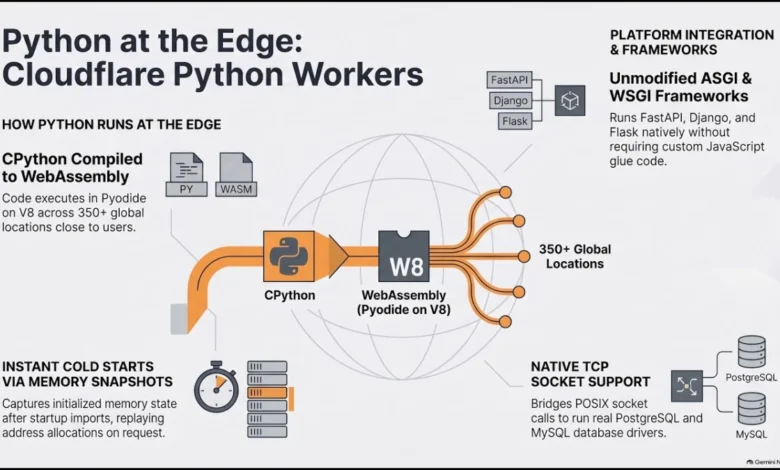
When combined, these two innovations create a powerful mechanism: CPython compiled to WebAssembly running inside V8 instances distributed across Cloudflare’s global network. Developers are no longer required to rewrite their business logic in JavaScript or TypeScript to leverage edge computing. Instead, applications can be authored in plain Python files, packaged alongside their dependencies, and deployed globally with a single command.
The journey toward general availability required surmounting substantial technical obstacles. Unlike JavaScript, which is native to the V8 runtime, running CPython via WebAssembly requires a robust system translation layer. Emscripten acts as a compiler toolchain targeting WebAssembly, translating standard operating system calls and file system operations into equivalents that can be executed safely within a JavaScript-driven edge runtime.
Overcoming Packaging Complexities and the Role of PEPs
Historically, one of the most formidable hurdles for Python on WebAssembly was dependency management and cross-compilation. Packages containing C, C++Fortran, or Rust extensions—such as NumPy, SciPy, and various cryptographic libraries—could not be easily installed via standard package managers like pip. Previously, projects like Pyodide had to cross-compile and build hundreds of binary wheels within their own continuous integration pipelines, resulting in prolonged build times and frequent pipeline failures due to the fragile nature of multi-platform compilation.
This bottleneck prompted crucial advancements in Python Enhancement Proposals (PEPs) spearheaded by core contributors. Notably, PEP 783 established a standardized framework for Emscripten packaging, empowering upstream package maintainers to build Pyodide-compatible wheels directly within their own repositories using familiar tools like cibuildwheel. By decentralizing the build process and shifting the responsibility of WebAssembly packaging back to individual maintainers, the Python-on-WebAssembly ecosystem has achieved greater scalability.
Additionally, proposals such as the integration of the Pyodide foreign function interface (FFI) core aim to streamline how Python interacts with underlying JavaScript environments. Because functionality within modern web runtimes flows through JavaScript just as traditional operating system functionality flows through C, establishing a standardized, upstream-supported FFI is critical for long-term stability and feature parity.
Seamless Integration with Edge Data and Storage Services
Python Workers do not operate in a vacuum; their utility is vastly amplified by integration with Cloudflare’s broader developer platform. Modern applications require robust database and storage layers, and deploying a Python application to the edge introduces challenges if it must communicate with a centralized database located on another continent.
To resolve this, Python Workers integrate natively with Cloudflare’s distributed storage and database ecosystem. This includes D1, a globally distributed SQLite database service that brings relational data management directly to the edge. SQLite’s compact footprint, combined with its high performance, makes it an ideal match for edge-executed Python code. Furthermore, TCP socket support built into Pyodide enables workers to establish outbound connections, facilitating integration with external relational databases through services like Hyperdrive, which maintains connection pools across global edge locations to optimize read and write latencies.
For object storage, integration with R2—Cloudflare’s S3-compatible object storage solution characterized by the absence of egress fees—allows Python applications to read and write large files, datasets, and media assets without incurring prohibitive bandwidth costs. Additional platform components, such as Cloudflare Queues for asynchronous task processing and Workers AI for localized machine learning inference, provide developers with a comprehensive suite of tools to construct full-stack Python applications.
Cold Starts, Memory Constraints, and Execution Models
Despite the flexibility offered by Python Workers, developers must navigate architectural limitations inherent to edge computing environments. Unlike traditional virtual private servers or containerized Kubernetes clusters with dedicated resources, edge workers operate under strict resource profiles. Standard worker instances are bounded by memory limits—typically starting around 128 megabytes—and CPU time limits, such as a 10-millisecond execution limit for free tiers and extended caps for paid subscriptions.
To mitigate latency penalties associated with application initialization, Cloudflare engineers implemented advanced memory snapshotting technologies. In standard Python runtimes, top-level code execution—including module imports, syntax parsing, and bootstrapping—occurs during every cold start. Memory snapshots allow the runtime to pre-execute this initialization phase, capturing the memory state of the interpreter after imports and setup have completed. When a new edge request arrives, the worker restores the pre-computed memory state almost instantaneously, bypassing the traditional startup delay.
This optimization required addressing deep technical complexities within CPython and Emscripten, particularly concerning memory layouts, dynamic library relocations, and garbage collection states. By intercepting memory allocation routines and ensuring that dynamic libraries reload at consistent virtual memory addresses, the runtime can safely restore snapshots without breaking internal pointers or crashing the interpreter.
Practical Implications and Industry Adoption
The general availability of Python Workers lowers the barrier to entry for developers seeking to harness the performance and low latency of edge infrastructure without abandoning their preferred programming language. Organizations running standard API architectures built on frameworks like FastAPI can package their applications with modern tooling, leverage dependency management via uv, and deploy globally with minimal friction.
While compute-intensive data science workloads involving heavy matrix manipulations or massive Pandas data frames remain better suited for traditional centralized computing clusters or client-side browser execution (such as JupyterLite), I/O-bound web applications, microservices, and business logic handlers are exceptionally well-positioned to benefit from the edge.
As the WebAssembly ecosystem continues to mature and core Python development increasingly acknowledges non-traditional execution targets, initiatives like Python Workers signal a shift in how cloud architectures are conceptualized. By bringing the server to the user, the industry has taken another decisive step toward a truly distributed, language-agnostic computing future.