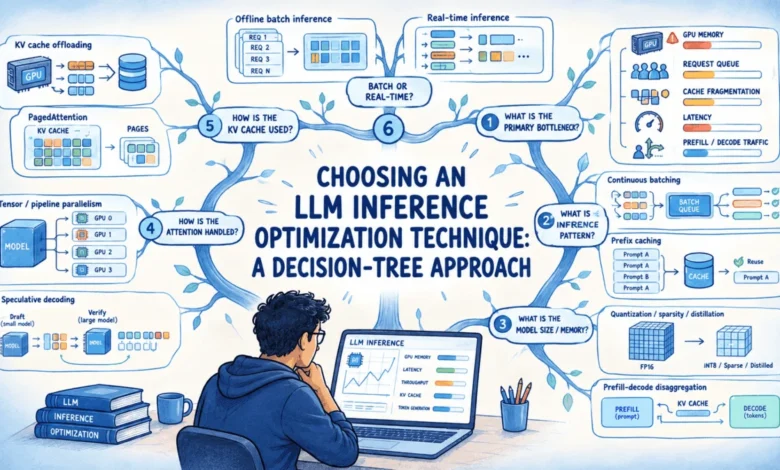
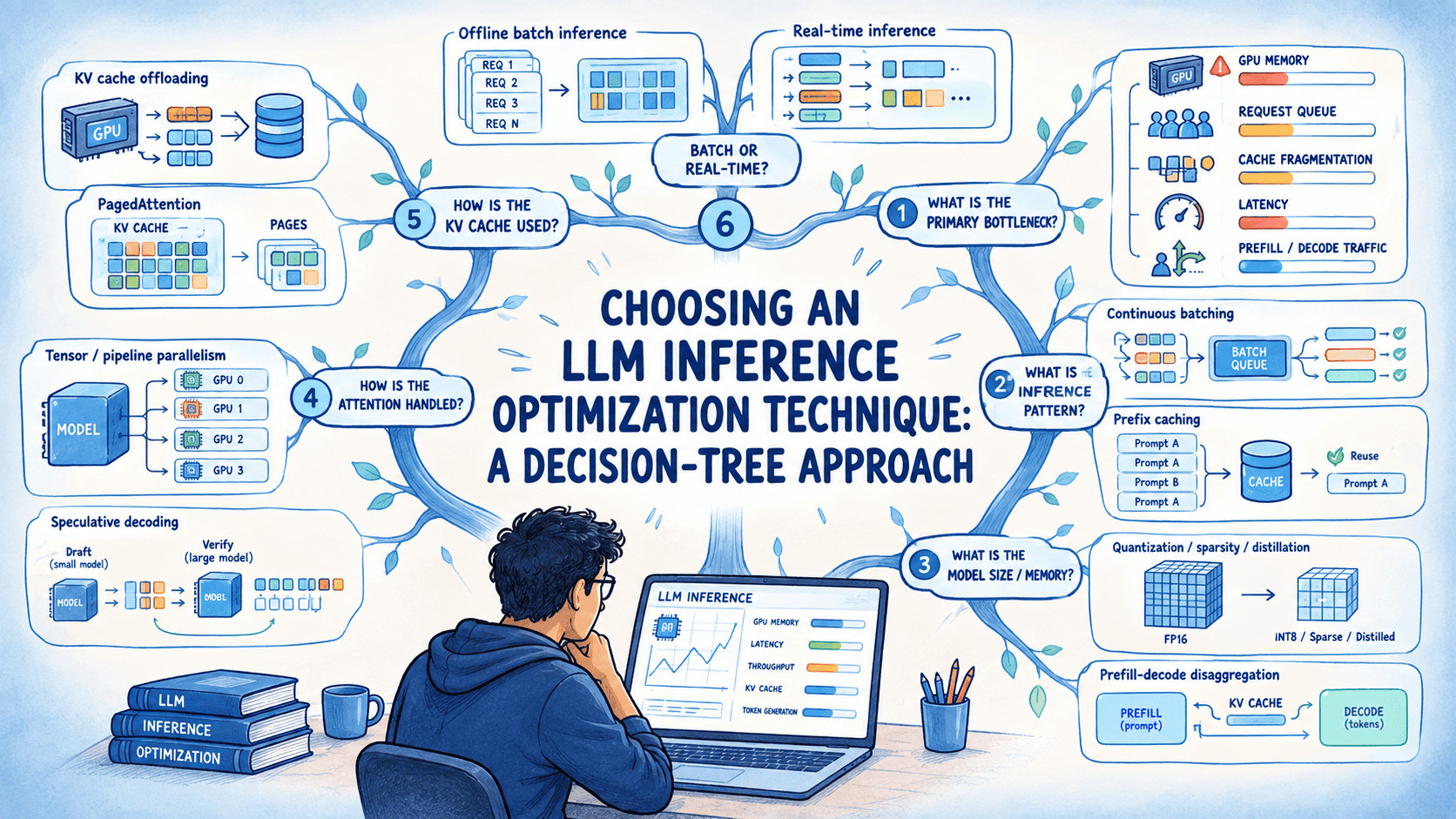
As Large Language Models (LLMs) transition from experimental research projects to core infrastructure in enterprise software, the primary challenge for engineering teams has shifted from model training to efficient inference. The rapid adoption of generative AI has highlighted a critical technical reality: as traffic scales, the cost and latency associated with LLM inference can become prohibitive. When requests queue behind long-running generation tasks, GPU memory becomes saturated with cached attention states, and hardware utilization plateaus due to memory-bound operations, the necessity for structured optimization becomes paramount. By utilizing a systematic six-question decision tree, developers can match specific optimization techniques to the actual bottlenecks within their workloads, avoiding the common pitfall of applying complex, high-overhead solutions to problems that do not require them.
The Mechanics of LLM Bottlenecks
To understand the necessity of these optimizations, one must first recognize the underlying hardware constraints. Modern LLM serving is rarely compute-bound in the traditional sense; rather, it is often memory-bound. The process of generating tokens requires moving the model parameters and the Key-Value (KV) cache from high-bandwidth memory (HBM) to the compute units on the GPU. Because the number of parameters in state-of-the-art models (such as Llama 3 or Mistral) has grown significantly, the sheer volume of data transfer often exceeds the bandwidth capacity of the hardware.
Historically, the industry approached this by simply throwing more compute at the problem. However, as of late 2024 and early 2025, data center constraints and the rising costs of H100 and B200 GPU clusters have forced a shift toward efficiency. Infrastructure engineers are now categorizing workloads based on three specific vectors: memory footprint, computational intensity, and request scheduling dynamics.
A Chronological Evolution of Inference Optimization
The trajectory of inference optimization has evolved in three distinct waves. The first wave, occurring between 2020 and 2022, focused primarily on model compression. Techniques like quantization—reducing the precision of weights from FP16 to INT8 or INT4—became the standard for fitting large models onto consumer or mid-tier enterprise hardware.
The second wave, emerging around 2023, shifted the focus to the serving stack. With the introduction of projects like vLLM and TensorRT-LLM, developers gained access to PagedAttention and continuous batching. These innovations addressed the "memory fragmentation" problem, where the KV cache—a history of tokens generated during an inference session—would consume vast amounts of contiguous memory, often leaving 30% to 50% of allocated GPU space idle.
The third and current wave involves architectural decoupling. Techniques such as prefill-decode disaggregation and speculative decoding represent a sophisticated attempt to treat the "prefill" (processing the prompt) and "decode" (generating the tokens) phases as two distinct computational problems. This represents a significant departure from monolithic inference engines.
The Six-Question Decision Framework
To navigate the current landscape, engineering leads should apply the following diagnostic framework to their production environments.
1. Is the model size the primary constraint?
If a model cannot fit into the available VRAM, or if inference is consistently sluggish even when processing a single request, the issue is model-level. In this case, quantization, sparsity, or knowledge distillation are the correct starting points. By compressing the model, one effectively increases the headroom for the KV cache, which is the prerequisite for scaling batch sizes.
2. Is there high prompt redundancy?
Many modern applications, particularly those utilizing Retrieval-Augmented Generation (RAG) or complex agentic workflows, repeatedly feed the same system prompts or document context to the model. Prefix caching allows the inference engine to store the KV cache for these static sequences. By skipping the recomputation of these tokens, systems can realize latency improvements of 2x to 5x for repetitive tasks.
3. Does your traffic involve variable output lengths?
In standard batching, a long-form writing request and a brief classification request would be coupled in a single batch, forcing the system to wait for the long request to finish. Continuous batching solves this by allowing finished requests to exit the batch immediately and new requests to enter, ensuring the GPU is never idle while waiting for stragglers.
4. Is memory fragmentation limiting throughput?
If the system shows sufficient free memory but refuses to increase batch sizes, the issue is likely fragmentation. PagedAttention—which mimics the virtual memory paging used in operating systems—allows the KV cache to be stored in non-contiguous memory blocks. This is arguably the most impactful "default" setting for modern high-traffic inference.
5. Is per-token latency the critical success metric?
For user-facing chatbots, the "Time to First Token" and the rate of subsequent token streaming are paramount. Speculative decoding, which uses a smaller, faster "draft" model to guess tokens that are then verified in parallel by the primary model, can drastically reduce user-perceived latency. This is particularly effective when the primary model is highly accurate but computationally expensive.
6. Does your scale justify architectural disaggregation?
For massive, high-throughput systems, the contention between prefill and decode phases can cause system-wide instability. Disaggregation involves routing prompts to specialized "prefill" nodes and passing the resulting KV cache to "decode" nodes. This is an advanced optimization reserved for massive scale; it adds significant complexity, including network overhead and inter-node synchronization requirements.
Quantitative Implications and Industry Feedback
Industry benchmarks indicate that applying the correct optimization can result in a 300% to 600% increase in effective throughput. For instance, according to recent reports from infrastructure-focused firms like Modular and various contributors to the vLLM project, the transition from static to continuous batching combined with PagedAttention has become the industry benchmark for reducing the total cost of ownership (TCO) per request.
However, industry experts caution against "optimization fatigue." There is a recurring scenario where engineering teams implement too many layers of optimization—such as combining speculative decoding with heavy quantization—which can lead to diminishing returns or, in rare cases, degradation in model output quality. A recurring piece of advice from major cloud service providers (CSPs) is to profile the workload using tools like NVIDIA Nsight Systems to identify whether the bottleneck is truly the compute, the HBM bandwidth, or the network fabric connecting the GPU nodes.
Broader Impact on AI Adoption
The shift toward granular inference optimization has profound implications for the accessibility of generative AI. By reducing the hardware requirements for large-scale deployments, these techniques enable smaller organizations to deploy sophisticated models that were previously limited to companies with massive capital expenditure budgets.
Furthermore, as models continue to grow in context window length—now reaching into the millions of tokens—the management of the KV cache has become the single most important factor in enterprise LLM viability. The ability to cache prefixes and efficiently manage memory for long-context windows is no longer a "nice-to-have" feature; it is the fundamental gatekeeper for any enterprise application relying on RAG or complex document analysis.
Conclusion: The Path Forward
In summary, the path to efficient LLM inference is not paved with a single "silver bullet" technology. Instead, it requires a diagnostic approach that matches the specific nature of the traffic to the appropriate architectural remedy.
Engineers should prioritize the following sequence:
- Model Fit: Ensure the model fits with room for the cache.
- Batching Dynamics: Implement continuous batching and PagedAttention as a baseline.
- Contextual Efficiency: Leverage prefix caching for repetitive prompt structures.
- Latency Tuning: Apply speculative decoding only if per-user latency targets remain unmet.
- Architectural Scaling: Reserve disaggregation for only the most massive, highly distributed production environments.
By adhering to this structured approach, organizations can maximize the performance of their models while keeping operational costs within sustainable limits, ultimately ensuring that the promise of generative AI is matched by the efficiency of its execution.