The Death of the Button: Why the Future of Web Design Is Moving Beyond Interfaces

The digital landscape is undergoing a structural transformation that threatens to render decades of established user experience (UX) conventions obsolete. Since the commercialization of the graphical user interface (GUI) by foundational systems like the Xerox Star and its subsequent popularization by the Apple Macintosh, software has relied heavily on point-and-click interactions. For more than forty years, digital navigation has required users to master a labyrinth of menus, range sliders, multi-step forms, cookie consent banners, and a multitude of browser tabs just to cross-reference basic information. This paradigm forced individuals to spend more time managing software mechanics than actually achieving their real-world objectives. Today, advances in artificial intelligence and large language models are officially dismantling this historical contract, ushering in an era of Intent-Driven Design where human goals are captured and executed invisibly in the background.
The Chronology of Digital Friction: From Command Lines to Intent-Driven Systems
To understand the magnitude of the current shift, it is necessary to trace the evolution of human-computer interaction (HCI). In the 1970s and 1980s, the transition from command-line interfaces to graphical user interfaces democratized computing by replacing text inputs with visual metaphors like desktops, folders, and clickable buttons. Throughout the 1990s and 2000s, the commercial web expanded this philosophy, converting static web pages into highly interactive digital storefronts and applications.

However, this commercial expansion created a culture of maximized digital friction. Companies optimized their software for metrics such as time-on-site, click-through rates, and page views, inadvertently incentivizing complex multi-step funnels that required users to act as manual data-entry clerks. By the mid-2010s, industry critics began pushing back against this mechanical burden. Visionaries like Golden Krishna published foundational critiques such as The Best Interface Is No Interface, arguing that glowing rectangles and arbitrary buttons were often symptoms of lazy design rather than optimal solutions. Concurrently, Don Norman’s human-centered design principles emphasized reducing cognitive load. Despite these theoretical milestones, the fundamental architecture of the web remained point-and-click-based—until the widespread maturation of generative artificial intelligence and autonomous agent workflows in the mid-2020s.
Deconstructing the Traditional 10-Click Workflow
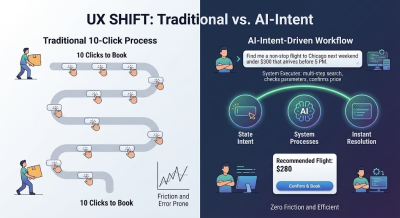
The contrast between legacy design and modern intent-driven architecture is most apparent in routine digital tasks, such as booking travel, conducting research, or managing personal productivity. In a traditional flight-booking scenario, a user is subjected to a hyper-interactive workflow: opening a browser, navigating to an aggregator, inputting departure and destination airports via dropdown menus, selecting calendar dates, applying filters for stops and luggage, sorting through dozens of dynamic pricing tables, dismissing promotional pop-ups, and finally proceeding through a multi-page checkout process.
This model relies on a passive computational container where the human acts as the primary orchestrator, manually executing every micro-step. Intent-driven design fundamentally inverts this relationship. Instead of navigating a mechanical series of menus, the user expresses a high-level outcome in natural language—such as requesting a non-stop flight under a specific budget that arrives by a designated time. The underlying software interprets this intent, executes parallelized search queries, filters the parameters across multiple databases, and presents a single, actionable resolution. The traditional ten-click process collapses into a single intent outcome.
Industry Examples: Platforms Pioneering the Shift
This philosophy is no longer confined to academic laboratories or speculative technology roadmaps; it is actively reshaping prominent web platforms across search, development, and productivity.
1. Perplexity AI and the Elimination of Open Tabs
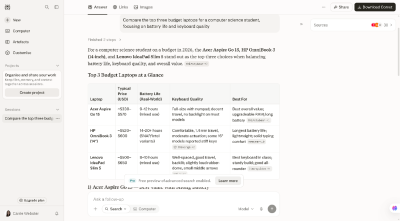
Traditional search engines were historically engineered as directories. Users entered keywords, and interfaces responded with pages of blue links, leaving the cognitive labor of opening multiple tabs, evaluating sources, and synthesizing data to the user. Platforms like Perplexity AI bypass this friction by synthesizing direct, context-aware answers. By aggregating multiple sources instantly and presenting structured summaries—such as comparative tables for consumer electronics—these tools eliminate the need for manual tab management.
2. Vercel v0 and Generative UI Development
For decades, web design and development required manual layout construction using specialized vector tools like Figma or drag-and-drop web builders. Professionals spent hours positioning rectangles, defining hexadecimal color codes, and writing cascading style sheets (CSS). Modern generative environments, such as Vercel v0, allow users to input natural language descriptions of desired dashboard layouts or software components. The system dynamically renders functional code and interactive user interfaces on the fly, transforming abstract intent into working digital infrastructure without manual layout manipulation.
3. Goblin.tools and Micro-Task Automation
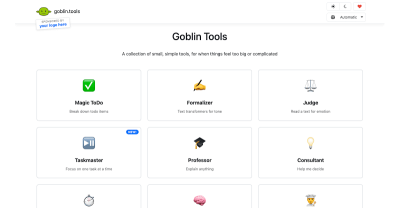
Productivity software has traditionally demanded significant administrative overhead, requiring users to manually construct task hierarchies, assign priority tags, and manage Kanban boards. Single-page AI suites like Goblin.tools cater to cognitive accessibility by allowing users to input an overwhelming objective—such as preparing for a job interview or cleaning a home—and automatically breaking it down into granular, manageable checklists. This reduces executive dysfunction and shifts the administrative burden from the human to the algorithm.
Core Pillars of Intent-Driven Web Architecture
As software transitions away from rigid menus and sidebars, user experience designers are establishing a new framework built upon three foundational pillars:
| Pillar | Traditional UX Approach | Intent-Driven UX Approach |
|---|---|---|
| User Input | Micro-actions (Clicks, dropdowns, toggles) | High-level goals (Natural language, context, behavioral patterns) |
| Interface State | Static layouts (Universal designs for all users) | Generative UI (Dynamic components rendered on the fly) |
| Task Execution | Manual execution orchestrated by the human | Autonomous execution managed by background AI agents |
Contextual and Ambient Inputs
Rather than waiting for explicit keystrokes or menu selections, modern systems leverage environmental metadata—including device state, geographic location, and historical interaction habits—to anticipate user requirements proactively. This aligns with modern interface guidelines established by platform leaders like Apple, which emphasize ambient computing and contextual responsiveness.
Generative User Interfaces
In legacy web design, digital layouts were static. Every visitor to an e-commerce platform encountered the exact same navigational hierarchy, regardless of whether they required immediate customer support or post-purchase tracking. Under the emerging paradigm documented by organizations like the Nielsen Norman Group, computing is shifting from command-based interaction to outcome-specification. This enables Generative UI, where interface components are dynamically summoned to fulfill an immediate task and automatically recede once the objective is achieved.
Autonomous Execution and Reversibility
Traditional software design relies heavily on preventative friction, frequently interrupting users with confirmation dialog boxes and warning modals. Intent-driven interfaces replace these intrusive safeguards with robust, frictionless reversibility. Because autonomous agents execute actions in the background, platforms prioritize transparent audit logs, clear revision prompts, and prominent "Undo" mechanics, aligning with established usability heuristics regarding user control and error recovery.
Ethical Implications, Risks, and the Black Box Problem
Despite the clear efficiency gains of removing interface friction, the transition to intent-driven web design introduces significant ethical, psychological, and technical challenges for product teams.
The Illusion of Control and Manipulative Defaults
When software makes autonomous decisions on behalf of a user, systems risk becoming overly paternalistic or intrusive. Research groups in human-computer interaction at institutions like Stanford University emphasize that automation must maintain strict operational boundaries to prevent user alienation. Furthermore, ethical frameworks from organizations such as the Center for Humane Technology warn that inferred intent can be exploited through dark patterns or manipulative defaults. Designers are tasked with a delicate equilibrium: automating routine, low-stakes execution while mandating explicit human confirmation for high-stakes actions, such as financial transactions, public data dissemination, or privacy modifications.
Troubleshooting the Black Box Dilemma
In traditional graphical interfaces, unexpected outcomes are typically easy to diagnose; a user can review selected filters, check input fields, or verify date ranges. Intent-driven systems complicate troubleshooting because the underlying reasoning of an autonomous agent is often obscured. To combat this black box phenomenon, guidelines from initiatives like the Google People + AI Research (PAIR) Guidebook advocate for transparent feedback loops. Systems must explicitly articulate their internal interpretation—such as displaying the exact parameters of an ongoing background query—allowing users to calibrate trust and correct misinterpretations instantly.
Implications for the UX Design Profession
The evolution toward intent-driven experiences forces a fundamental re-evaluation of the professional competencies required of UX designers. The discipline is shifting away from the creation of static buttons, rigid wireframes, and fixed design systems toward the mapping of dynamic conversational paths, ambient feedback loops, and generative component libraries. Designers must become architects of behavior and trust, ensuring that screenless, agent-driven applications remain intuitive, ethical, and aligned with human values.
Ultimately, this structural pivot redefines how digital success is measured. For decades, the technology sector evaluated products through engagement metrics designed to maximize user captivity. By embracing the philosophy that the ultimate goal of design is to eliminate unnecessary friction, modern web architecture champions a different standard: evaluating software not by the visual complexity of its interface, but by its capacity to solve problems efficiently and recede seamlessly into the background.