Amazon Web Services Expands Generative AI Offerings with Launch of WhisperX Deep Learning Container on SageMaker AI

Enterprises handling large volumes of spoken audio have long struggled with the limitations of generic speech-to-text transcription services. Standard automated speech recognition tools typically produce utterance-level timestamps that can lag by several seconds, while entirely failing to attribute statements to specific speakers. In critical environments such as contact centers, high-stakes legal depositions, boardrooms, and broadcast media production, these deficiencies undermine compliance reviews, automated content redaction, and large-scale data analytics.
To bridge this operational gap, Amazon Web Services (AWS) has announced the official release of the WhisperX Deep Learning Container (DLC) for Amazon SageMaker AI. This purpose-built image integrates OpenAI’s robust Whisper model architecture with advanced technological wrappers, including batched inference, wav2vec2 forced alignment for precise per-word timestamping, and sophisticated speaker diarization. By packaging these capabilities into a production-ready, GPU-accelerated container, AWS aims to provide developers and data engineers with a seamless deployment pathway for structured, highly accurate audio transcription workloads.
The launch forms a core component of a broader AWS multimodal series highlighting specialized deep learning containers. Alongside solutions like vLLM-Omni for text-to-speech, image, and video processing, as well as llama.cpp, the WhisperX DLC specifically addresses the acute need for enterprise-grade speech recognition that meets stringent regulatory and operational demands.
Understanding the Technical Anatomy of WhisperX
OpenAI’s Whisper family of models has achieved widespread acclaim for its multilingual accuracy and resilience against acoustic noise. However, out-of-the-box Whisper outputs are primarily segmented at the phrase level, lacking the granular temporal precision required for automated video captioning or precise audio redaction. Furthermore, standard implementations do not natively distinguish between multiple speakers participating in a conversation.
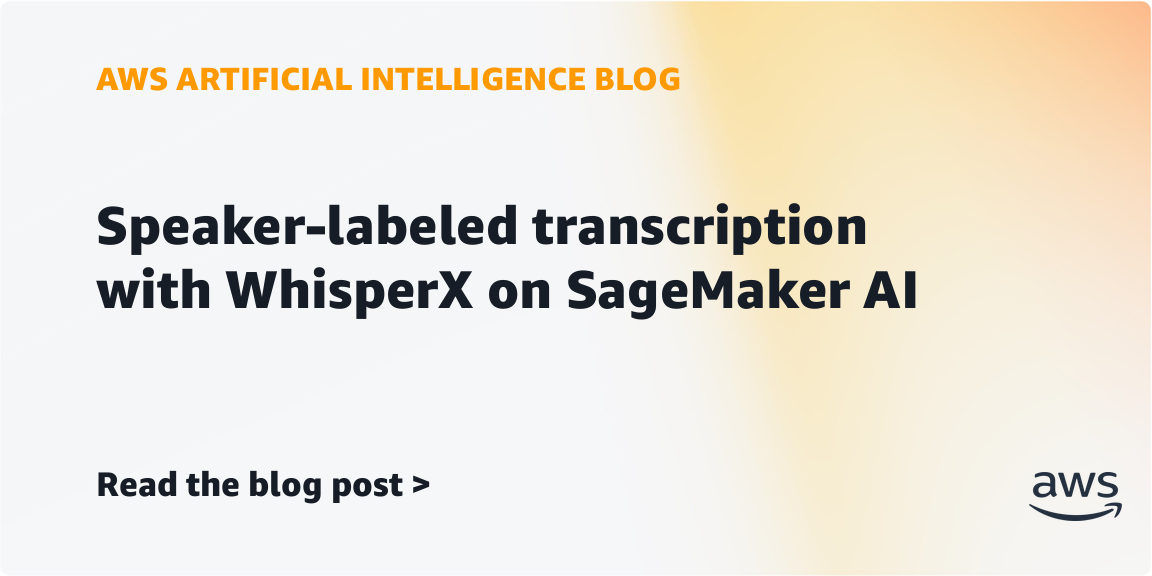
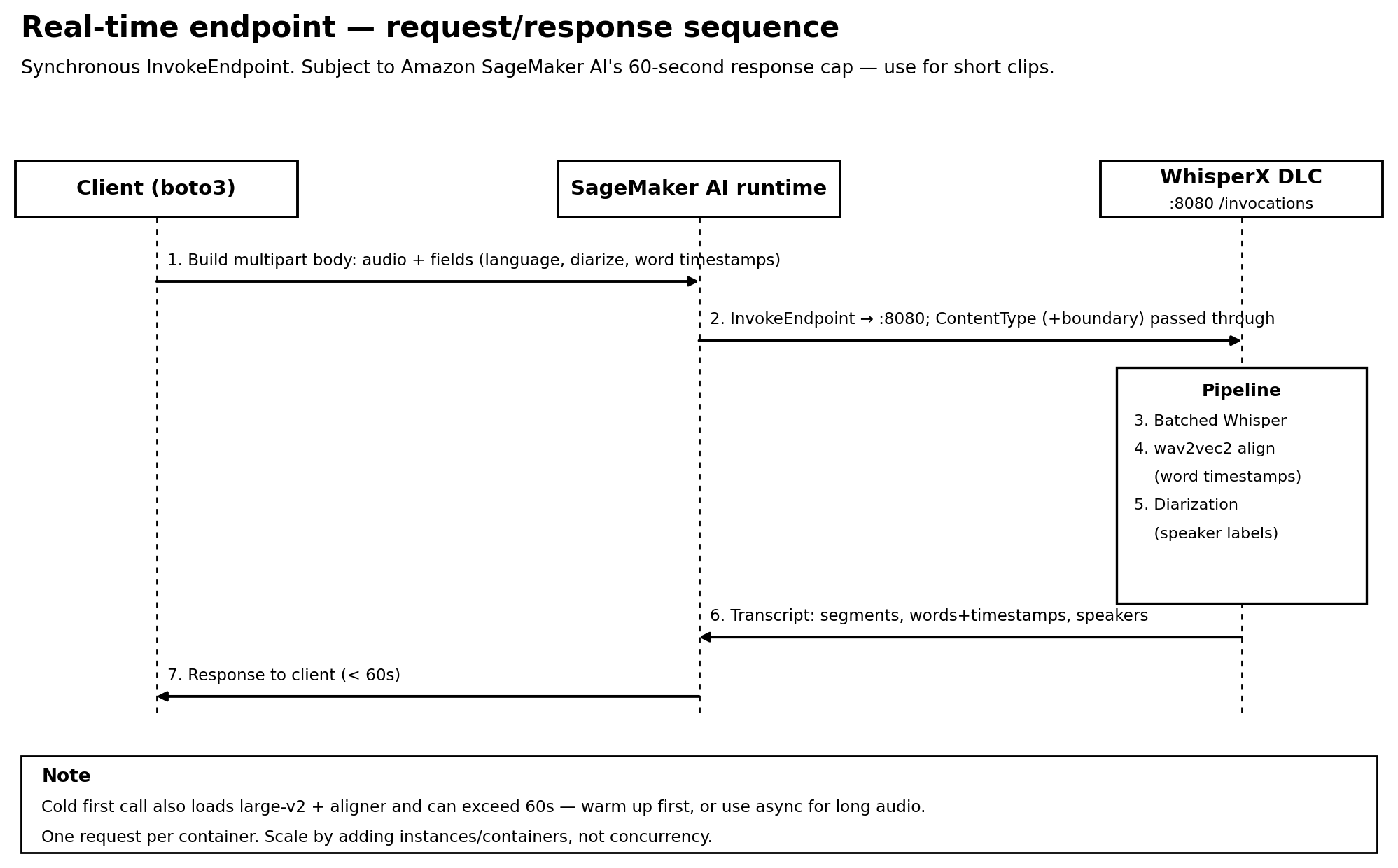
WhisperX resolves these structural shortcomings through a multi-stage pipeline. First, it applies voice-activity detection (VAD) alongside batched inference to accelerate processing speeds significantly. Second, it incorporates wav2vec2 forced alignment models to pinpoint word boundaries with millisecond precision, generating subtitle-ready data formats such as SubRip Subtitle (SRT) and Web Video Text Tracks (VTT). Finally, it executes speaker diarization algorithms to isolate individual voices and assign distinct labels—such as Speaker 01 or Speaker 02—throughout the duration of the audio file.
By encapsulating these complex dependencies, model weights, and alignment libraries within a single pre-built Docker container, AWS removes the heavy lifting traditionally associated with managing specialized machine learning environments. The container operates smoothly without requiring external authorization tokens, adhering strictly to the standard Amazon SageMaker AI serving contract.
Real-Time Versus Asynchronous Deployment Paradigms
Organizations adopting the WhisperX DLC on Amazon SageMaker AI can select between two distinct endpoint architectures depending on their specific application requirements: real-time endpoints and asynchronous endpoints.
Real-time endpoints are tailored for short, interactive audio clips that must return analytical results instantly. Operating synchronously, these endpoints process requests within Amazon SageMaker AI’s strict 60-second response window. Developers transmit audio payloads packaged as multipart/form-data directly to the endpoint, which executes the transcription pipeline and returns a verbose JSON response containing word-level timestamps and speaker tags.
Conversely, asynchronous endpoints are engineered to handle high-volume batch processing and long-form audio files that exceed standard timeout constraints. Utilizing Amazon Simple Storage Service (Amazon S3) as an intermediary broker, asynchronous endpoints allow clients to submit jobs by reference, retrieve immediate task references, and poll for completion at scale. This architecture effectively removes the 60-second ceiling, making it the preferred deployment pattern for multi-hour depositions, conference recordings, and broadcast archives. Additionally, asynchronous endpoints support scaling down to zero compute instances during idle periods, yielding substantial cost efficiencies for enterprise budgets.
Performance Benchmarks and Real-World Stress Testing
To demonstrate the efficacy of the WhisperX DLC under challenging acoustic conditions, AWS engineers utilized a public-domain recording of air traffic control (ATC) communications from US Airways Flight 1549—the historic 2009 emergency landing famously known as the "Miracle on the Hudson."
The recording presents severe testing criteria, characterized by heavy background noise, radio compression artifacts, overlapping dialogue, and rapid exchanges involving complex aeronautical callsigns and frequency readouts. When applied to a 40-second segment evaluated via a real-time endpoint running on an ml.g4dn.xlarge GPU instance, the WhisperX DLC successfully delineated rapid interactions between air traffic controllers and flight crew. Similarly, processing the full three-minute audio stream through an asynchronous endpoint deployed on an ml.g5.2xlarge instance yielded a comprehensively structured, diarized transcript complete with exact word boundaries.
These results underscore the model’s robustness in mission-critical environments where audio quality is suboptimal. In contact centers, managers can leverage these precise metrics to evaluate script adherence, calculate agent talk-to-listen ratios, and execute automated sentiment analysis. In legal, financial, and healthcare sectors, speaker-labeled documentation directly streamlines compliance audits, electronic discovery procedures, and medical charting workflows.
Operational Requirements and Production Considerations
Successful deployment of the WhisperX DLC on Amazon SageMaker AI requires careful attention to specific infrastructure configurations. Engineers must explicitly designate the Inference AMI version as al2-ami-sagemaker-inference-gpu-3-1 when provisioning GPU variants utilizing CUDA 12.8 DLCs. Omitting this explicit pin results in container initialization failures characterized by zero-log CannotStartContainerError exceptions.
Furthermore, because deep learning weights load lazily into GPU memory upon container startup, operators are advised to configure generous health-check timeouts—such as 900 to 1200 seconds—to prevent premature termination during the initial boot sequence. For asynchronous workloads, maintaining a concurrency setting of one request per container (MaxConcurrentInvocationsPerInstance=1) ensures optimal memory allocation and prevents resource contention during intensive diarization routines.
Cost management remains a vital consideration for cloud administrators. GPU-backed endpoints incur continuous hourly charges while active. Consequently, production pipelines must incorporate automated teardown scripts or leverage asynchronous scale-to-zero capabilities to decommission unused model resources promptly.
Broader Industry Implications and Future Outlook
The introduction of the WhisperX Deep Learning Container reflects a broader industry shift toward specialized, turnkey generative AI components that solve verticalized enterprise pain points. Rather than forcing organizations to construct custom machine learning pipelines from fragmented open-source repositories, cloud providers are increasingly delivering pre-integrated, hardware-optimized architectures.
By democratizing access to word-level alignment and speaker diarization at scale, AWS is positioning Amazon SageMaker AI as a central hub for multimodal data processing. As enterprises face mounting pressure to extract actionable intelligence from unstructured audio repositories, tools that bridge the gap between raw sound and structured, searchable data will become indispensable components of modern digital infrastructure.
Comprehensive documentation, deployment guides, and fully runnable JupyterLab notebooks detailing the end-to-end integration of the WhisperX DLC are currently available through the official AWS Samples GitHub repository. Developers can immediately deploy these assets within Amazon SageMaker AI Studio to evaluate transcription performance against proprietary organizational datasets.