MOS Architects Unveils Egg-Shaped Aluminum Pavilion at Art Omi, Blending Pre-Modern Craft and Mid-Century Futurism in Upstate New York

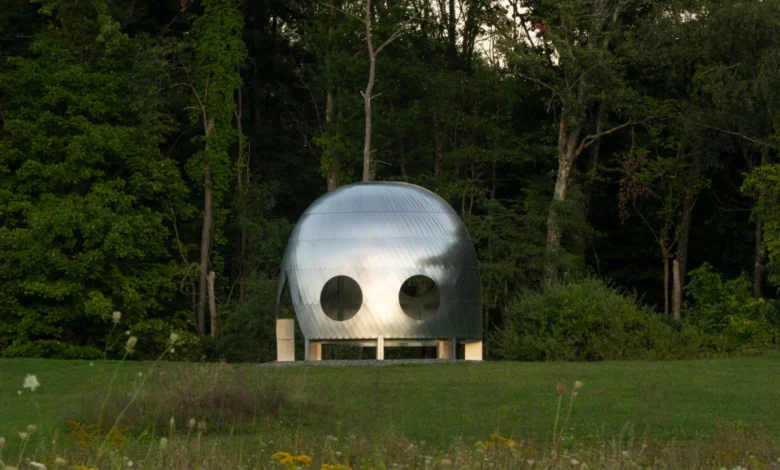
Architecture as cultural critique and experimental form has found a new canvas in the rolling landscape of Upstate New York. MOS Architects, a prominent United States-based studio recognized for its boundary-pushing conceptual designs and theoretical writings, has completed its latest installation at the Art Omi arts center. Titled A Dome with Four Oculi, the structure is an egg-shaped, stilt-mounted pavilion wrapped entirely in overlapping aluminum shingles. Designed to offer visitors a place of shelter and rest, the project bridges ancient craftsmanship traditions, such as pre-modern basketry, with the sleek, aerodynamic aesthetics of mid-century futurism, evoking everything from nomadic shelters to Airstream trailers and cinematic machinery.
The installation forms part of Art Omi’s expanding architectural programming, reflecting the institution’s growing commitment to integrating experimental structures across its expansive fields. By engaging with small-scale fabrication and lightweight material assemblies, MOS Architects continues to challenge prevailing industry trends that prioritize commercial scale and commodified design over pure spatial expression.
Anatomy of an Experimental Pavilion: Form, Material, and Assembly
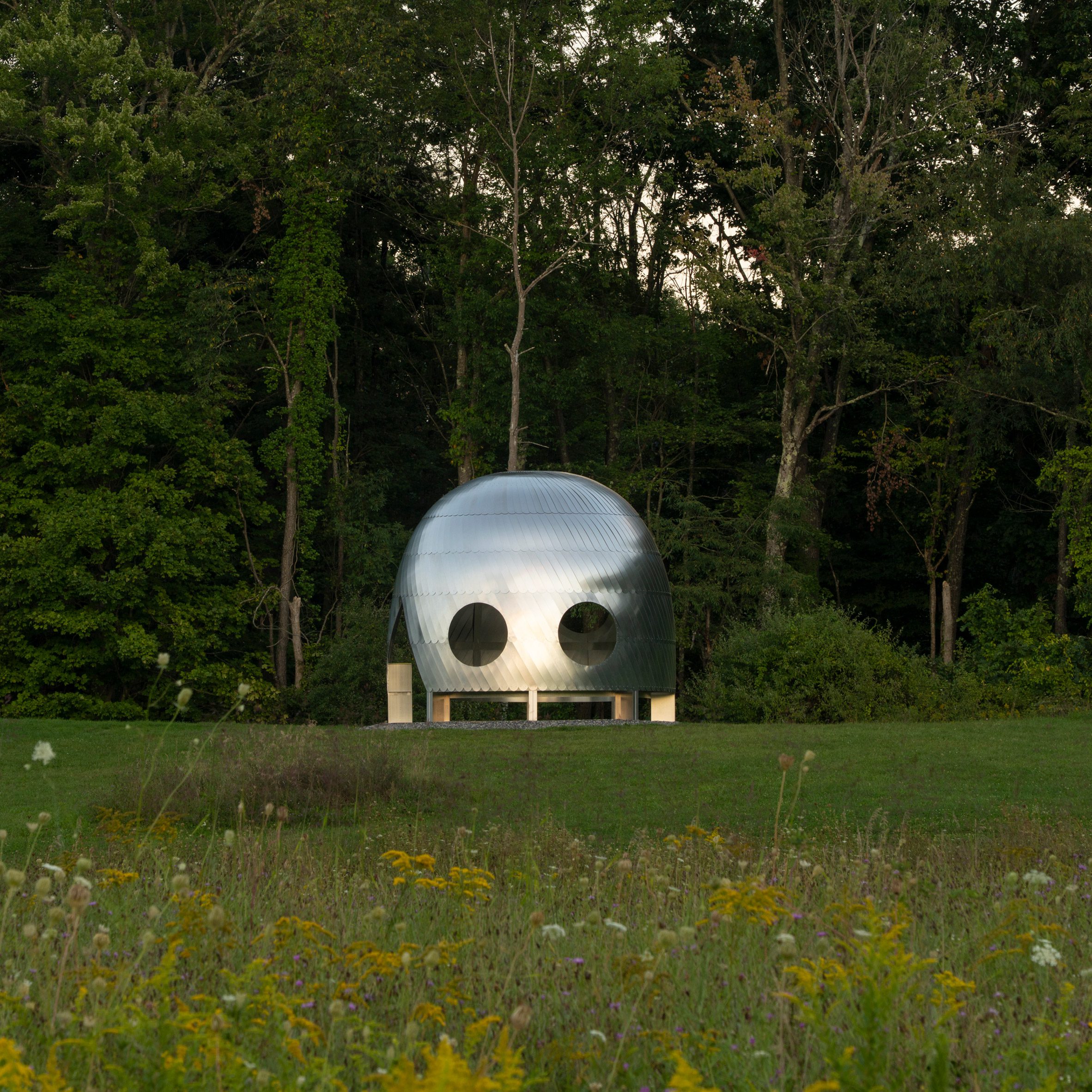
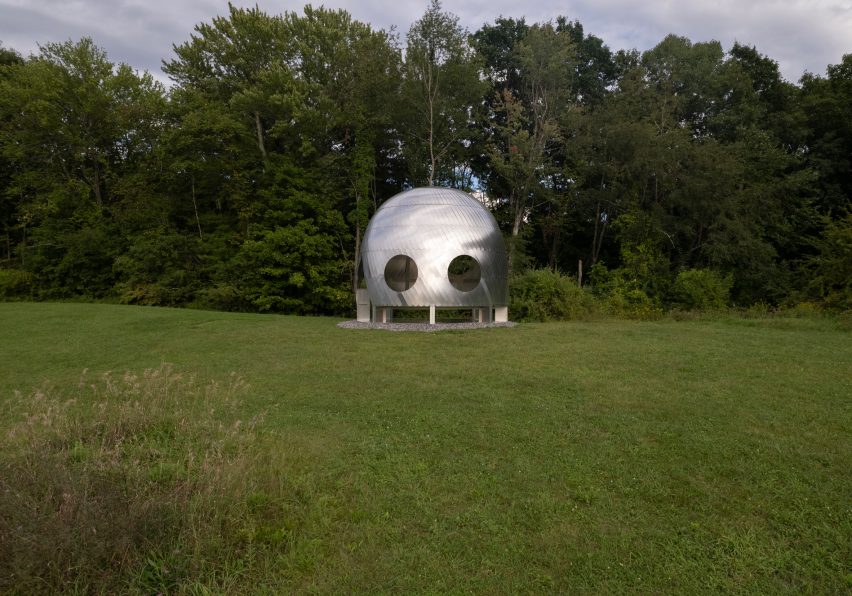
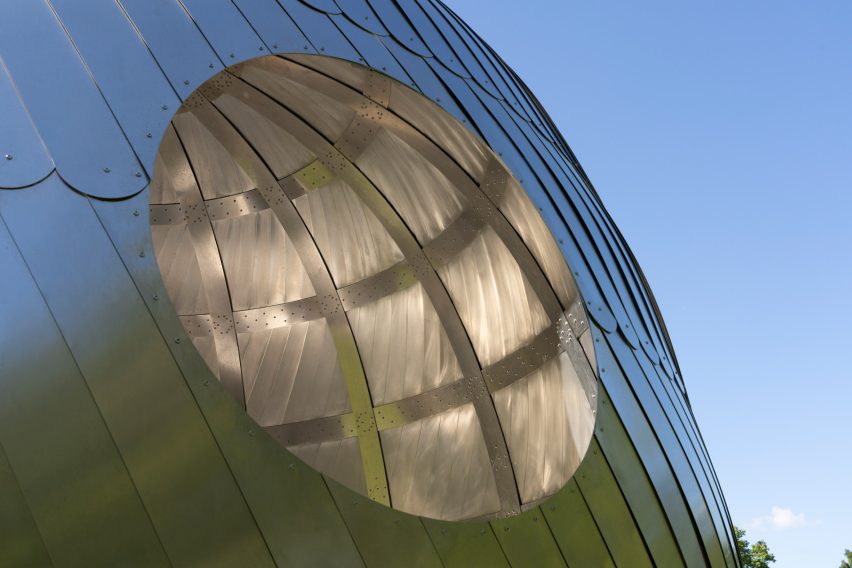
Standing elevated on slender stilts, A Dome with Four Oculi presents a striking silhouette against the natural backdrop of Art Omi. MOS co-founder Michael Meredith has likened the structural shell to a crinoline dress, suspended gracefully above the ground. The exterior skin is composed of precision-cut aluminum shingles that overlap systematically, secured tightly in place by stainless steel bolts. Despite its robust appearance, the entire composite shell measures a mere quarter-inch in thickness, demonstrating an extraordinary economy of material.
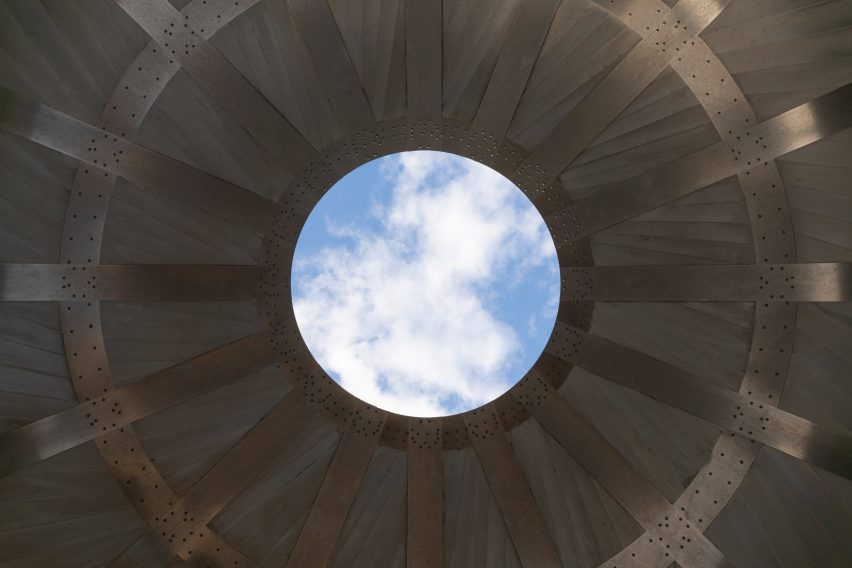
Access to the interior is granted through distinct triangular cutouts on the sides, which evoke the temporary, welcoming nature of a tent. Once inside, visitors encounter an intimate space designed for contemplation and repose. Natural light filters into the enclosure through an open oculus at the top, while two strategically placed side portholes frame targeted vistas of the surrounding fields. Viewed from a distance, the pavilion’s symmetrical openings and curved geometry give it a distinct, almost anthropomorphic character, bringing to mind the stylized head of the Iron Giant from the landmark 1999 animated film.
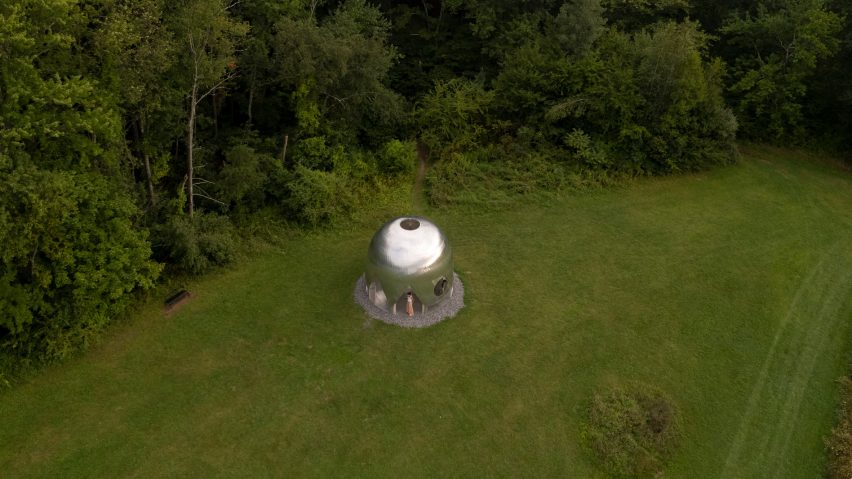
Structurally, Meredith compares the pavilion to an upside-down basket. This design choice underscores the studio’s ongoing exploration of folded aluminum sheets—a technique MOS has refined over years of practice, treating rigid metal with the pliable, lightweight characteristics of paper to build large-scale models that easily transition into full-scale architecture. Designed to be assembled rapidly using standard construction tools, the pavilion can be put together in a matter of days, emphasizing modular efficiency and prefabrication potential.
Conceptual Roots: Between Nomadism and Mid-Century Modernism
The conceptual lineage of A Dome with Four Oculi draws from two distinct historical references: pre-modern basketry and mid-century recreational vehicles. According to Meredith, woven architecture offers valuable lessons in structural efficiency. Woven systems inherently demand an economic use of materials, resulting in exceptionally lightweight configurations that carry a distinctly nomadic quality. Unlike rigid, permanent masonry, woven structures possess an inherent flexibility, allowing for surface modifications and shaping that traditional architectural domes do not easily afford.
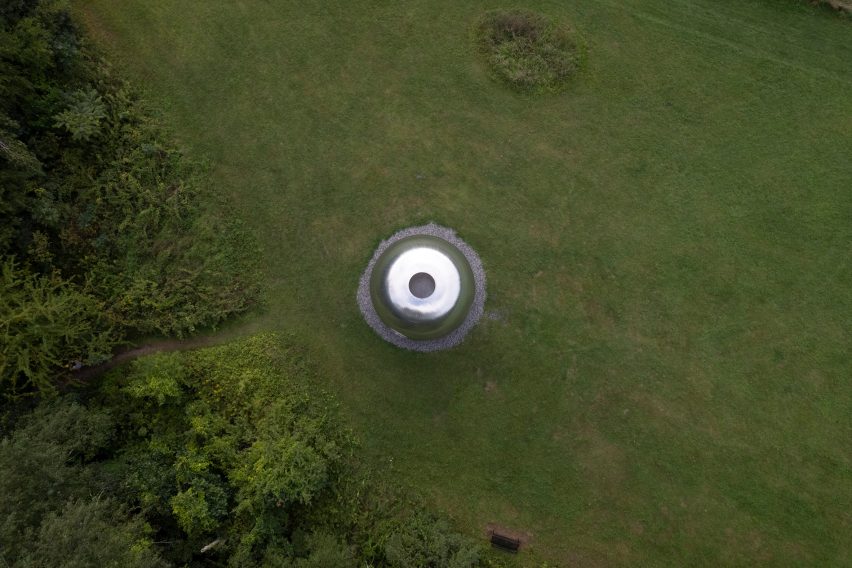
At the same time, the pavilion shares an undeniable kinship with mid-century futurism, specifically evoking the polished, metallic sheen and riveting details of classic Airstream travel trailers. Meredith describes the design as a conceptual collision between a Buckminster Fuller geodesic dome and the figurative, expressive paintings of artist Philip Guston. This playful yet rigorous synthesis results in a structure that is simultaneously functional, aesthetically provocative, and refreshingly unorthodox.
Broader Context and Art Omi’s Architectural Ambitions
The debut of MOS Architects’ pavilion aligns with Art Omi’s robust fall architecture programming, which also featured contributions such as TAELON7’s Limbo Engawa pavilion. Over recent years, Art Omi has significantly intensified its focus on architecture as a vital medium for artistic expression. In 2024, the institution made waves in the design community by announcing a permanent commission series featuring 18 dedicated pavilions crafted by renowned international architecture practices, including experimental studio SO-IL.
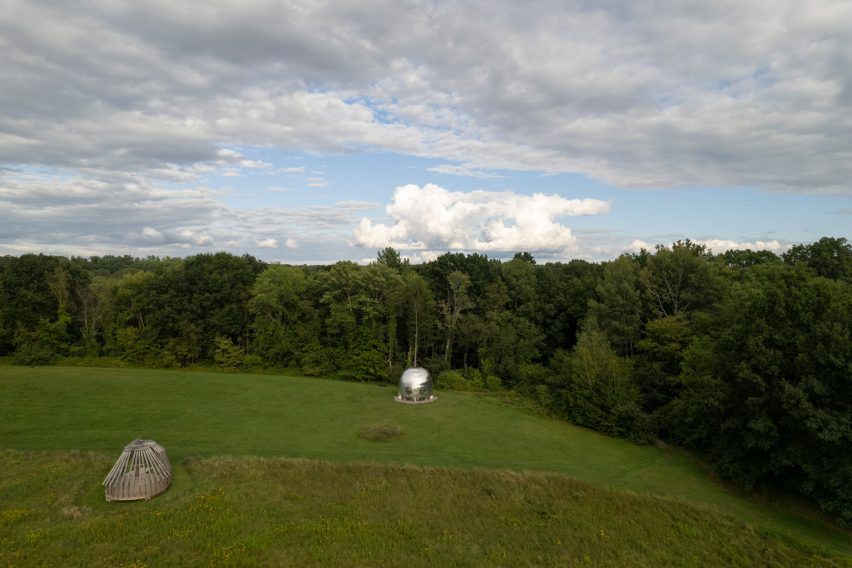
Located in Ghent, New York, Art Omi’s sculpture and architecture park spans sprawling fields and woodlands, providing an open-air laboratory where rotating installations can interact directly with the natural topography. This setting offers architects a rare canvas free from the constraints of dense urban zoning laws, commercial developer pressures, and strict programmatic requirements.
Architecture in a "Weird Moment": The Philosophy of MOS Architects
Beyond its physical manifestation as a roadside shelter for art enthusiasts, A Dome with Four Oculi serves as a physical manifestation of MOS Architects’ theoretical stance on the current state of the profession. The studio, widely celebrated for both its built works and influential publications—such as their book Smaller Architecture—has been vocal about what Meredith characterizes as a "weird moment" for contemporary architecture.
In interviews discussing the project, Meredith reflected on how architecture has gradually drifted away from its historical role as a primary driver of cultural production. Instead of serving as a medium for critical discourse, societal reflection, and experimental expression, the profession has increasingly succumbed to market forces, prioritizing sheer scale, bigness, and commercial commodification.
"Architecture used to be a more active part of cultural production," Meredith explained. "At some point, though, it sort of shifted and just feels commercial. Everything just feels like a commodity."
In this light, institutions like Art Omi take on heightened significance for contemporary designers. By operating outside the traditional economic system of real estate development and urban commercialization, Art Omi provides a protected space for architects to step back, reflect, and test radical ideas at a reduced scale. Small architecture studios, MOS argues, must actively reclaim this territory to test alternative methodologies, material applications, and spatial narratives without the crushing pressure of commercial viability.
Implications and Future Outlook for Experimental Structures
The completion of A Dome with Four Oculi arrives at a time when temporary pavilions and small-scale installations are gaining renewed prominence globally as vehicles for architectural research. Across the world, cultural institutions and design festivals are increasingly turning to lightweight, sustainable, and easily disassemblable structures to address pressing concerns regarding material scarcity and carbon footprints.
By demonstrating that aluminum shingles and simple mechanical fasteners can create a structurally sound, weather-resistant, and aesthetically compelling shelter, MOS Architects offers practical insights into lightweight prefabrication. The use of aluminum not only ensures longevity and minimal maintenance in outdoor environments but also highlights the potential for circular design, as the metal components can theoretically be unbolted, repurposed, or recycled at the end of the installation’s lifecycle.
As Art Omi continues to expand its architectural footprint, and as firms like MOS push the boundaries of what small architecture can achieve, projects like A Dome with Four Oculi demonstrate that rigorous conceptual inquiry does not require monumental scale. By marrying the ancestral logic of the woven basket with the industrial polish of mid-century design, MOS has delivered a pavilion that invites visitors to pause, look through a different lens, and reconsider the fundamental relationship between shelter, art, and the natural landscape.
Related posts: