Reducing LLM Token Costs Through Markdown Optimization: A Strategy for AI Agent Efficiency

The rapid proliferation of autonomous AI agents has ushered in a new era of software capability, but it has simultaneously introduced a significant financial and operational challenge: the "token tax." AI agents, particularly those designed for research, data retrieval, and complex task automation, frequently process massive volumes of unstructured data. When an agent is tasked with a seemingly simple query, such as searching for local services or analyzing market trends, it often consumes thousands of tokens just to ingest the raw, verbose output typically returned by APIs. This bloat, often comprised of metadata, tracking scripts, and deep object nesting, can lead to exorbitant costs and constrained context windows. As organizations scramble to optimize their AI infrastructure, a shift from traditional JSON outputs to Markdown-formatted data is emerging as a critical technique for mitigating these overheads.
The Anatomy of Token Bloat in AI Pipelines
To understand the scale of the problem, one must first recognize how Large Language Models (LLMs) interpret input. When an API returns a standard JSON object, it is structured primarily for machine-to-machine communication. It includes brackets, quotes, keys, and values that are essential for programming languages like JavaScript or Python to parse, but which offer little to no semantic value to an LLM.
Consider a standard search query. A modern API response might include detailed navigation links, internal tracking identifiers, redundant metadata, and schema markup. While these elements are vital for a web browser or a front-end application to render a UI, they are largely irrelevant for an agent that simply needs to summarize information or extract specific insights. For an LLM, every character—including the syntax required for JSON structure—consumes tokens. When an agent enters a recursive loop, rerunning queries or browsing through multiple search results, this inefficiency compounds. A query that consumes 25,000 tokens in a raw JSON format might represent only a few hundred words of actual useful information. The remaining 24,000+ tokens are effectively "noise," yet they are billed at the same rate as the high-value content.
A Chronology of API Evolution and Token Sensitivity
The history of API development has long favored JSON (JavaScript Object Notation) as the universal standard for data exchange. Since its inception in the early 2000s, JSON has been the backbone of the web, prized for its ability to represent complex hierarchies of data in a way that is both human-readable and machine-parseable. However, the rise of Generative AI has fundamentally altered the requirements for data transmission.
In the early stages of LLM adoption (circa 2022–2023), developers treated LLM context windows as virtually infinite, focusing primarily on the accuracy of the model rather than the efficiency of the input. As production-grade agents began to scale, however, the financial reality set in. Companies began noticing that their "inference budget" was being consumed by data formatting rather than model reasoning.
In late 2023 and early 2024, industry leaders began experimenting with alternative serialization formats. The realization was that while JSON is ideal for structured databases, it is fundamentally inefficient for LLM prompts. By contrast, Markdown—a lightweight markup language—has gained traction. Markdown uses plain-text formatting that is natively intuitive for LLMs, which are trained on massive corpuses of text that mirror the structure of Markdown (headers, lists, tables, and bold text). This alignment allows the model to process the data more naturally, often with higher accuracy and significantly lower token density.
Quantifiable Gains: The SerpApi Benchmarking Study
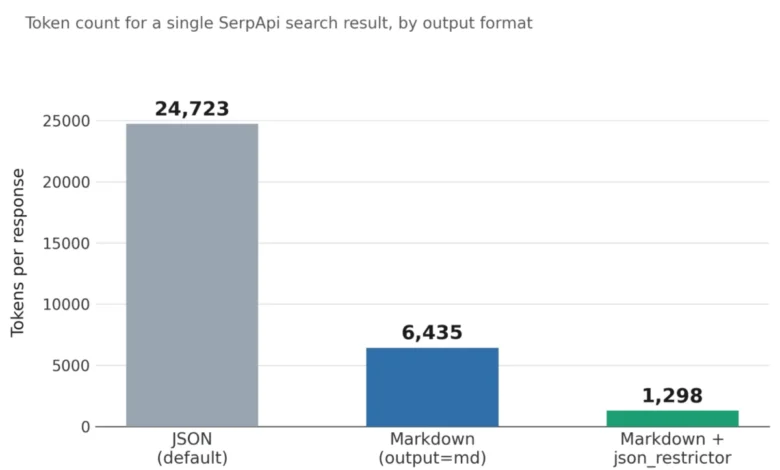
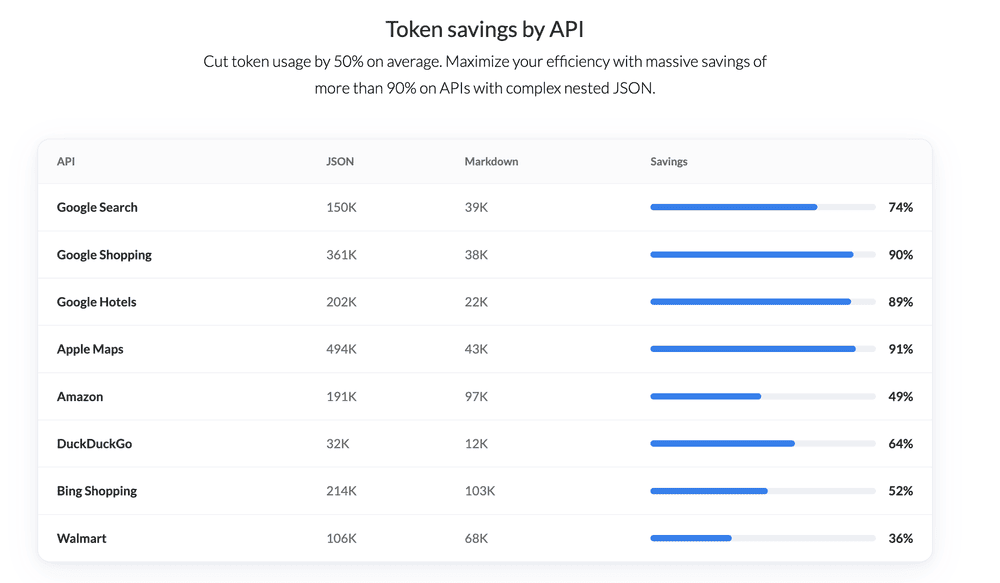
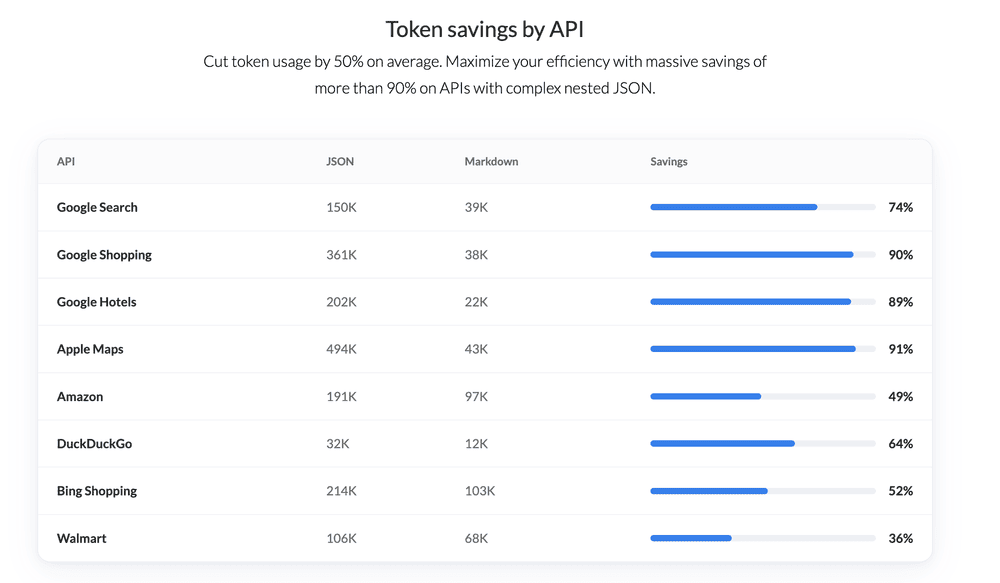
Recent data provided by SerpApi illustrates the efficacy of this transition. In a controlled test comparing the two formats, a search query for "coffee" yielded a JSON response requiring 24,723 tokens. When the same search was executed using the new Markdown output format, the token requirement dropped to 6,435 tokens. This represents a 74% reduction in data volume.
Further refinement, utilizing field-level filtering (often referred to as a "restrictor"), allowed that same query to be contained within just 1,298 tokens. The implications of this are twofold: first, the direct cost of the API call and the subsequent LLM processing are drastically slashed. Second, the model’s context window is preserved for actual reasoning tasks. When a context window is cluttered with 20,000 tokens of JSON metadata, the model’s "attention" is diverted. By cleaning the input via Markdown, developers can fit more relevant search results into the same context window, thereby enabling agents to perform more comprehensive research without hitting the model’s token limits.
Technical Implementation and Strategy
The transition to Markdown for AI agents is not merely a cosmetic change; it involves a fundamental shift in how developers interact with data feeds. SerpApi, for instance, has introduced a parameter-based approach that allows developers to request Markdown output with a single switch. This is accessible via query parameters or header modifications, making it highly portable for existing systems.
The process of stripping "token noise" involves several key removals:
- Redundant Schema Markup: Removing schema.org metadata that is intended for SEO indexing but useless for agent reasoning.
- Internal Tracking Identifiers: Stripping session IDs, click-tracking links, and server-side logs that do not contribute to the informational value of the search result.
- Array Flattening: Replacing deeply nested JSON objects with structured tables or lists that provide the same data in a format the LLM can process in fewer tokens.
However, the industry consensus remains that Markdown is not a universal replacement for JSON. For tasks requiring strict data integrity—such as financial transaction processing, coordinate-based mapping, or algorithmic data analysis—JSON remains superior. If a system requires exact float values for pricing or structured arrays for downstream database insertion, the overhead of JSON is a necessary cost of doing business. The strategy, therefore, is one of bifurcation: using Markdown for agent-led research and reasoning, and JSON for high-precision, programmatic data pipelines.
Broader Implications for the AI Economy
The shift toward token-efficient data formats is part of a larger trend toward "Agentic Efficiency." As AI systems become more prevalent in enterprise environments, the "cost per reasoning step" is becoming a key performance indicator (KPI) for CTOs and software architects.
- Scalability: By reducing token usage, businesses can scale their autonomous agents to handle millions of queries without incurring exponential cloud costs.
- Latency Reduction: Smaller payloads mean faster transmission times and shorter prompt processing times, leading to more responsive AI applications.
- Model Performance: Research indicates that LLMs perform better when the input is focused. By removing "distractor" data, developers can improve the retrieval-augmented generation (RAG) performance, leading to fewer hallucinations and higher factual accuracy.
Conclusion: The Future of Data Serialization
The rise of Markdown as a preferred input format for LLMs highlights a critical maturation point in the AI industry. We are moving past the "sandbox" phase, where experimental token consumption was tolerated, into an era of optimization and sustainable development. As developers continue to refine their architectures, the ability to tailor data output to the specific "reader"—whether that reader is a database, a human, or an LLM—will become a core competency.
For organizations currently struggling with the financial burden of high-volume agentic systems, the path forward is clear: audit the data payload. If the input is primarily destined for an LLM’s context window, the overhead of traditional JSON is likely an unnecessary burden. By embracing formats that prioritize semantic density over rigid syntax, developers can unlock greater performance, lower costs, and ultimately, more powerful and capable AI agents. The era of the "token-blind" application is ending, and the era of precise, efficient data engineering has begun.
Related posts: