Beyond the Prediction: Integrating Traditional Machine Learning with Agentic Reasoning for Advanced AI Systems

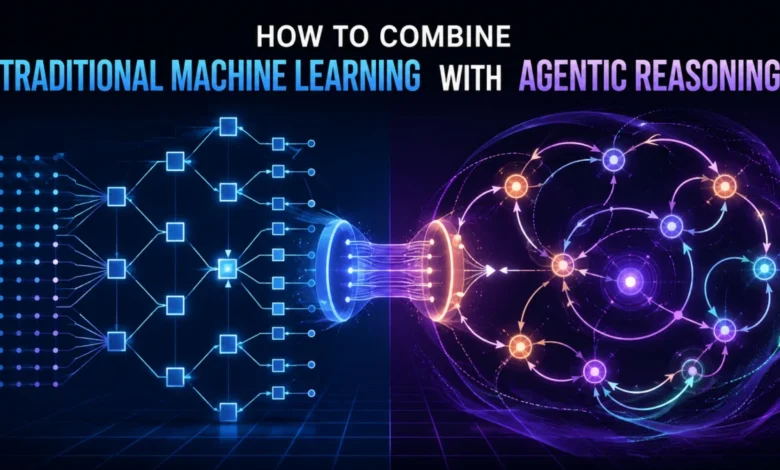
For over a decade, the enterprise AI landscape has been defined by the dominance of predictive modeling. From financial services to diagnostic healthcare, organizations have invested heavily in supervised machine learning systems designed to ingest structured data and output precise, statistically sound predictions. However, as the limitations of these static models become increasingly apparent in dynamic, multi-step business environments, the industry is witnessing a shift toward a more sophisticated architecture: the integration of traditional machine learning (ML) with agentic reasoning. This transition marks a fundamental change in how autonomous systems are built, moving from simple input-output mapping to complex, goal-oriented orchestration.
The Evolution of Predictive Architecture
Traditional machine learning relies on the paradigm of supervised learning. A model is trained on historical datasets, learning to recognize patterns that correlate specific inputs with target outputs. This methodology has proven highly effective for tasks characterized by high volumes and low ambiguity. For example, in credit scoring, a model evaluates an applicant’s financial history to generate a probability of default. In manufacturing, sensors collect telemetry data to predict equipment failure.
The maturity of these models is supported by extensive engineering frameworks. According to industry data from recent AI infrastructure reports, companies that have successfully deployed these models report significant gains in operational efficiency, often reducing manual processing times by 40% to 60%. These systems are prized for their interpretability, speed, and auditability. Once deployed, they function within a closed loop: they receive an input, execute a mathematical function, and return a result.
However, the rigidity of this structure is its primary weakness. Because these models are static—trained on a snapshot of the world at a specific moment—they cannot handle the "unknown unknowns" of real-world operations. They lack the capacity to request missing data, evaluate the validity of an input, or pivot when a business process requires a sequence of actions rather than a single classification.
The Rise of Agentic Reasoning
The emergence of large language models (LLMs) has provided the necessary "reasoning engine" to address the shortcomings of static ML. Unlike traditional models that are purely predictive, agentic systems are designed to interact with their environment. They perceive, deliberate, act, and observe. This cycle—often referred to as the "Observe-Orient-Decide-Act" (OODA) loop—allows AI to manage complex workflows that extend far beyond a single prediction.
The distinction is critical: where a machine learning model is a tool, an agent is an operator. Agentic reasoning enables four core capabilities that have long been absent from standard automated systems:
- Decomposition: The ability to break a high-level goal, such as "resolve this customer complaint," into a series of actionable steps.
- Tool Orchestration: The capacity to interface with external APIs, databases, and software applications to gather information or trigger changes in state.
- Dynamic Adaptation: The ability to evaluate the results of an action and modify the plan if the outcome is insufficient or unexpected.
- Operational Agency: The authority to execute tasks in external systems, such as updating a CRM record or initiating a financial transaction.
Bridging the Gap: A Hybrid Architectural Model
Industry experts argue that the most robust AI implementations are not moving away from traditional ML, but rather embedding it within agentic frameworks. In this hybrid approach, the traditional ML model serves as a specialized component—a "skill" that the agent can invoke when high-precision pattern recognition is required.
Consider a modern supply chain management system. A traditional ML model might predict a 75% probability of a port delay based on historical weather and shipping patterns. An agentic system, however, takes this probability as a starting point. Upon receiving the prediction, the agent autonomously retrieves the latest status of specific containers, checks alternative shipping routes via API, identifies which suppliers are affected, drafts communication to those suppliers, and updates the inventory management database.
The ML model provides the "what" (the probability of failure), while the agent provides the "how" (the response to that failure). This symbiosis ensures that the system maintains the high-accuracy pattern recognition of traditional models while gaining the adaptability of an autonomous agent.
Strategic Implications for Business Processes
The shift toward agentic integration has profound implications for how organizations deploy capital in digital transformation. Historically, firms have spent millions on "brittle" automation—complex, hard-coded rule engines designed to handle every possible scenario. These systems are notoriously difficult to maintain and scale.
By contrast, an agentic architecture allows for a more flexible design. Because agents operate based on goal-directed reasoning rather than rigid conditional logic, they are inherently more resilient to change. When a business process changes—for instance, a change in regulatory requirements for loan approvals—the agent can be instructed to incorporate new steps or tools without requiring the total retraining of the underlying predictive models.
Analysts at major technology consultancies suggest that this hybrid approach is the key to overcoming the "AI implementation gap," where models are developed in isolation but fail to integrate into the messy reality of day-to-day operations. By wrapping traditional models in an agentic layer, companies can finally achieve "closed-loop automation," where the AI not only predicts the need for action but carries it out.
Challenges and Future Outlook
Despite the promise, the integration of agentic reasoning is not without significant hurdles. The primary challenge remains the issue of control and guardrails. While a traditional ML model is predictable—it will always return the same output for the same input—an agentic system is non-deterministic. Because it relies on LLM-based reasoning, it can occasionally choose inefficient paths or encounter unforeseen errors in tool usage.
To mitigate this, organizations are adopting "Human-in-the-Loop" (HITL) checkpoints. In this configuration, the agent performs the bulk of the cognitive heavy lifting and orchestration, but requires human approval for sensitive actions or high-stakes decisions.
Looking forward, the evolution of these systems is expected to follow a three-stage trajectory:
- Stage 1 (Current): Agents act as "assistants" to humans, performing research and data gathering while a human makes the final decision.
- Stage 2 (Emerging): Agents execute multi-step workflows, using traditional ML models to provide data-driven insights, with humans acting as supervisors who review the agent’s reasoning trace.
- Stage 3 (Future): Autonomous agents manage end-to-end business processes, with human intervention reserved only for edge cases and strategic policy adjustments.
Conclusion
The narrative that traditional machine learning is being superseded by newer technologies is a misconception. In reality, the future of artificial intelligence lies in the convergence of these two paradigms. Traditional machine learning provides the stable foundation of predictive intelligence, while agentic reasoning provides the dynamic intelligence required to translate those predictions into meaningful, real-world action.
Organizations that successfully integrate these capabilities will move from having "AI that predicts" to having "AI that performs." This transition represents the next frontier in digital transformation, promising a level of operational agility that was previously unattainable with static models alone. As the supporting infrastructure matures, the question for business leaders is no longer whether they should use machine learning or agentic reasoning, but how effectively they can combine them to create systems that possess both the precision of a calculator and the adaptability of a human operator.