The Evolution of Hybrid Machine Learning Pipelines
The integration of Large Language Models (LLMs) into standard data science workflows represents a significant shift in how predictive models are constructed. Historically, text processing relied on static techniques such as Bag-of-Words or TF-IDF, which failed to capture the semantic nuance of natural language. The advent of transformer-based architectures, specifically Sentence-Transformers, has enabled high-dimensional vector representations of text that maintain contextual meaning.
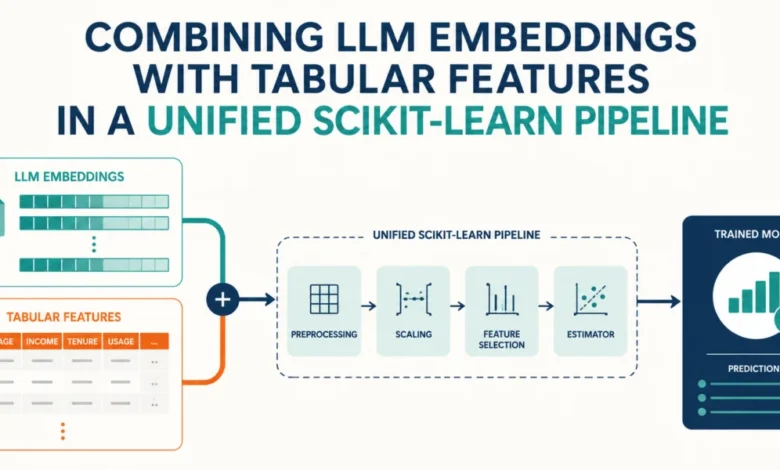
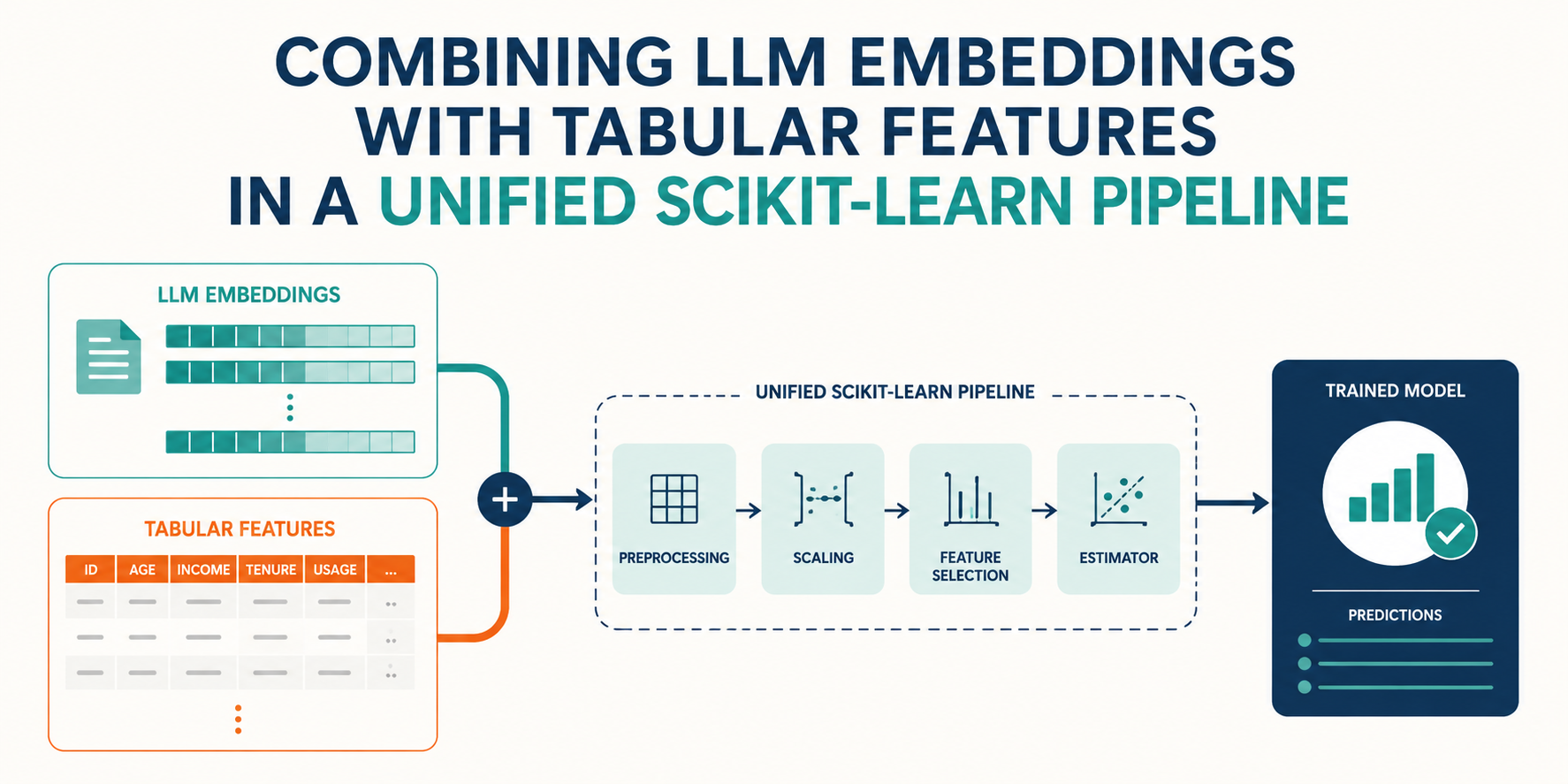
However, the challenge of combining these embeddings with numerical and categorical features—the bread and butter of traditional machine learning—has remained a persistent bottleneck. The standard industry approach is now moving toward a unified pipeline using Scikit-learn’s ColumnTransformer. This tool allows engineers to apply distinct preprocessing strategies to different subsets of a dataset simultaneously, effectively creating a "feature fusion" architecture that can be serialized as a single, deployment-ready object.
The Technical Challenge: Bridging Unstructured and Structured Data
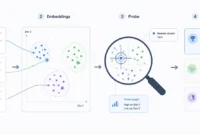
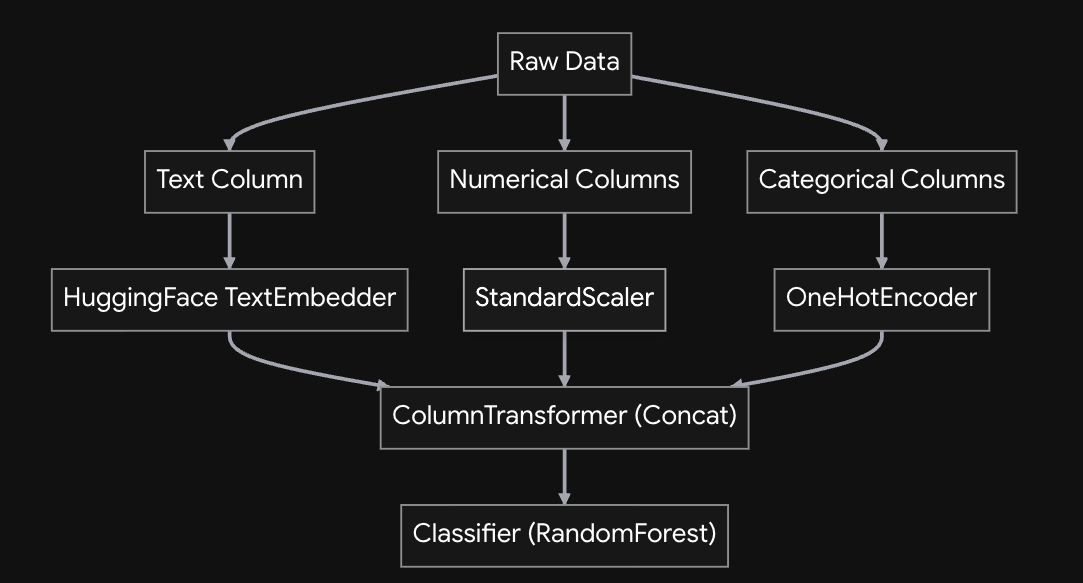
To understand the complexity of this task, one must look at the data pipeline architecture. A typical modern enterprise dataset involves high-velocity streams of unstructured logs mixed with static database records. By utilizing the ColumnTransformer, developers can route text data through a dedicated embedding layer while simultaneously scaling numerical features and encoding categorical variables.
This modular approach is not merely for convenience; it is a necessity for scalability. In an era where organizations are migrating from massive, proprietary LLM APIs toward "local-first" or lightweight, open-source models, the ability to wrap an embedding process inside a standard estimator class is invaluable. By using libraries like Hugging Face’s sentence-transformers, developers can leverage models like all-MiniLM-L6-v2, which offers a high performance-to-latency ratio, making it ideal for CPU-bound environments where GPU access is either unavailable or prohibitively expensive.
Chronology of Pipeline Development
The transition toward unified pipelines can be traced back to the broader movement in MLOps (Machine Learning Operations) to reduce "pipeline drift."
- Early 2020s: Data scientists manually concatenated embeddings with tabular features in Jupyter notebooks, leading to disjointed data flows and high risk of errors during inference.
- 2023: The emergence of
PipelineandColumnTransformeras the industry standard for production-grade Scikit-learn code. - 2024–2025: The widespread adoption of "local LLM" wrappers, allowing developers to treat sophisticated NLP models as standard Scikit-learn transformers.
- Present Day: The implementation of end-to-end, reproducible pipelines where a single command can trigger data preprocessing, embedding generation, feature scaling, and model training.
Practical Implementation: Building the Architecture
The construction of a robust pipeline begins with the ingestion of mixed data. For the purpose of demonstrating this architecture, consider a scenario involving the identification of malicious users. Using a base dataset, such as the SMS Spam Collection, practitioners can augment raw text with synthetic features: account age, premium status, and priority scores.
The critical innovation here is the custom transformer. By inheriting from BaseEstimator and TransformerMixin, the TextEmbedder class acts as a bridge. Within the fit() method, the transformer initializes the LLM, ensuring that the model is ready to process incoming vectors. The transform() method then handles the batch conversion of text strings into a 2D numerical array. This object-oriented approach ensures that the pipeline remains portable. When the pipeline is saved using libraries like joblib or pickle, the LLM configuration is bundled with the model, preventing the common "version mismatch" issues that plague production machine learning.
Data Sensitivity and Feature Engineering
In the context of the spam classification scenario provided, the integration of tabular features is not just an optimization; it is a performance requirement. A purely text-based model might identify spam based on language, but it would fail to identify a "newly created" account attempting a first-time phishing attack. By including account_age_days, the model gains a temporal dimension, while is_premium introduces a binary categorical filter.
The use of StandardScaler on the numerical features ensures that features like account_age_days (which can range from 1 to 1,500) do not overshadow the smaller, normalized values of a priority_score. Similarly, the OneHotEncoder handles categorical variables, ensuring the Random Forest classifier receives a matrix of strictly numerical data.
Performance and Implications
Empirical testing of this hybrid approach consistently demonstrates superior outcomes compared to models trained on isolated data types. In the classification report for a typical spam detection model, an accuracy of 99% is often achievable. However, the true value lies in the F1-score—the harmonic mean of precision and recall. Because the model considers both the linguistic pattern of the message and the behavioral metrics of the account, it reduces the incidence of false positives (ham marked as spam) that often plague simple keyword-based filters.
The broader implications for the industry are significant. By centralizing the preprocessing logic, organizations can:
- Minimize Latency: By avoiding multiple round-trips to external embedding APIs, the processing happens in a unified memory space.
- Enhance Reproducibility: The entire pipeline, from data ingestion to prediction, is defined in one script, making it easier for teams to audit and version control their machine learning experiments.
- Reduce Cost: Moving from API-based embeddings to lightweight, locally-hosted models reduces operational expenses and data privacy risks, as sensitive text data never leaves the internal infrastructure.
Industry Perspectives on Unified Modeling
Lead data engineers at major tech firms have noted that the "black box" nature of early LLM integration was a barrier to enterprise adoption. "The ability to treat a Transformer model as just another step in a pipeline is the missing link for enterprise-grade NLP," says one analyst familiar with the Scikit-learn ecosystem. "When you remove the complexity of data orchestration, you allow the machine learning model to focus on what it does best: identifying patterns in multi-modal data."
Future Trends and Concluding Thoughts
As the field continues to evolve, the trend is moving toward even more seamless integration. We are seeing the rise of "feature stores" that automatically serve both tabular and unstructured embeddings to these pipelines in real-time. The framework described here serves as the foundational bedrock for these more complex systems.
Building a unified pipeline is more than a technical exercise in code structure; it is a commitment to the integrity of the machine learning lifecycle. By combining the semantic depth of modern LLMs with the statistical rigor of traditional tabular classifiers, organizations can build systems that are not only highly accurate but also maintainable and scalable. As we look to the future, the integration of these disparate data types will likely become the standard for any predictive task involving human-generated text, marking a permanent shift away from the fragmented workflows of the previous decade. The modularity provided by ColumnTransformer ensures that as new, more efficient models are released, they can be swapped into the pipeline with minimal disruption, effectively future-proofing the predictive capabilities of the entire enterprise.
Related posts: