The professional landscape of artificial intelligence is currently undergoing a structural shift, moving from experimental research to rigorous, high-stakes enterprise integration. Central to this transition is the emergence of the Forward Deployed Engineer (FDE), a hybrid technical role that is rapidly becoming the backbone of the AI industry. As of August 2026, the demand for these professionals has reached a critical juncture, underscored by massive training initiatives from industry leaders such as Anthropic and DXC Technology. These companies have committed to certifying tens of thousands of engineers to bridge the gap between sophisticated large language models (LLMs) and the complex, often legacy-bound infrastructure of global enterprise systems.
The Evolution of the Forward Deployed Engineer
The FDE role represents a departure from traditional software engineering paradigms. While a standard software engineer often operates within a well-defined set of requirements—building a specific service or feature—the FDE functions as a technical diplomat and systems architect. The scope of the role is broad, encompassing discovery, technical scoping, system design, implementation, evaluation, and production rollout.
In a practical sense, an FDE might be tasked with a nebulous objective, such as reducing the processing time of complex insurance claims by automating data extraction from disparate, non-interoperable legacy systems. This requires the engineer to navigate messy enterprise data, understand the specific regulatory requirements of the client, and deploy an AI solution that is not only effective but also secure and reliable. The role is effectively a convergence of four distinct disciplines: software engineering, AI/data engineering, solutions architecture, and technical consulting.
Market Data and Economic Outlook
The professional market for FDEs is characterized by high compensation and significant technical barriers to entry. According to 2026 industry analysis from ZipRecruiter, the average U.S. salary for a Forward Deployed Engineer stands at approximately $116,463 per year, with median figures reaching $124,300. However, at top-tier AI-focused firms, compensation packages frequently exceed these averages, reflecting the scarcity of candidates who possess the requisite blend of soft skills and technical proficiency.
The surge in demand is partially attributed to the "enterprise AI gap." Organizations are eager to integrate LLMs into their workflows, but they lack the internal expertise to manage the transition from sandbox prototypes to mission-critical production environments. Anthropic’s recent partnership with DXC to train tens of thousands of Claude-certified engineers is a direct response to this bottleneck. This move signals an industry-wide recognition that the future of AI will be decided not just by model performance, but by the ability to successfully deploy these models in environments characterized by technical debt and strict security compliance.
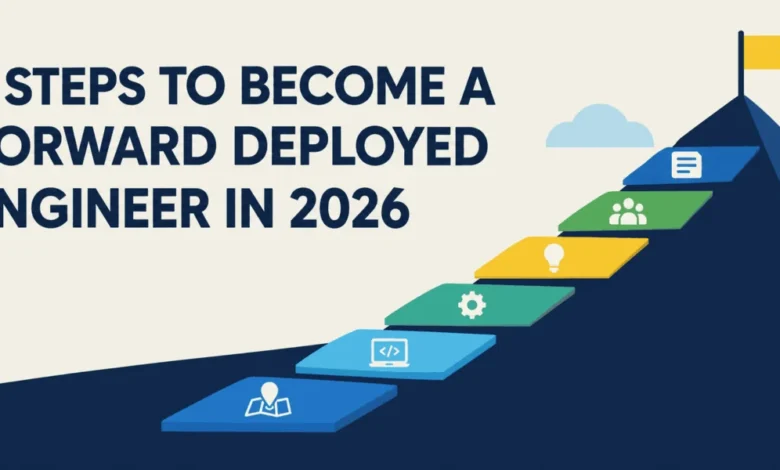
A Seven-Step Roadmap to Proficiency
Transitioning into an FDE role requires a methodical approach to skill acquisition. Aspiring candidates should view the following roadmap as a framework for building a versatile technical profile.
1. Establishing Software Engineering Fundamentals
Python remains the primary language for FDEs, appearing in over 2,200 recent job postings analyzed in the 2026 State of FDE Jobs report. Proficiency in backend development, automation scripts, and basic data manipulation is non-negotiable. While competitive programming expertise is rarely the focus, candidates must demonstrate an ability to write clean, maintainable, and production-ready code.
2. Mastering Data Integration and API Ecosystems
Real-world enterprise environments rarely offer clean datasets. FDEs must be proficient in navigating complex data architectures, including PostgreSQL databases, Salesforce integrations, Snowflake data warehouses, and various legacy message queues. Familiarity with OAuth protocols, webhooks, and the ability to interpret outdated API documentation are essential for connecting modern AI tools to existing infrastructure.
3. Scaling Deployments and Operational Reliability
The transition from a prototype to a stable deployment is where many engineers struggle. FDEs must move beyond local development to understand containerization (Docker, Kubernetes), cloud infrastructure (AWS, GCP, Azure), and CI/CD pipelines. Owning the lifecycle of an application—from development to monitoring and error logging—is a hallmark of the senior FDE.
4. Applied AI Engineering
In 2026, the focus has shifted from theoretical machine learning to the application of existing models. Candidates should prioritize learning retrieval-augmented generation (RAG) systems, agentic workflows, and LLM orchestration frameworks. The objective is to leverage models to solve specific business problems rather than attempting to train frontier models from scratch.
5. Prioritizing Enterprise Security and Compliance
For many corporate clients, the primary barrier to AI adoption is data privacy. An FDE must understand the mechanics of tenant isolation, least-privilege access models, and data handling protocols. Understanding how to build systems that comply with GDPR, HIPAA, or industry-specific security standards is what differentiates a high-level engineer from a hobbyist.
6. Cultivating Customer Discovery Skills
Perhaps the most significant differentiator for an FDE is the ability to conduct effective customer discovery. This involves active listening and critical questioning. When a client requests an "AI chatbot," the FDE must be capable of probing deeper: What is the underlying bottleneck? Is the data reliable enough for automated decisions? What are the potential failure modes? Turning ambiguous business requests into concrete technical requirements is the defining skill of the role.
7. Developing an FDE-Centric Portfolio
Portfolio projects should reflect the complexity of real-world deployments. Instead of isolated tutorials, candidates should build end-to-end systems that solve domain-specific problems. A strong portfolio project might include an enterprise support agent that features RAG, robust authentication, cost-monitoring metrics, and a human-in-the-loop approval workflow for critical actions. The goal is to provide a repository that acts as a testament to the engineer’s ability to manage constraints and ship functional software.
The Broader Impact on Enterprise Operations
The rise of the Forward Deployed Engineer signals a shift in how enterprises view their technical human capital. By integrating the developer directly into the client-facing side of the business, firms are able to accelerate the feedback loop between end-user needs and software updates. This is particularly crucial in the context of the AI boom, where the speed of innovation is unprecedented.
The long-term implication is that the "software-only" era of engineering is receding in favor of a "solutions-oriented" model. Companies are no longer looking for developers who can simply write code; they are searching for architects who can navigate the messy, non-linear reality of enterprise digital transformation.
Future Projections and Conclusion
Looking toward 2027 and beyond, the FDE role is expected to evolve alongside advancements in AI agent technology. As models become more capable of writing their own code and debugging infrastructure, the role of the FDE may shift further toward high-level systems oversight and strategic technical consulting. However, the fundamental need for a human intermediary to bridge the gap between complex organizational structures and cutting-edge AI remains constant.
For those looking to enter this field, there is no shortcut or singular certification that guarantees success. The path to becoming a Forward Deployed Engineer is defined by the accumulation of a specific, interdisciplinary skill set and the development of a mindset that views technical challenges as part of a larger business ecosystem. Success in this role requires not just technical rigor, but the adaptability to walk into an unfamiliar, complex environment and deliver tangible value through software.