The Death of the Button: Why the Web is Shifting Toward Intent-Driven AI Experiences

The global digital landscape is undergoing its most profound structural transformation since the commercialization of the Graphical User Interface (GUI) in the late 20th century. For decades, human-computer interaction has been governed by point-and-click mechanics—a paradigm pioneered by foundational systems like the Xerox Star and popularized by the Apple Macintosh. Today, however, web development and user experience (UX) design are pivoting away from complex menus, multi-step forms, and endless browsing tabs toward a radically simplified philosophy: intent-driven design. Driven by rapid advancements in artificial intelligence and large language models (LLMs), modern digital platforms are increasingly designed to capture high-level human goals and execute the underlying labor silently in the background, signaling a definitive evolution beyond traditional software interfaces.
Chronology of Interface Evolution: From Command-Line to Ambient AI
To understand the magnitude of the current shift, it is necessary to examine the historical trajectory of human-computer interaction over the past half-century.

The evolution of digital interfaces can be categorized into four distinct generational shifts:
- 1970s–1980s (The Command-Line to Graphical Era): Computing transitioned from text-based command lines to the visual desktop metaphor. Systems like the Xerox Star introduced windows, icons, menus, and pointers (WIMP), democratizing software interaction for non-technical users.
- 1990s–2000s (The Web and E-Commerce Era): The birth of the World Wide Web scaled the GUI paradigm into browsers. Digital tasks became hyper-interactive, requiring users to navigate static directories, search via ten-blue-links, and manually complete rigid multi-page checkout flows.
- 2010s (The Mobile and App Era): The proliferation of smartphones compressed interfaces into touchscreens. While apps reduced physical friction through mobile gestures, they retained the foundational requirement of manual data entry, app switching, and micro-navigation.
- Present Era (The Intent-Driven and Generative UI Era): AI systems have begun to decouple digital utility from static visual containers. Instead of requiring users to orchestrate tasks step-by-step, platforms now interpret natural language intent, dynamically generate necessary UI components on the fly, and execute background operations autonomously.
The Problem with the Traditional Ten-Click Paradigm
For decades, digital product metrics have rewarded friction. Businesses engineered platforms to maximize "time spent on site," click-through rates, and page views per session, inadvertently forcing users to spend more time managing software than achieving actual goals.
Consider the conventional process of booking a flight online. A consumer is typically required to open a web browser, navigate to an airline aggregator, manually input departure and arrival airports using dropdown menus, adjust calendar range pickers, filter by stopovers, sort by price, handle cookie consent banners, and cross-reference baggage fees across multiple tabs. This mechanical workflow forces the human to act as the primary processor of raw data, executing dozens of micro-steps to accomplish a single outcome.
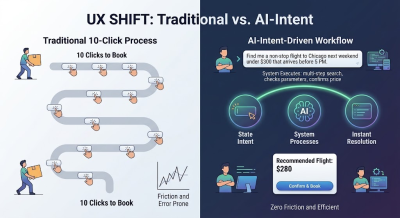
Intent-driven design reverses this dynamic entirely. By leveraging natural language processing, a user can simply state a comprehensive goal—such as requesting a non-stop flight under a specific budget that arrives by a designated time. The underlying software interprets the directive, queries multiple databases simultaneously in the background, reconciles scheduling constraints, and presents a single, actionable resolution. The traditional ten-click process collapses into a single moment of intent fulfillment.
Real-World Adoption: Platforms Replacing Buttons with Intent
This transformation is no longer a theoretical exercise confined to academic research laboratories; it is actively reshaping consumer-facing web architecture. Several prominent platforms illustrate how digital services are replacing static UI elements with dynamic intent processing.
1. Perplexity AI and Conversational Synthesis
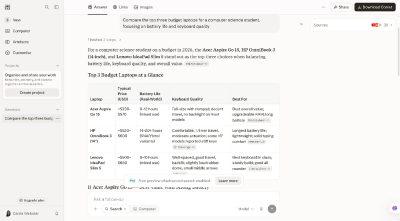
Traditional search engines were constructed as directories requiring manual curation. Users typed keywords and were presented with lists of links, leaving the cognitive labor of reading, cross-referencing, and synthesizing information to the individual. Platforms like Perplexity AI bypass this friction by capturing informational intent and generating synthesized, cited answers immediately. Instead of opening multiple browser tabs to compare consumer products or research historical data, the interface delivers a consolidated resolution, fundamentally altering how information is retrieved on the web.
2. Vercel v0 and Generative Interface Creation
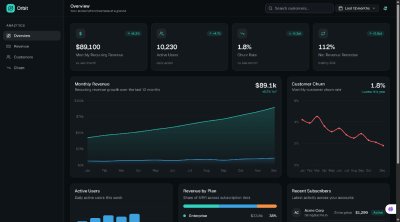
In software development and web design, creating digital assets historically required manual layout construction in tools like Figma or drag-and-drop website builders. Designers spent hours positioning rectangles, defining hexadecimal color codes, and writing cascading style sheets (CSS). Generative platforms such as Vercel v0 allow users to input textual descriptions of desired software components—such as a specific SaaS dashboard or e-commerce checkout module—and instantly render functional user interfaces and underlying code structures without manual layout engineering.
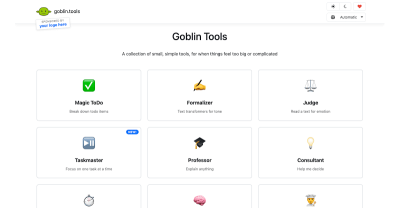
3. Goblin.tools and Micro-Task Automation
Traditional productivity applications require users to manually populate kanban boards, assign priority tags, and construct rigid schedules. Single-purpose AI tools like Goblin.tools are designed to ingest overwhelming human projects and autonomously break them down into granular, manageable checklists. By eliminating the administrative overhead of organizing work, these tools reduce cognitive load, particularly for users navigating neurodivergent challenges or complex logistical hurdles.
Core Pillars of Intent-Driven Web Design
Industry analysts, including researchers at the Nielsen Norman Group, have identified three foundational pillars that define this emerging UX paradigm:
| Pillar | Traditional UX Approach | Intent-Driven UX Approach |
|---|---|---|
| User Input | Micro-actions (Clicks, dropdowns, toggles) | High-level goals (Natural language, context, habits) |
| Interface State | Static layouts (Universal pages for all users) | Generative UI (Layouts created dynamically on demand) |
| Task Execution | Manual execution orchestrated by the human | Autonomous execution managed by background AI agents |
Ambient Context and Predictive Input
Modern intent-driven systems increasingly rely on contextual metadata—such as device telemetry, location data, and historical interaction patterns—to anticipate needs before a direct command is issued. Drawing from established design principles such as Apple’s Human Interface Guidelines on Contextual and Ambient Design, software can quietly adapt to environmental cues, surfacing relevant utilities precisely when required and receding when the task concludes.
Generative User Interfaces
Historically, web applications maintained rigid layouts where every visitor encountered the exact same navigational structure. Generative UI upends this convention by rendering components dynamically based on real-time user intent. If an individual requires complex financial computations, the system generates a bespoke calculator widget on the fly, which subsequently dissolves once the numerical analysis is complete, keeping the screen clean and focused entirely on the immediate objective.
Autonomous Execution and Reversibility
Traditional software design relies heavily on preventative friction, inundating users with precautionary modal dialogs (e.g., "Are you sure you want to delete this file?"). Intent-driven design adapts Jakob Nielsen’s heuristics regarding user control by shifting the safety net from prevention to frictionless reversibility. Because autonomous agents operate in the background, platforms prioritize clear audit trails, prominent "Undo" functions, and inline revision prompts over intrusive warning pop-ups.
Implications and Critical Industry Challenges
While the elimination of interface friction offers substantial efficiency gains, industry experts and academic institutions—including the Stanford Human-Computer Interaction Group and the Center for Humane Technology—have raised critical concerns regarding the ethics and mechanics of intent-driven systems.
The Illusion of Control and Ethical Boundaries
When software proactively makes decisions on behalf of a user, systems risk crossing the line from helpful automation to intrusive overreach. UX designers face the delicate challenge of establishing clear operational boundaries. Routine administrative execution can be safely automated, but high-stakes actions—such as financial transactions, public data publishing, or privacy modifications—require explicit human confirmation to prevent unintended consequences and loss of user autonomy.
The Black Box Problem and Trust Calibration
In a traditional user interface, unexpected outcomes can usually be diagnosed by inspecting user inputs, such as an incorrectly checked filter box. In contrast, intent-driven systems can introduce opacity, often referred to as the "black box problem," where the rationale behind an AI-generated decision is obscured. To mitigate this risk, frameworks developed by Google’s People + AI Research (PAIR) initiative emphasize transparent feedback loops. Systems must explicitly articulate their interpretation of a user’s goal—such as displaying a clear text confirmation of search parameters—allowing individuals to calibrate trust and correct misinterpretations instantly.
Conclusion
The evolution of the web is steering digital architecture toward an ambitious horizon inspired by Golden Krishna’s seminal thesis: The Best Interface Is No Interface. For decades, digital success was measured by engagement metrics that captured attention through visual complexity and interaction volume. Today, the metric of success is shifting toward invisible efficiency.
As software transitions from static containers of data to intelligent agents capable of understanding and executing human intent, the role of the UX designer is similarly transforming. The ultimate objective of modern web design is no longer to construct more captivating buttons or intricate navigation menus, but to design transparent, ethical, and human-centered experiences that render complex interfaces entirely obsolete.