Mastering Availability and Troubleshooting for Apache HBase on Amazon EMR: A Strategic Guide for Engineers

Operating Apache HBase on Amazon EMR demands a high degree of technical precision, as the platform serves as the backbone for massive-scale NoSQL data storage. Because HBase is often integrated into mission-critical data pipelines, maintaining its availability is not merely a task of cluster management but a fundamental requirement for business continuity. When anomalies occur—such as a sluggish HMaster coordinator, an unexpected drop of a RegionServer, or persistent region transitions—the ability to diagnose these issues systematically is what separates a stable production environment from one plagued by downtime.
This guide provides a standardized, tiered approach to triage, designed for site reliability engineers (SREs), data engineers, and operations teams who manage HBase clusters. By moving from non-invasive read-only checks to deeper diagnostic interventions, teams can restore cluster health with minimal risk to data integrity.
The Architectural Framework of HBase on EMR
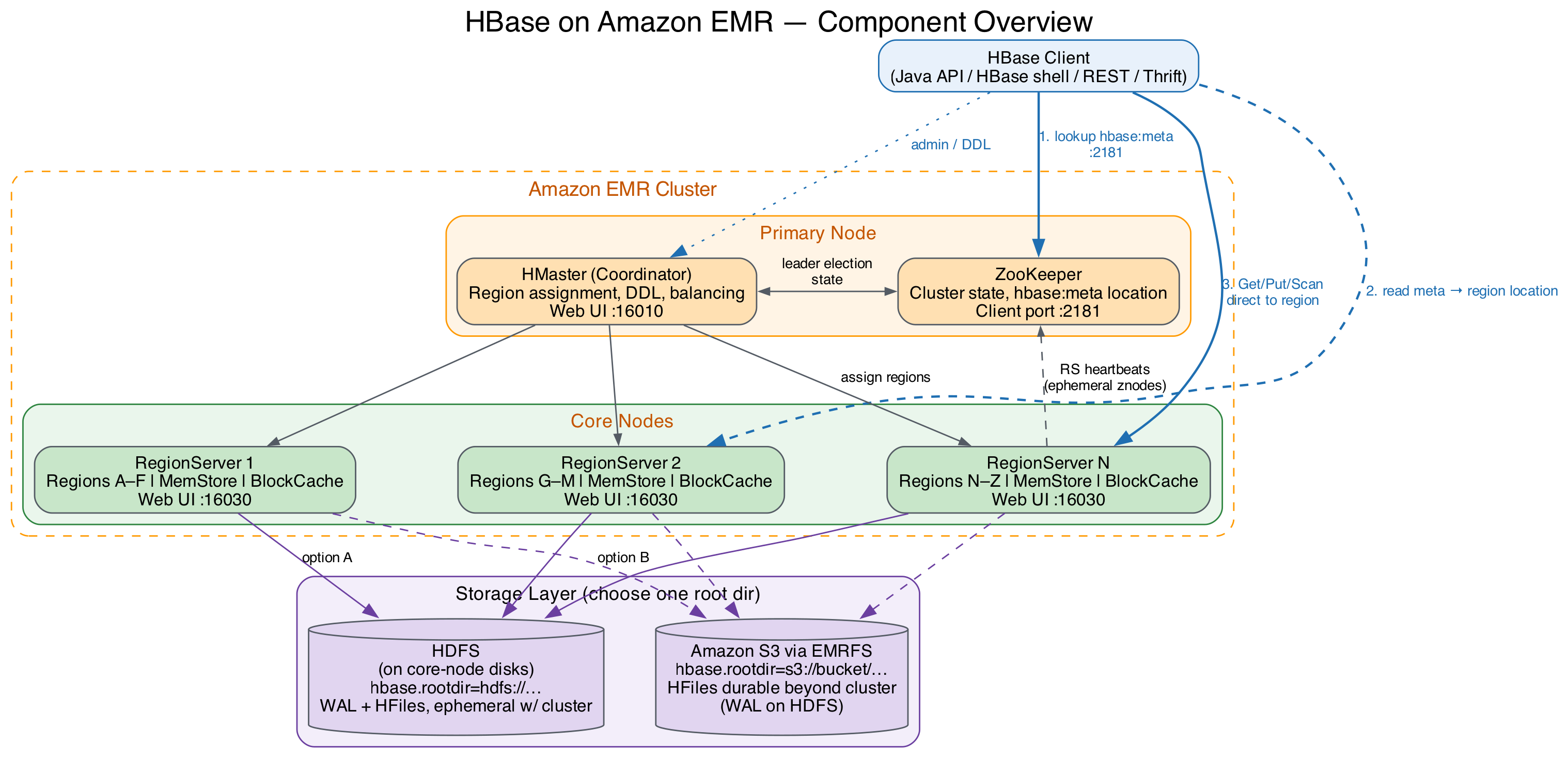
To understand how to troubleshoot HBase, one must first grasp the core components of the architecture. The HMaster, or HBase coordinator, acts as the primary authority, managing region assignments and monitoring the health of individual nodes. Beneath this, RegionServers function as the workhorses, serving read and write requests for specific row ranges. ZooKeeper provides the essential coordination layer, managing distributed state and ensuring that nodes remain in sync.
When these components fail to communicate effectively, the cluster’s state becomes fragmented. For instance, in an HDFS-based storage model, the NameNode must be fully operational before the HMaster can initialize. If the NameNode reports a SafeModeException or missing blocks, the entire HBase ecosystem enters a stalled state. In the context of the cloud, Amazon S3 storage adds another layer of complexity: if the EMR File System (EMRFS) encounters 503 "Slow Down" errors, it signals that the request rate has exceeded the service limits, requiring a strategic adjustment of retry policies and load distribution.
Systematic Triage: A Three-Tiered Approach
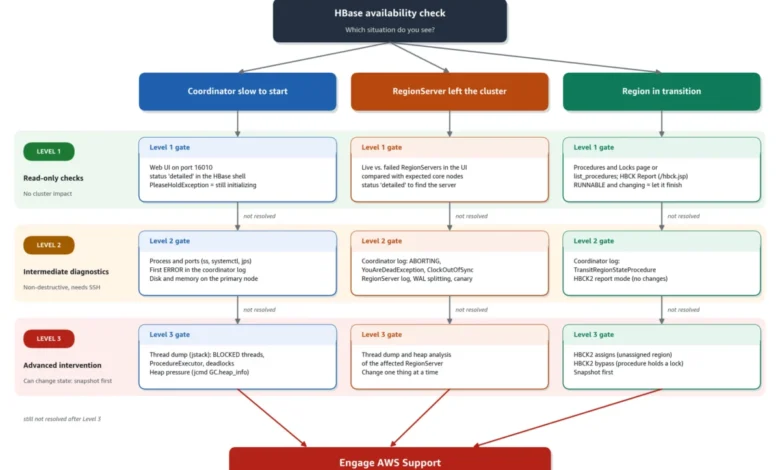
Effective troubleshooting should always follow a hierarchical logic gate process. Level 1 involves non-destructive, read-only observations. Level 2 focuses on resource and process diagnostics, such as checking thread dumps, logs, and port availability. Level 3 is reserved for active intervention, such as adjusting heap configurations or utilizing the HBCK2 operator tool to resolve meta-data inconsistencies.
Phase 1: Addressing the Slow-Starting HMaster
The HMaster is the brain of the cluster. If it fails to reach an initialized state, the cluster remains paralyzed regarding administrative tasks. The most common culprit is a resource contention issue within the Java Virtual Machine (JVM). If the HMaster’s garbage collection (GC) cycles are too frequent or prolonged, the coordinator may lose its connection to ZooKeeper, triggering an endless loop of restarts.
Engineers should first monitor the process using sudo jps -l | grep -i master to identify the Process ID (PID). If the PID is volatile, the logs in /var/log/hbase/ will reveal the root cause. If the issue is related to memory pressure, increasing the coordinator’s heap size through the hbase-env classification in EMR is the standard resolution. However, if the logs point to HDFS issues, such as BlockMissingException, the focus must shift immediately to the NameNode’s health.
Phase 2: Maintaining RegionServer Integrity
RegionServers are the most susceptible to node-level failures. A server may leave the cluster due to a network partition, a fatal JVM error, or a sudden hardware failure. When a RegionServer drops, the HMaster must initiate a "failover" process, reassigning the lost regions to surviving nodes.
Data shows that the majority of RegionServer exits are preceded by YouAreDeadException signatures in the logs, which usually indicates that the server’s heartbeat was lost—often due to a "stop-the-world" GC pause. By examining the hbase-hbase-regionserver-*.log files on the specific core node, administrators can pinpoint the exact moment of failure. In scenarios where a node is flapping, checking the system time synchronization via NTP is crucial; a ClockOutOfSyncException is a common, yet often overlooked, cause for cluster instability.
Phase 3: Resolving Regions in Transition (RIT)
Regions that remain in a "transition" state for more than a few minutes represent a bottleneck in the cluster’s performance. These regions are essentially locked, preventing read/write access. This typically happens when the HMaster, the RegionServer, and the Meta-table fall out of alignment during a split or merge operation.
Before attempting a repair, it is imperative to use the HBCK2 tool to report the state without modifying it. For clusters running on EMR 6.x or 7.x, developers should avoid legacy HBCK1 commands, which can cause irreparable harm to the HBase 2.x metadata structure. By running reportMissingRegionsInMeta, engineers can gain a clear view of the discrepancy before using the assigns or bypass commands to restore normalcy.
The Critical Role of Log Analysis
Log signatures act as the primary language of failure. The following table highlights key indicators that should trigger specific, predefined responses from an operations team:
| Log Signature | Root Cause Analysis | Corrective Path |
|---|---|---|
SafeModeException |
HDFS in read-only mode | Address HDFS NameNode health |
SessionExpired |
ZooKeeper coordination failure | Inspect ZooKeeper quorum health |
503 Slow Down |
EMRFS/S3 throttling | Increase fs.s3.maxRetries |
JvmPauseMonitor |
Excessive Garbage Collection | Tune JVM heap/GC parameters |
ClockOutOfSync |
Node time skew | Synchronize NTP/Chrony services |
Broader Implications and Strategic Best Practices
The transition to cloud-native big data platforms like Amazon EMR has fundamentally shifted the operational burden for many organizations. While the underlying hardware is abstracted, the complexity of distributed systems remains.
Industry analysis suggests that organizations that implement automated, "repeatable" troubleshooting processes reduce their mean time to resolution (MTTR) by approximately 40% compared to those relying on manual, ad-hoc investigation. This is particularly important when managing clusters at scale, where a single malfunctioning RegionServer can cascade into a wider system failure if not addressed within a reasonable timeframe.
Furthermore, the integration of EMR with Amazon S3 means that storage and compute are decoupled. While this offers immense flexibility, it introduces the risk of request throttling. Proactive monitoring of the emrfs-site configuration and the implementation of AIMD (Additive-Increase/Multiplicative-Decrease) retry strategies are essential for maintaining throughput during peak demand.
Official Guidance and Expert Support
When initial diagnostics fail to yield a solution, the most responsible action is to engage AWS Support rather than performing destructive operations on the ZooKeeper znodes. The hbase:meta table and associated ZooKeeper state are the foundations of the cluster’s truth; modifying these without guidance can result in permanent data loss.
Before opening a support case, engineers should compile a comprehensive "triage package." This should include:
- A dump of the coordinator logs covering the period of the incident.
- The output of
list_proceduresfrom the HBase shell. - A snapshot of the Procedures and Locks page from the HMaster web UI.
- Encoded region names and recent thread dumps.
Conclusion: A Disciplined Path Forward
Operating HBase on Amazon EMR is an exercise in managing distributed state. By adhering to the three-level triage process—starting with read-only validation, moving to log-based diagnosis, and ending with targeted, snapshot-backed interventions—operations teams can maintain high availability even in the face of complex failures.
As the ecosystem continues to evolve, keeping abreast of the latest EMR release notes and Apache HBase JIRA updates is essential. Many availability issues that were common in earlier versions have been mitigated in newer releases through enhanced automated recovery procedures and more robust handling of region transitions. Ultimately, a successful SRE strategy for HBase is built on the understanding that while failures are inevitable, the path to recovery should always be predictable and deliberate.