Scaling AI Agent Architectures Through Sequence-Level Knowledge Distillation on Amazon SageMaker AI

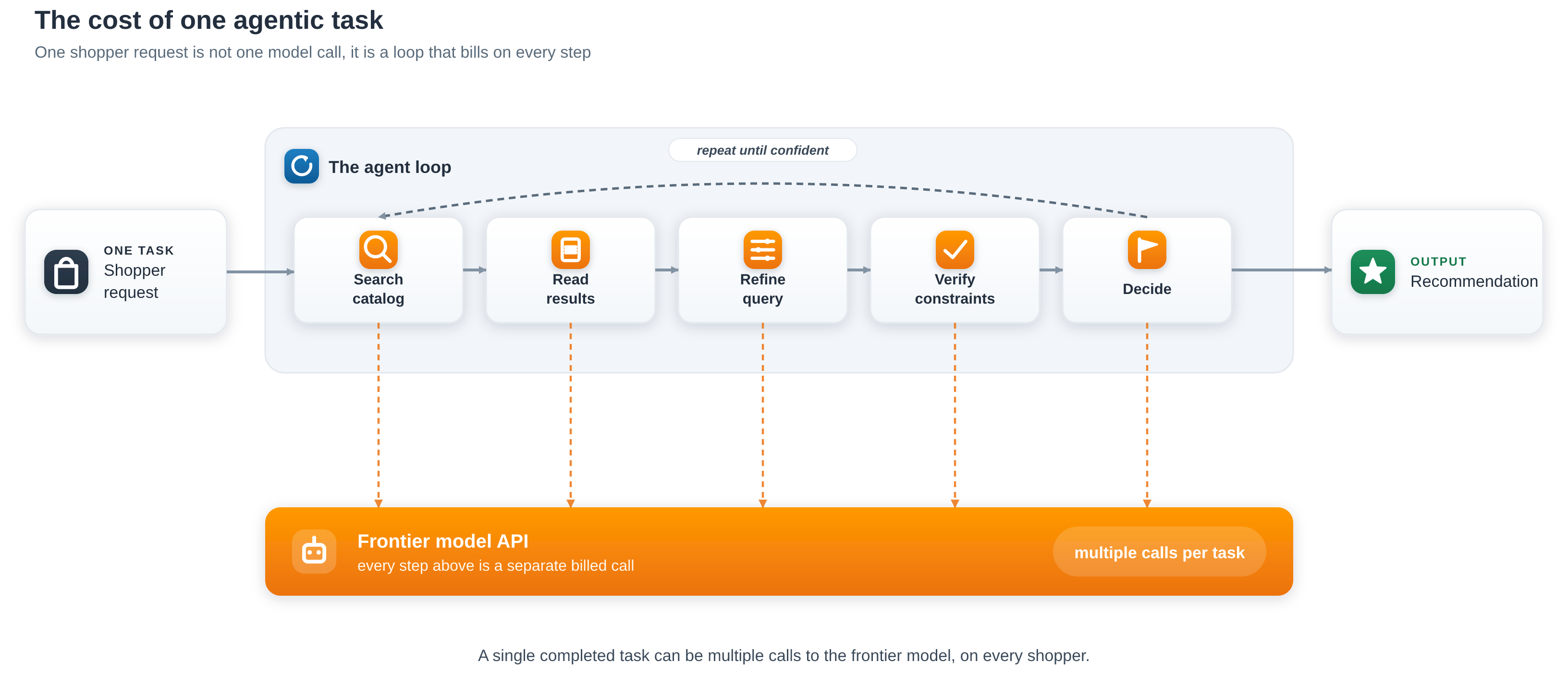
Deploying autonomous artificial intelligence agents for complex, multi-step consumer tasks has transformed enterprise software engineering, but it has simultaneously introduced unprecedented operational expenditures. When a customer interacts with a modern AI-driven shopping assistant—requesting specific criteria such as a black waist bag under twenty dollars from a merchant holding at least a 4.5-star rating—the underlying architecture rarely relies on a single model inference call. Instead, the agent executes an iterative computational loop: querying product catalogs, inspecting candidate results, validating strict constraints, refining parameters, and ultimately committing to a recommendation.
At production scale—processing millions of customer queries daily—this recursive agentic loop requires multiple calls to expensive frontier models per completed task. Because developers are billed on a per-token basis for every single iteration across every active user, cumulative expenses compound rapidly. This economic friction frequently erodes project return on investment (ROI), preventing promising agentic applications from successfully transitioning from development environments to enterprise-grade production deployments.
To mitigate these escalating expenditures, artificial intelligence teams have increasingly turned toward model distillation. Traditionally, deploying smaller open-weight models offers a faster, more cost-effective alternative to proprietary frontier systems. However, smaller models typically suffer from a severe degradation in task performance, failing to navigate complex, multi-step workflows reliably. Knowledge distillation addresses this performance gap by transferring the behavioral patterns of a larger "teacher" model into a smaller "student" model. Through targeted training, the student learns to replicate the teacher’s outputs, capturing a significant portion of the larger model’s accuracy while retaining the operational speed and low hosting costs associated with smaller architectures.
The Mechanics of Sequence-Level Knowledge Distillation
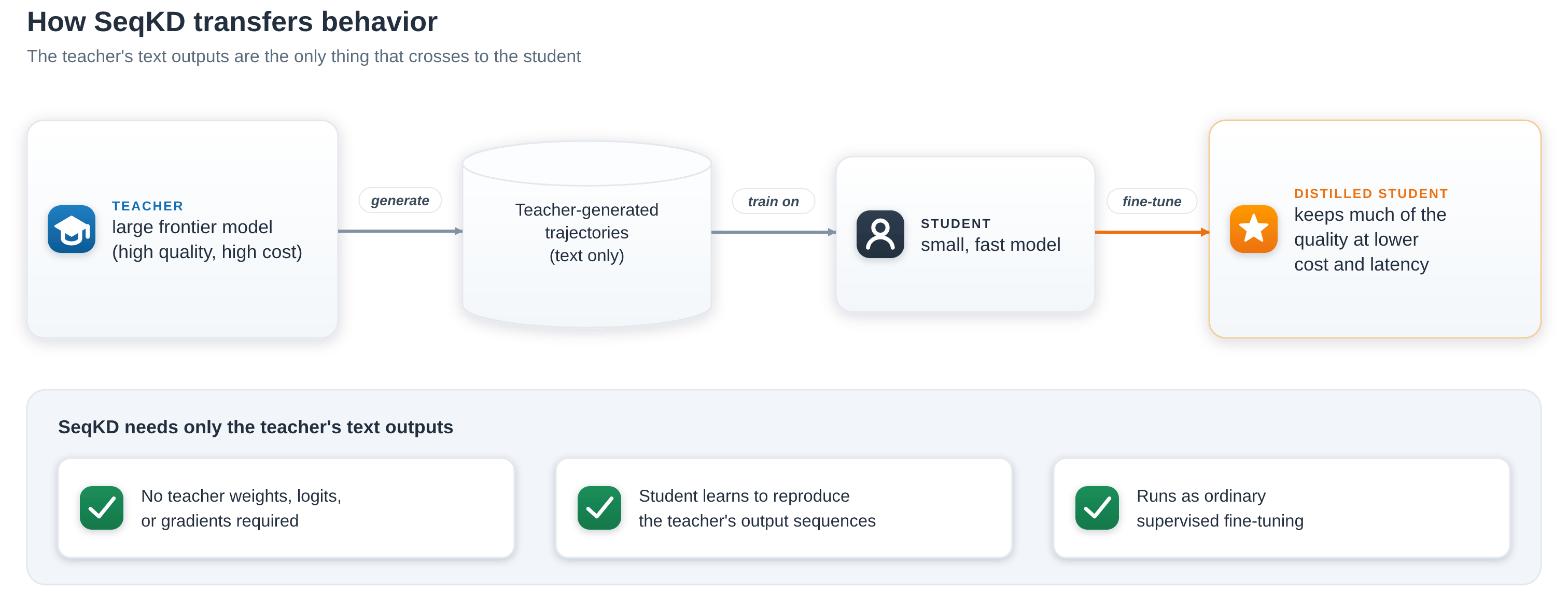
Among various distillation paradigms, sequence-level knowledge distillation (SeqKD) has emerged as an accessible and highly efficient methodology for enterprise teams. Unlike logit-based distillation—which requires direct access to internal model probabilities, gradients, and model weights—SeqKD relies entirely on the text outputs generated by the teacher model. This characteristic makes SeqKD uniquely compatible with closed, API-only frontier models where internal parameters remain entirely inaccessible.
In the context of agentic workflows, the sequence produced by a teacher model is not a simple block of narrative prose. Rather, it represents an ordered operational trajectory consisting of internal reasoning traces, tool invocations, and environmental observations, where each sequential step conditions the next. By fine-tuning a smaller student model on these comprehensive multi-step trajectories using supervised fine-tuning (SFT), developers effectively teach the student the logical progression required to solve complex problems.
Furthermore, SeqKD serves as a foundational data generation mechanism. Organizations supplying raw inputs without pre-existing high-level target labels can leverage frontier teachers to synthesize robust training datasets. By coupling this teacher generation process with programmatic validation mechanisms—such as automated benchmarks equipped with deterministic scorers—developers can isolate successful trajectories, discarding failed runs and training the student exclusively on verified, high-quality behaviors.
End-to-End Solution Architecture on Amazon SageMaker AI
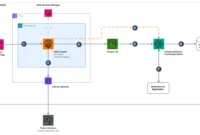
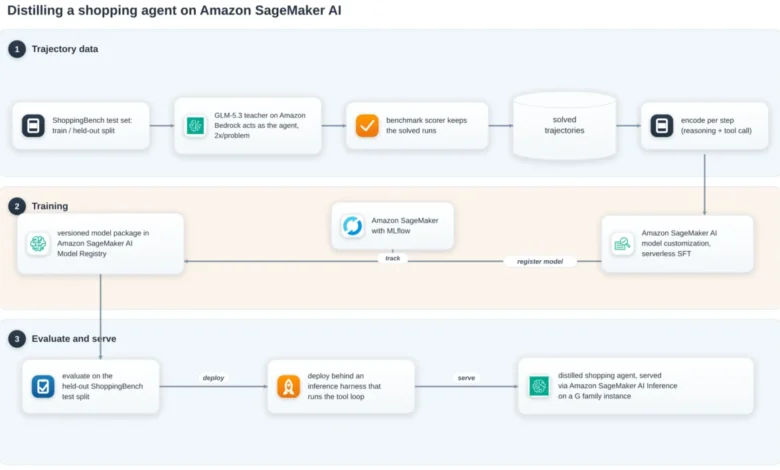
Recent technical implementations demonstrate how organizations can execute sequence-level distillation at scale using managed cloud infrastructure. In a benchmark deployment utilizing Amazon SageMaker AI and Amazon Bedrock, engineers constructed a robust shopping assistant pipeline designed to optimize cost without sacrificing domain-specific accuracy.
The implementation utilized a frontier teacher model—specifically GLM-5.3 hosted on Amazon Bedrock—acting as an automated shopping agent across standardized benchmark environments. This environment published structured synthetic shopping problems spanning multiple consumer intents, including product searches, merchant selection, and voucher discovery. Each problem established strict constraints and hidden ground-truth answers.
To compile a diverse and resilient training dataset, the frontier teacher processed training problems multiple times at a higher temperature setting (1.0). This stochastic decoding approach encouraged the teacher to explore diverse reasoning paths and query formulations across repeated attempts, generating a expansive pool of candidate trajectories. Subsequently, programmatic scoring harnesses evaluated each trajectory against task constraints, performing rigorous rejection sampling. Only trajectories that successfully achieved the objective were retained for fine-tuning.
Following trajectory filtering, engineers structured the dataset into multi-turn chat formats. Each step of an agentic episode was encoded into conversational turns, explicitly separating system instructions, user prompts, user-tool interactions, and assistant reasoning traces. To prevent contextual leakage during model training, datasets were partitioned strictly at the problem level rather than the individual row level. Additionally, token efficiency was optimized by pruning extraneous environmental observations—retaining only essential metadata such as product identification numbers, pricing figures, and rating metrics—thereby ensuring training sequences remained comfortably within memory limits.
Managed Serverless Fine-Tuning and Inference Optimization
With training datasets formatted and securely stored in Amazon Simple Storage Service (Amazon S3), fine-tuning was executed using serverless supervised fine-tuning capabilities via Amazon SageMaker AI model customization. Selecting an open-weight base architecture—such as the Qwen3.5-4B model—developers initiated managed customization jobs without the overhead of provisioning specialized compute clusters or configuring custom container environments.
Training metrics were systematically tracked in real time through integrated Amazon SageMaker MLflow tracking environments. Hyperparameters were tailored to accommodate extended multi-step context lengths, employing Low-Rank Adaptation (LoRA) strategies to efficiently update model weights. Upon completion, the customization pipeline automatically registered the resulting model artifacts into versioned model package groups.
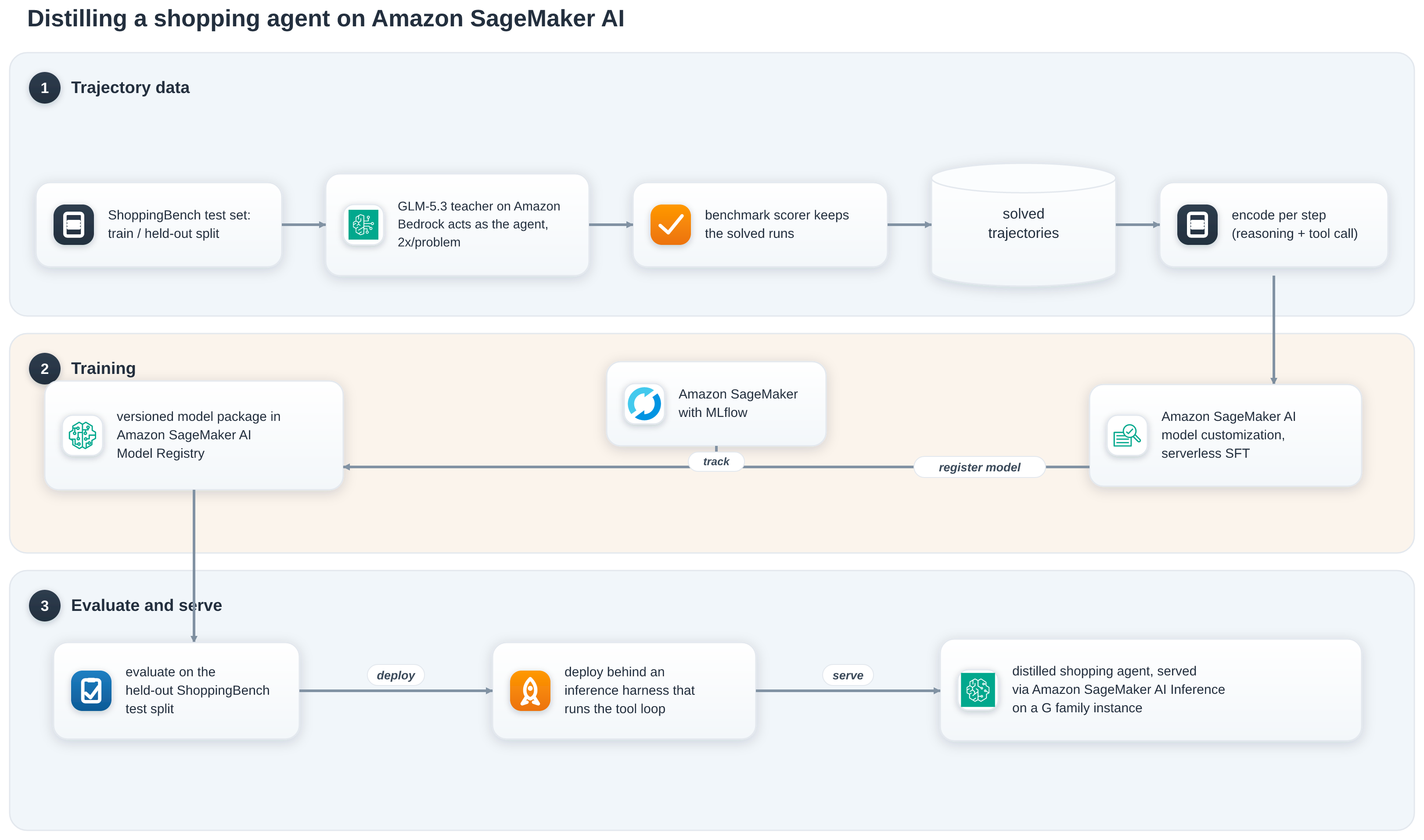
To evaluate the distilled student prior to resource-intensive end-to-end testing, engineers deployed managed model evaluation workflows utilizing custom reward functions. These pre-checks specifically audited whether the student model emitted the correct tool selection sequence in response to prompts, comparing its outputs directly against teacher reference standards.
For production serving, the distilled student was deployed on real-time inference endpoints leveraging high-throughput serving engines such as the Deep Java Library Large Model Inference (DJL LMI) container integrated with vLLM acceleration. To maximize hardware efficiency, engineers deployed the base model weights once while attaching the student model’s LoRA adapter as a discrete inference component on the same underlying endpoint. This configuration allowed organizations to serve both the foundational model and the specialized student side-by-side on a single GPU instance—such as an NVIDIA-powered G-family instance—incurring minimal additional memory overhead compared to duplicating full model weights.
Empirical Results and Performance Analysis
Comprehensive evaluations conducted on held-out benchmark splits revealed remarkable performance retention in distilled student models. Measuring Absolute Success Rate (ASR) across product, shop, and voucher intents, empirical findings demonstrated that the 4B student model successfully recovered essentially all of its frontier teacher’s task performance.
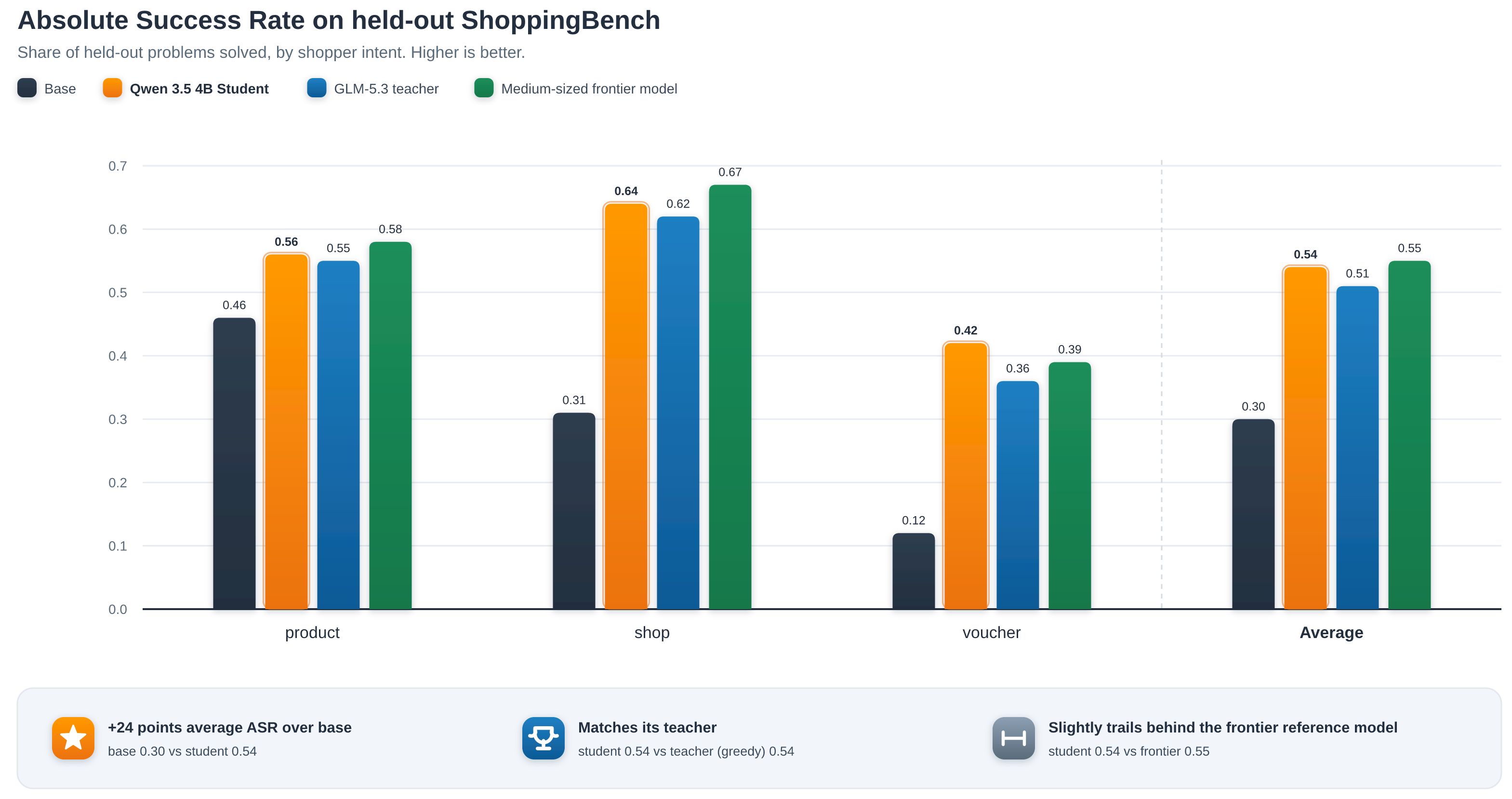
While an un-fine-tuned base Qwen3.5-4B model achieved an average ASR of approximately 0.297 across evaluation metrics, the SeqKD-distilled student achieved an average ASR of 0.541. This performance matched the efficacy of the frontier teacher model that generated its training data (0.511 for sampled decoding; 0.540 for greedy decoding) and closely rivaled larger mid-sized frontier models (0.546).
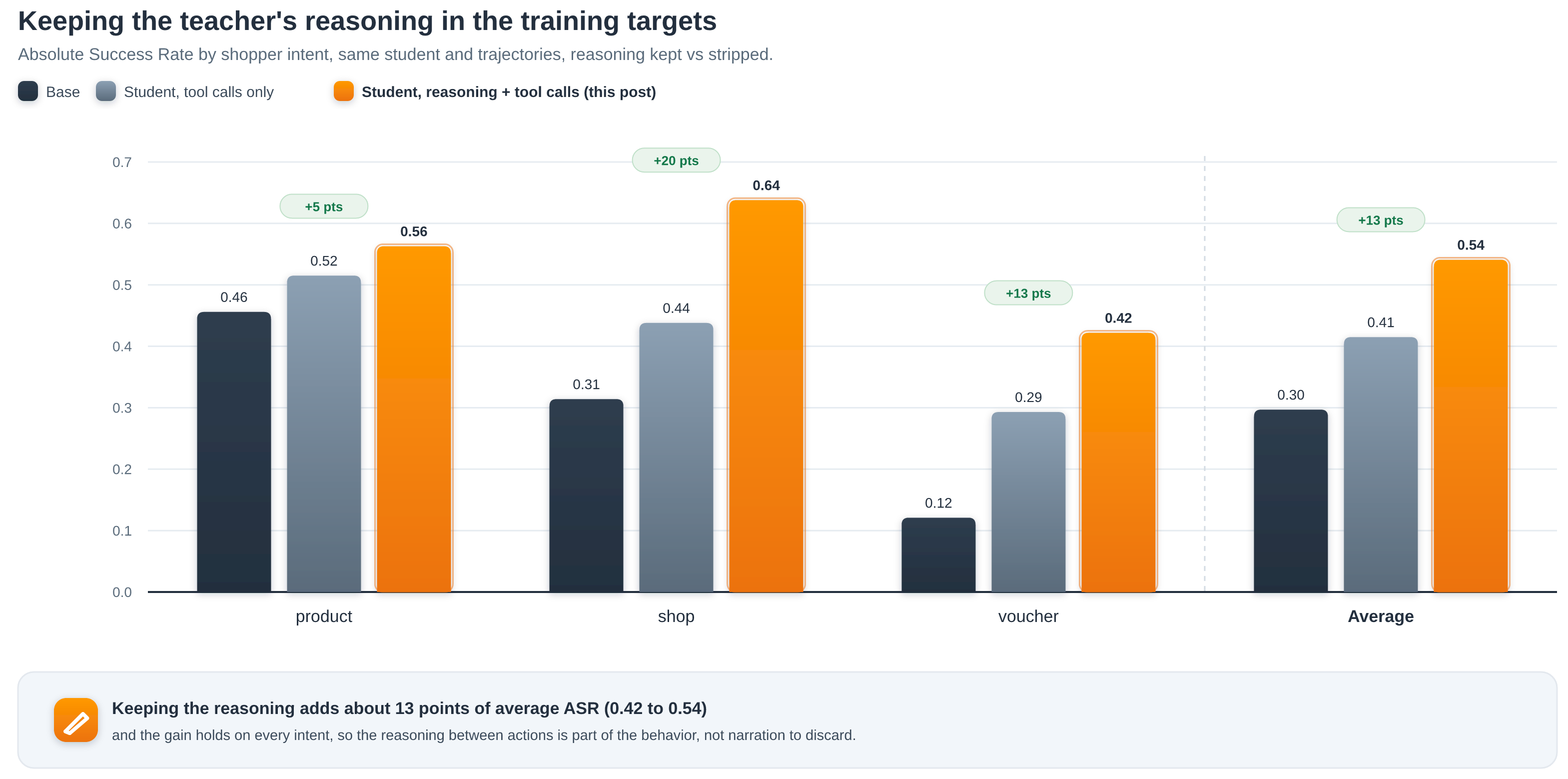
Crucially, comparative ablation studies underscored the vital importance of retaining reasoning traces within the training targets. Training identical student models solely on bare tool calls—stripping away the intermediate reasoning text—resulted in a sharp decline in average ASR, dropping from 0.541 down to 0.415. This empirical evidence confirmed that intermediate logical reasoning acts as an active catalyst for problem resolution rather than superfluous conversational filler.
Furthermore, general instruction-following capabilities were audited using standardized evaluation frameworks such as IFEval. While specialized fine-tuning introduced a minor regression in strict formatting compliance—with strict prompt scores shifting downward by approximately six to eight points—this trade-off was quantified as an expected and acceptable cost of domain specialization.
Implications and Strategic Outlook
The widespread adoption of sequence-level knowledge distillation represents a fundamental shift in how enterprises approach artificial intelligence unit economics. By successfully compressing frontier-tier agentic reasoning into lightweight, open-weight student models, organizations can transition from a variable, per-token API expenditure model to a predictable, fixed infrastructure hosting cost.
This architectural paradigm significantly lowers the financial barrier to deploying autonomous agents at scale. However, industry practitioners emphasize that SeqKD operates within specific boundaries. Distillation successfully transfers capabilities that a student model possesses the foundational capacity to represent; it cannot overcome strict cognitive capacity walls if the underlying model scale is vastly mismatched to the inherent complexity of the target domain. Consequently, complex agentic tasks requiring sophisticated self-correction mechanisms often require subsequent on-policy reinforcement learning stages to surpass performance plateaus.
As enterprises continue to refine automated customer engagement platforms, logistics orchestrators, and intelligent search tools, sequence-level knowledge distillation on managed cloud environments like Amazon SageMaker AI provides a scalable, economically viable blueprint for sustainable artificial intelligence development.