Deploying Advanced AI Infrastructure: Integrating OpenAI Frontier Models and Codex within AWS GovCloud (US) via Amazon Bedrock

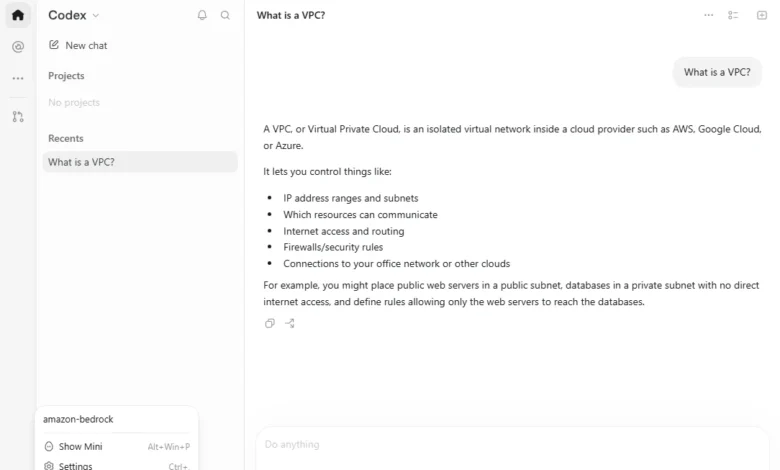
The technological landscape of artificial intelligence in secure environments has reached a significant milestone with the official integration of the ChatGPT desktop application and its specialized coding agent, Codex, into Amazon Bedrock within AWS GovCloud (US). This development provides public sector agencies, defense contractors, and highly regulated enterprises with direct access to advanced frontier models while maintaining strict adherence to federal data sovereignty, security, and compliance frameworks.
By routing model requests through Amazon Bedrock Mantle located in the us-gov-west-1 Region, organizations can leverage sophisticated multi-step reasoning and automated software development tools without compromising compliance mandates. This deployment architecture ensures that organizations handling sensitive workloads can utilize state-of-the-art AI while keeping data governance aligned with rigorous federal standards.
Background and Context of the Integration
The demand for generative artificial intelligence within government and highly regulated industries has grown exponentially over recent years. However, public sector entities face unique hurdles regarding data residency, zero data retention policies, and identity management. Standard commercial AI deployments often fall short of meeting the stringent requirements outlined by federal frameworks such as the Federal Risk and Authorization Management Program (FedRAMP) and Department of Defense (DoD) Impact Levels.
To bridge this gap, cloud service providers and AI developers have increasingly focused on localized, highly secure inference pathways. The introduction of OpenAI frontier models to AWS GovCloud (US) addresses these concerns directly. By decoupling commercial data pipelines from secure government endpoints, agencies can harness artificial intelligence for complex data synthesis, automated code review, and advanced systems testing. The integration utilizes foundational components—Work for complex multi-step tasks and Codex for developer workflows—housed entirely within secure, authenticated AWS boundaries.
Chronology of Deployment and Configuration Mechanics
Implementing this advanced architecture requires a structured, multi-phase rollout designed to ensure comprehensive security validation before any production scaling occurs. Security teams typically begin by establishing a controlled testing environment on an organization-managed workstation.
The configuration process is divided into three primary milestones: authentication setup, configuration file deployment, and runtime verification. In the initial phase, administrators establish approved AWS identities using named profiles, such as codex-il5, or configure Amazon Bedrock API keys. The system accommodates both direct bearer tokens and standard AWS SDK credential chains, seamlessly integrating with AWS IAM Identity Center for multi-factor authentication and temporary role assumption.

Following authentication, administrators deploy two critical configuration files: requirements.toml and config.toml. The requirements.toml file functions as an immutable, administrator-controlled policy guardrail. Placed in protected directories such as %ProgramData%OpenAICodexrequirements.toml on Windows or /etc/codex/requirements.toml on Unix-based systems, this file dictates capability restrictions that users cannot alter. It explicitly disables unauthorized network endpoints, unapproved plugins, and external telemetry while enforcing sandbox isolation.
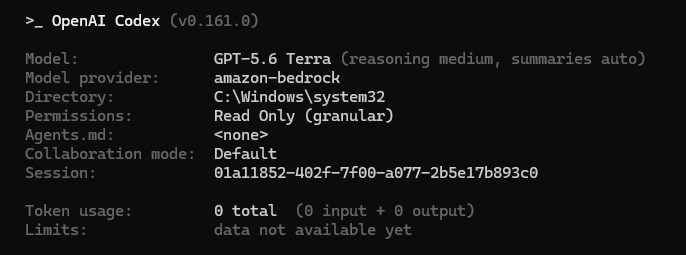
Concurrently, the config.toml file instructs the ChatGPT desktop application and Codex CLI to route all inference requests through the amazon-bedrock model provider. By specifying the base URL for the us-gov-west-1 endpoint and linking the designated AWS profile, the application bypasses standard commercial endpoints entirely. Once these files are correctly positioned prior to the initial application launch, administrators execute the software and verify the integration through the status interface, confirming that model inference is successfully bound to the secure regional Bedrock endpoint.
Technical Specifications and Security Parameters
The security architecture underpinning this deployment relies on strict network isolation and granular permission controls. Within the requirements.toml framework, outbound network traffic is heavily restricted. Domains associated with commercial OpenAI interfaces—including api.openai.com, chatgpt.com, and various telemetry endpoints—are explicitly denied. Conversely, the specific Amazon Bedrock Mantle endpoint (bedrock-mantle.us-gov-west-1.api.aws) is whitelisted to permit authorized inference traffic.
Furthermore, the deployment supports Zero Data Retention (ZDR) capabilities. In this mode, prompts and generated responses are processed within the selected AWS Region without being written to durable storage by AWS or shared downstream with model providers. This protects sensitive source code, proprietary algorithms, and classified or controlled unclassified information (CUI).
Pricing and licensing models have also been structured to accommodate institutional usage. Organizations incur costs strictly on a per-token consumption basis, eliminating the administrative overhead associated with individual seat licenses or rigid per-developer commitments. This usage-based model allows agencies to scale access efficiently based on active project demands.
Official Responses and Industry Implications
Industry analysts and public sector technology leaders have noted that the availability of frontier AI models within GovCloud environments marks a paradigm shift in how government agencies approach software engineering and data analysis. While major cloud providers and AI developers have previously offered isolated cloud instances, the integration of native desktop tools like the ChatGPT app and Codex CLI brings conversational AI and automated coding assistance directly to the developer’s local machine while preserving strict perimeter defense.
Representatives from participating organizations emphasize that while the AWS GovCloud infrastructure provides the necessary foundational security controls, ultimate responsibility for compliance remains with the customer. Agencies must rigorously review selected model parameters, workstation configurations, and IAM policies against their respective System Security Plans (SSPs) before granting widespread authorization.
Implications for Regulated Software Development
The integration of Codex into secure software development lifecycles addresses persistent bottlenecks in public sector technology modernization. Government IT departments frequently struggle with legacy codebases, extensive documentation requirements, and lengthy security review cycles. By deploying an AI coding agent configured to operate entirely within an isolated VPC and regional endpoint, development teams can accelerate code generation, unit testing, and vulnerability remediation without exposing intellectual property or proprietary logic to external networks.
Troubleshooting and Rollback Protocols
Despite the robust architecture, deployment teams may encounter operational hurdles during initial testing. Common issues include the application inadvertently prompting for a commercial OpenAI user account, which typically indicates that configuration files were placed after the application had already initialized. Other potential challenges involve misconfigured AWS credential chains or overly restrictive sandbox policies that limit developer workspace functionality.
In the event of a validation failure or security exception, standardized rollback protocols require administrators to immediately terminate all active Codex and ChatGPT processes, revert device policies to previous baselines, and revoke any temporary AWS credentials or session tokens. Comprehensive documentation of any anomalies is mandated to ensure continuous improvement of the agency’s security posture before subsequent deployment attempts.
Conclusion and Future Outlook
The successful integration of the ChatGPT desktop application and Codex on Amazon Bedrock within AWS GovCloud (US) demonstrates that cutting-edge artificial intelligence can coexist with stringent federal security mandates. By combining regional data residency, zero data retention capabilities, and rigorous administrator-enforced policy files, public sector organizations now possess a scalable framework to accelerate digital transformation. As agencies continue to test and evaluate these tools, this deployment model serves as a blueprint for balancing technological innovation with uncompromising data security.