Streamlining Data Engineering: AWS Glue 6.0 Introduces Spark Declarative Pipelines for Simplified ETL Architectures

The evolution of modern data platforms has long been dominated by the medallion architecture—a structured, multi-tiered approach that segments data into "bronze" raw ingestion, "silver" validated refinement, and "gold" business-ready aggregation. Historically, implementing this architecture on Amazon Web Services (AWS) required a complex, two-layered design: an orchestration layer, typically managed by Amazon Managed Workflows for Apache Airflow (MWAA) or AWS Step Functions, and a processing layer comprised of multiple AWS Glue jobs. This configuration, while robust, introduced significant overhead regarding dependency management, retry logic, and the wiring of directed acyclic graphs (DAGs). With the release of AWS Glue 6.0, powered by Apache Spark 4.1, AWS has introduced Spark Declarative Pipelines (SDP), a transformative feature that shifts the burden of orchestration from the developer to the framework itself.
The Shift from Imperative to Declarative Engineering
The fundamental challenge in data engineering has always been the discrepancy between "what" a developer wants to achieve and "how" the infrastructure executes that intent. Imperative pipelines require engineers to manually define the sequence of execution, handle intermediate checkpoints, and manage the failure recovery of individual tasks. As pipelines scale to include dozens of tables and complex transformations, the orchestration logic often becomes as large and difficult to maintain as the data transformation code itself.
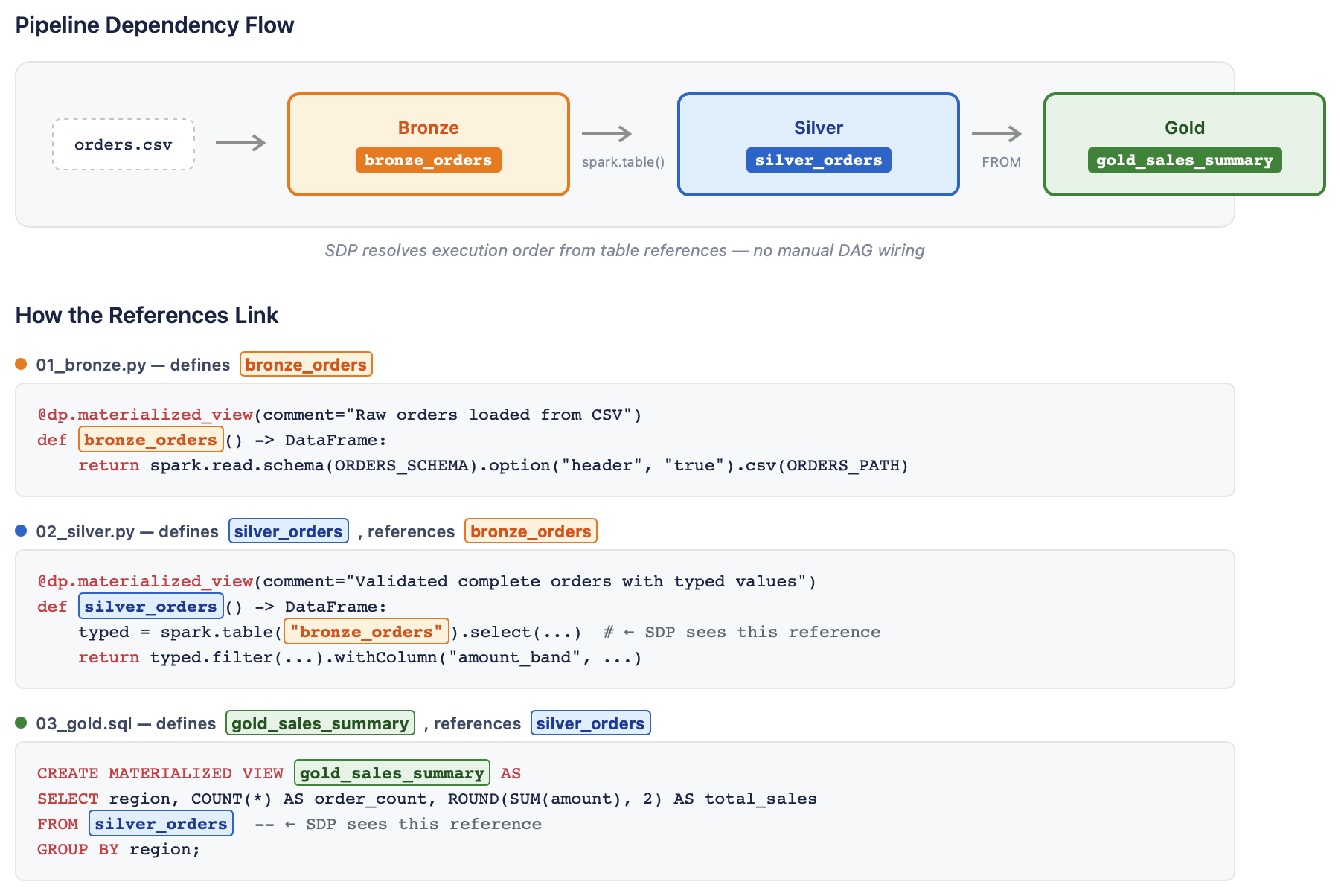
Spark Declarative Pipelines represent a paradigm shift. By utilizing Python decorators and declarative SQL, engineers can define their desired datasets, and the underlying framework automatically resolves the dependency graph. In this new model, the pipeline is no longer a collection of disparate jobs stitched together by an external scheduler; it is a single, cohesive unit of execution. The SDP framework analyzes table references within the code, automatically determining the execution order, managing checkpoints, and handling parallelization. This abstraction allows data teams to focus on business logic rather than infrastructure plumbing.
Technical Foundations and Implementation
At the core of SDP are three primary abstractions: @dp.table, @dp.materialized_view, and @dp.temporary_view. Each decorator serves a distinct purpose in the data lifecycle. Materialized views, which are central to the current implementation of batch-based medallion architectures, ensure that the entire dataset is recomputed, providing consistency for downstream analytics. Meanwhile, the ability to integrate Python-based data validation with SQL-based reporting within the same project allows for a seamless transition between complex ETL logic and business-level modeling.
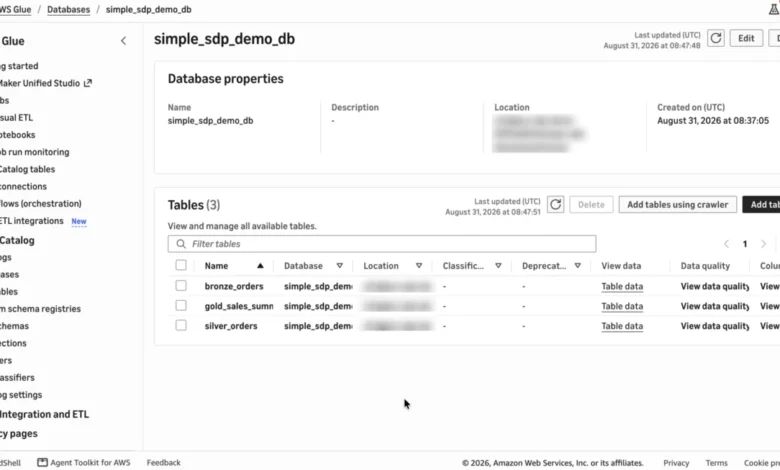
For organizations already entrenched in the AWS ecosystem, the transition to SDP is supported by full integration with the AWS Glue Data Catalog. This allows the output of every stage—bronze, silver, and gold—to be registered as discoverable tables, immediately queryable via services like Amazon Athena. This level of integration reduces the time-to-insight, as the data is cataloged as a native byproduct of the pipeline execution rather than a post-processing step.
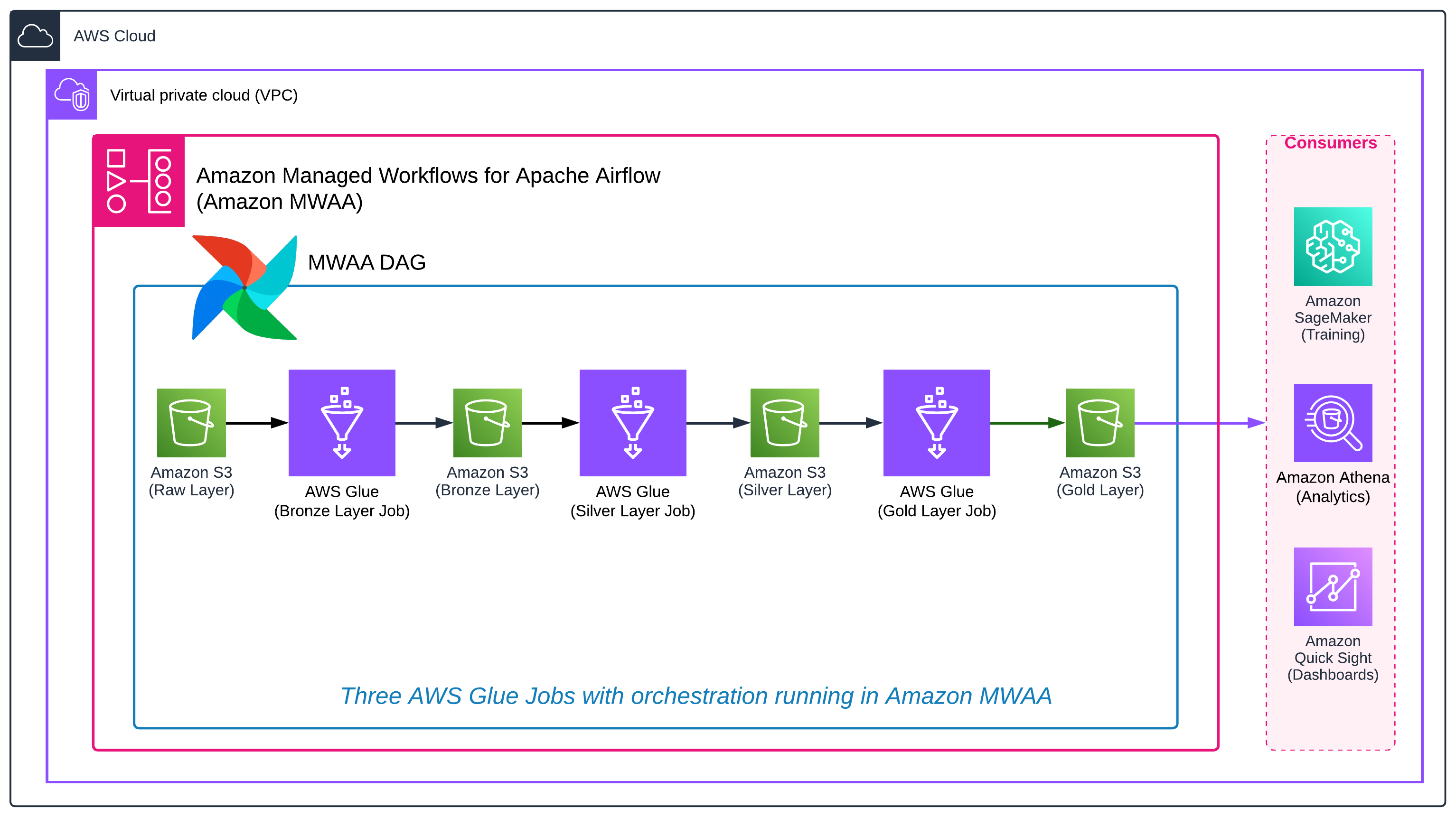
Chronology and Operational Workflow
The implementation of a declarative pipeline follows a structured, ten-step process that emphasizes efficiency and validation. The journey begins with establishing the necessary Identity and Access Management (IAM) roles, followed by the preparation of raw source data—typically in CSV or similar formats—stored within Amazon S3. Once the environment is configured, developers organize their project into transformation modules and a central spark-pipeline.yml specification file.
A critical phase in this process is the "Dry Run" or validation mode. Before committing compute resources to a full production run, developers can execute the pipeline in a VALIDATE mode. This command allows the SDP framework to parse the code, resolve the dependency graph, and check for syntax errors in both Python and SQL, all without writing a single row of data to the warehouse. This safety mechanism is a direct response to the industry-wide need for more reliable, testable data infrastructure. Following validation, the RUN mode executes the actual materialization, with flexible controls such as selective refreshing, which allows engineers to reprocess specific layers of the medallion architecture without triggering a full recompute of the entire data estate.
Supporting Data and Efficiency Gains
The economic implications of AWS Glue 6.0 are significant. Alongside the introduction of SDP, AWS has implemented a 30 percent price reduction per Data Processing Unit (DPU)-hour compared to version 5.1. When combined with the operational efficiency of running a single, streamlined job rather than an orchestrated web of multiple jobs, the cost-benefit analysis favors a transition to this new model.
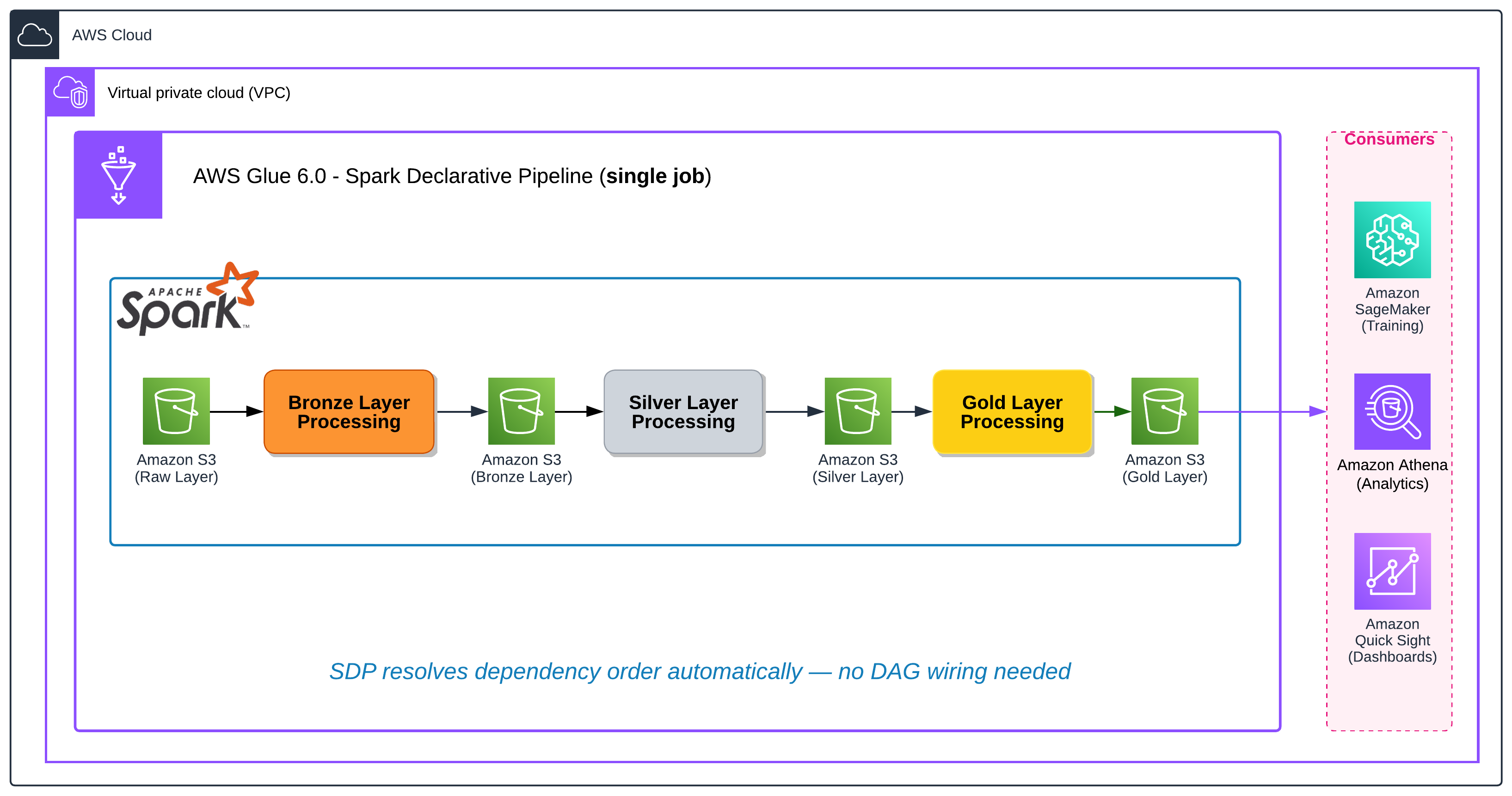
For a typical workload, the reduction in overhead—specifically the elimination of "wait time" between jobs in an orchestrator and the removal of duplicate compute cycles often found in imperative setups—can lead to substantially faster cycle times. In internal benchmarking, pipelines that once required a complex orchestrator to manage state and retries saw a reduction in total lines of boilerplate code by nearly 60 percent. This reduction not only lowers the surface area for bugs but also increases the agility of data engineering teams, allowing them to iterate on new data products at a faster cadence.
Industry Implications and Expert Perspectives
Industry analysts have long noted that the "plumbing" of data engineering—the maintenance of pipelines—often consumes more than 70 percent of a data engineer’s time. By offloading this work to the AWS Glue engine, organizations are effectively reclaiming that capacity for higher-value activities, such as feature engineering, advanced analytics, and machine learning model development.
"The industry is moving toward a declaration-first approach," noted a lead systems architect at a major financial services firm familiar with the transition to Glue 6.0. "We are seeing a trend where the infrastructure becomes an invisible participant in the data flow. By removing the need to manually build DAGs for standard medallion patterns, we reduce the ‘cognitive load’ on our engineers. It allows our team to treat data as a product, where they focus on the schema and the transformation, while the platform handles the scale and reliability."
Challenges and Future Considerations
While the declarative approach offers significant advantages, it does require a shift in mindset. Teams accustomed to the granular, step-by-step control of an orchestrator may initially find the "black box" nature of automatic dependency resolution to be a change of pace. However, the system provides enough hooks—such as the spark.glue.sdp.runMode arguments—to allow for granular control when necessary.
Furthermore, as organizations move toward more sophisticated streaming requirements, the role of Streaming Tables versus Materialized Views will become a key architectural decision. While the current walkthrough focuses on batch processing, the SDP framework is designed to accommodate the transition to real-time data ingestion as business needs evolve.
Conclusion
The release of AWS Glue 6.0 and the advent of Spark Declarative Pipelines marks a turning point in how cloud-native data platforms are constructed. By unifying the transformation logic and the orchestration graph, AWS has provided a path for data teams to simplify their architectures, reduce costs, and improve the reliability of their data pipelines. As the industry continues to prioritize data-driven decision-making, tools that reduce the complexity of the underlying infrastructure will be essential for scaling operations. For developers and architects, the path forward is clear: move away from hand-wiring the execution of the past, and embrace a declarative future where the focus remains squarely on the data itself.