Transforming Supply Chain Resilience: Amazon Quick and NVIDIA NeMo Agent Toolkit Streamline Disruption Management

Fast-growing companies and established enterprise supply-chain teams frequently find themselves with an abundance of data indicating operational issues, yet critically lack the time and resources to manually investigate every single disruption. A seemingly minor supplier delay, for instance, can trigger a cascade of complex tasks, demanding that a planner meticulously scrutinize purchase orders, inventory levels, customer commitments, intricate contract rules, available logistics options, and internal approval policies before a coherent next step can be determined. This manual, reactive approach is not only time-consuming but also highly susceptible to human error, often leading to suboptimal decisions that impact revenue, customer satisfaction, and overall operational efficiency.
Modern supply chains are intricate networks, often spanning continents and involving hundreds, if not thousands, of suppliers, countless SKUs, and diverse customer bases. The sheer volume and velocity of data generated across these operations can be overwhelming. While dashboards have become indispensable tools for visualizing real-time supply chain events, providing teams with a crucial "what’s happening" overview, the more formidable challenge lies in translating these signals into a reliable, actionable decision workflow. This workflow must not only recommend specific mitigation strategies but also transparently present the evidence and rationale underpinning those recommendations, empowering planners to act swiftly and confidently.
This pressing need for intelligent, automated decision support in supply chain management has spurred the integration of advanced AI and machine learning capabilities into enterprise platforms. A recent collaborative innovation demonstrates how Amazon Quick, a unified conversational workspace, can serve as the intuitive business-user interface for highly specialized agent workflows powered by the NVIDIA NeMo Agent Toolkit. This powerful combination is designed to empower supply chain professionals, enabling them to transition seamlessly from a dashboard-level understanding of a disruption to a guided, evidence-backed mitigation recommendation within a single, coherent environment.
The Evolving Landscape of Supply Chain Challenges
In an increasingly volatile global economy, supply chains are under unprecedented strain. Geopolitical shifts, natural disasters, public health crises, and economic fluctuations have transformed what were once predictable operational environments into landscapes rife with uncertainty. According to a recent survey by McKinsey & Company, 73% of companies experienced significant supply chain disruptions in the past year, with the average disruption lasting over two months. The cost of these disruptions can be staggering, often leading to lost revenue, increased operational expenses, and damage to brand reputation.
The complexity is further compounded by the vast amounts of disparate data residing in various enterprise systems—from ERPs and WMS to TMS and CRM—each containing critical pieces of the puzzle. Extracting, correlating, and analyzing this data manually to understand the full impact of a disruption, such as a supplier delay, is a Herculean task. A planner might need to cross-reference data from a purchase order system to see the delayed items, an inventory system to check current stock levels, a customer relationship management (CRM) system to identify affected customer orders and their service level agreements (SLAs), a contract management system for supplier agreements and penalties, and a logistics platform for alternative shipping routes. The cognitive load and time required for such an investigation are immense, often exceeding the window of opportunity for effective intervention.
A New Paradigm: AI-Powered Disruption Management
The integration of Amazon Quick and NVIDIA NeMo Agent Toolkit heralds a significant leap forward in addressing these challenges. Amazon Quick provides a single, conversational workspace that consolidates access to both structured data, such as that found in business intelligence dashboards, and unstructured enterprise knowledge, including documents stored in Amazon S3, Google Drive, Microsoft SharePoint, Atlassian Confluence, and internal web content. This allows business users to interact with their data and knowledge base using natural language, asking complex questions and receiving intelligent responses.
Beyond mere information retrieval, Amazon Quick also offers robust action capabilities, supporting over 100 pre-built connectors to perform actions in third-party systems like Microsoft Outlook, Slack, Jira, and Asana. Crucially, it can also invoke sophisticated agentic workflows exposed through the Model Context Protocol (MCP). This is where the NVIDIA NeMo Agent Toolkit comes into play. As an open-source, framework-agnostic library, NeMo Agent Toolkit is designed for connecting, evaluating, profiling, and optimizing complex agentic workflows. It seamlessly integrates with popular AI frameworks such as LangChain, LlamaIndex, CrewAI, Microsoft Semantic Kernel, and Google ADK, as well as custom Python agents, providing a flexible and powerful backend for orchestrating multi-step decision processes.
In this innovative solution, supply-chain analysts leverage an Amazon Quick chat agent as their primary interface. This agent, in turn, orchestrates a NeMo Agent Toolkit workflow to diagnose issues, call various supply-chain tools, validate potential recommendations against established policies, and ultimately present a ranked mitigation plan to the planner. This guided approach dramatically reduces the time spent on investigation and decision-making, shifting the focus from reactive firefighting to proactive, informed problem-solving.
This architecture offers tangible benefits across various roles. For supply-chain operations leaders, analysts, and builders, it provides a clear pathway from identifying a problem on a dashboard to executing a well-reasoned mitigation plan within Amazon Quick. Engineering leaders and developers gain a robust framework for constructing and optimizing backend agentic workflows using the NVIDIA NeMo Agent Toolkit, with Amazon Quick serving as the intuitive front door for business users. Startups, in particular, can utilize this approach to scale their operations efficiently without the need to rapidly expand their planning teams, ensuring that as order volumes, supplier networks, and customer commitments grow, the underlying architecture supports faster, more repeatable, and consistent supply chain decisions.
The NVIDIA NeMo Agent Toolkit further enhances this capability by offering comprehensive tools for inspecting and evaluating agentic workflows. Telemetry data, per-step latency metrics, and detailed evaluation results provide critical insights for developers to fine-tune workflows, optimize tool performance, and refine orchestration logic. This level of observability becomes increasingly vital as organizations transition from simple chat assistants to more complex, multi-faceted agentic workflows, ensuring reliability and performance in production environments.
Deep Dive into the Solution Architecture
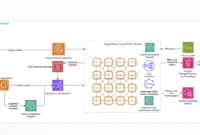
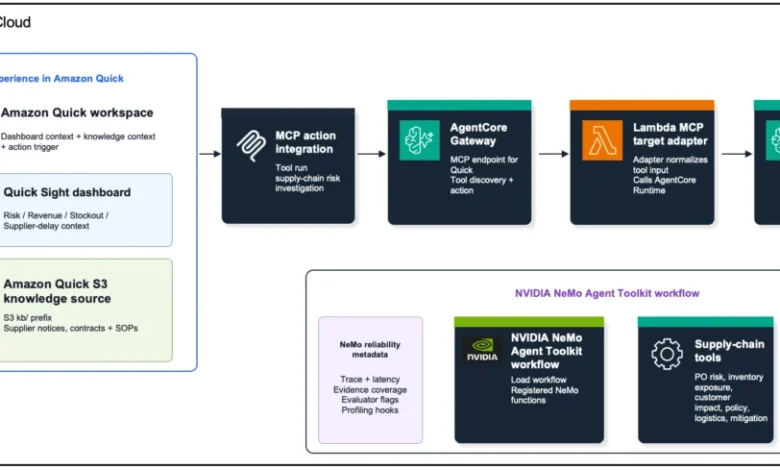
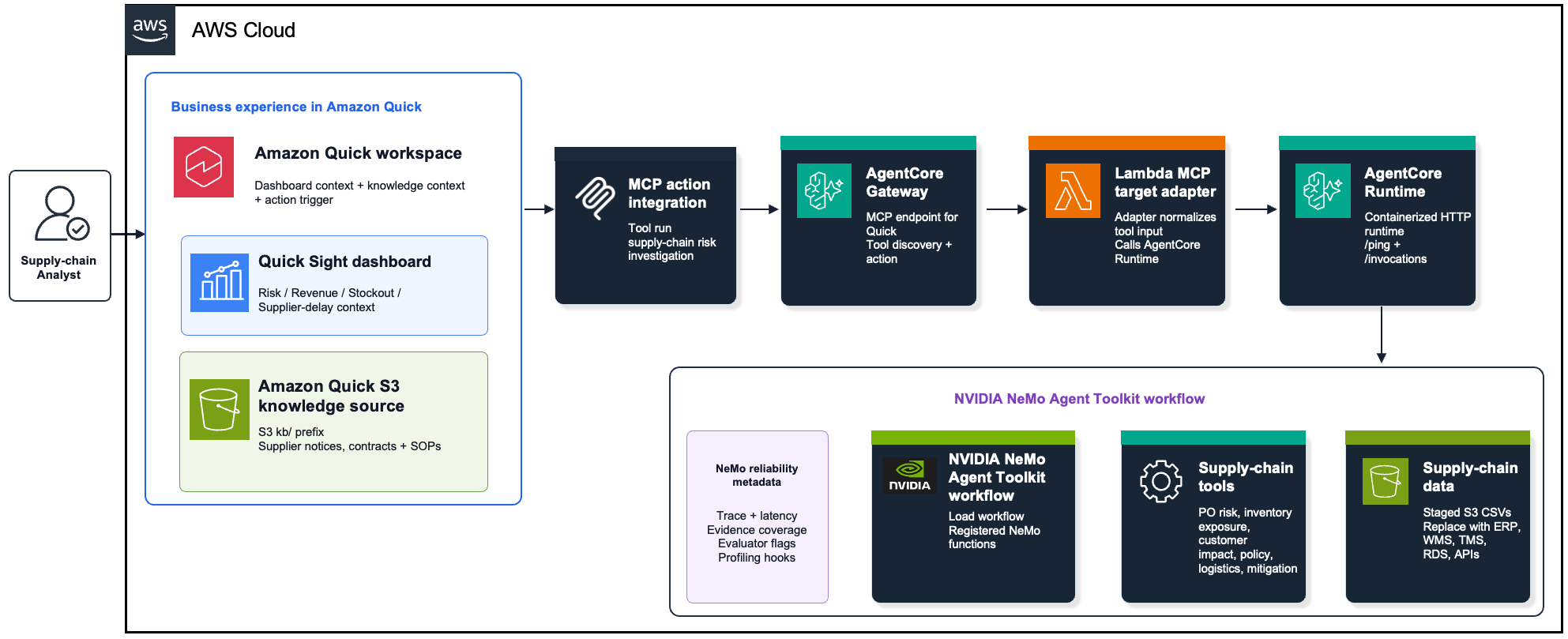
The underlying architecture seamlessly integrates Amazon Quick with the NVIDIA NeMo Agent Toolkit, orchestrated by AWS AgentCore services. Amazon Quick functions as the business-user interface, providing dashboard context, access to diverse knowledge sources, and the trigger for agentic actions. Amazon Bedrock AgentCore, a foundational service for building and deploying AI agents, provides the MCP gateway and the runtime hosting path for the backend workflows. The NeMo Agent Toolkit, residing within the AgentCore Runtime, is responsible for the core agentic workflow: registering specialized tools, orchestrating the supply-chain investigation, capturing detailed execution traces, and supporting robust evaluation and profiling capabilities that enable developers to refine the workflow before its deployment to production.
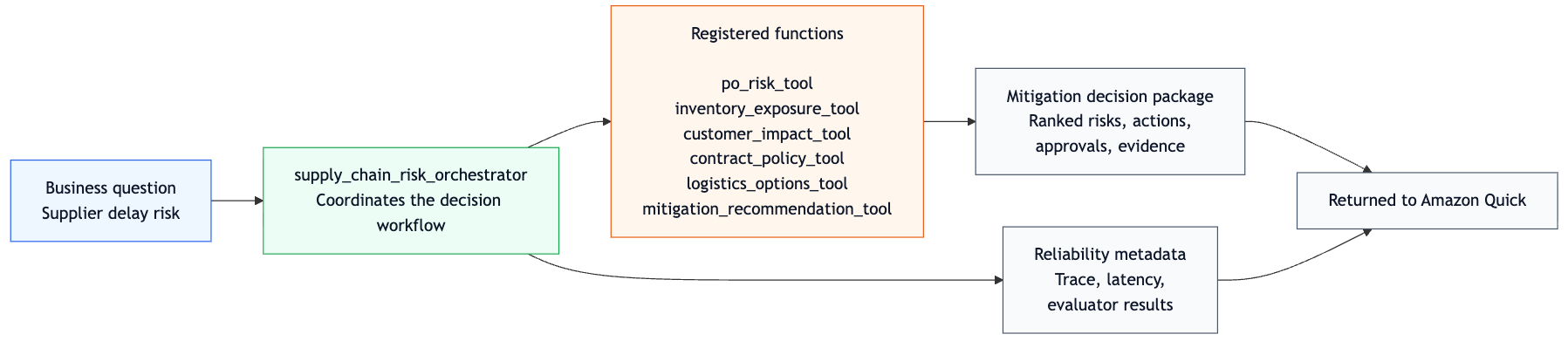
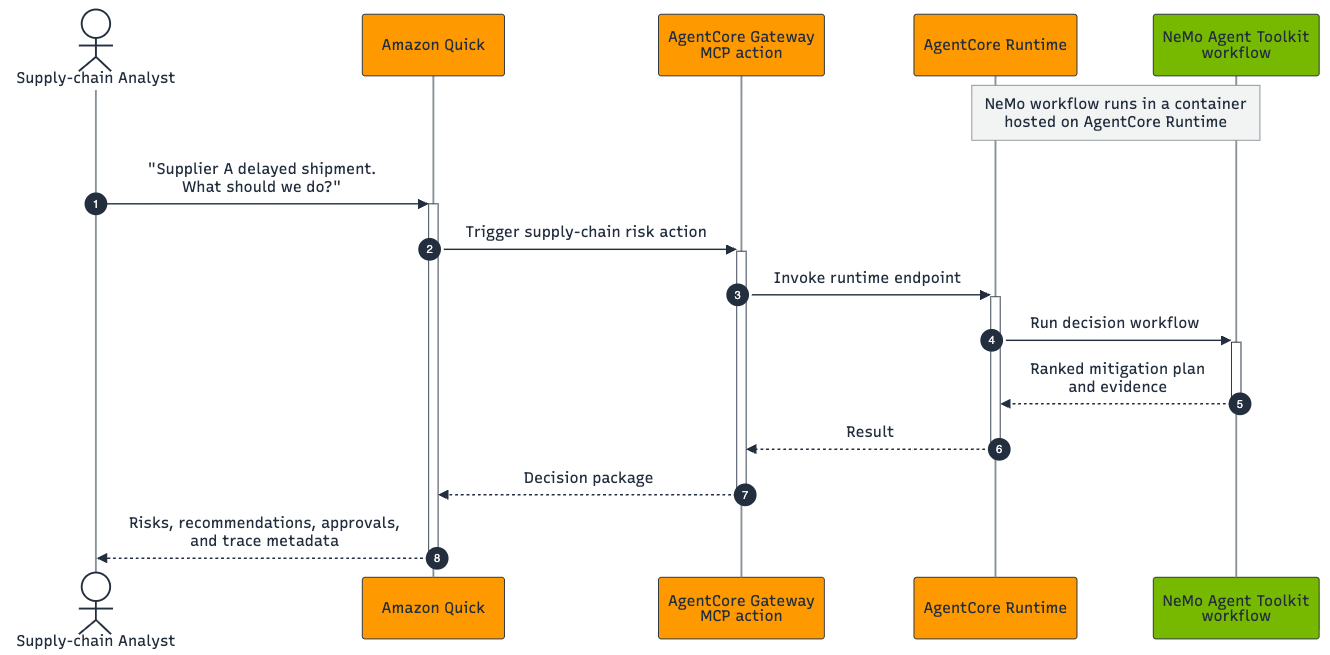
Figure 1 – Solution architecture. Amazon Quick provides the dashboard, knowledge context, and action trigger. AgentCore Gateway exposes the MCP action, and AgentCore Runtime hosts the NeMo Agent Toolkit workflow container.
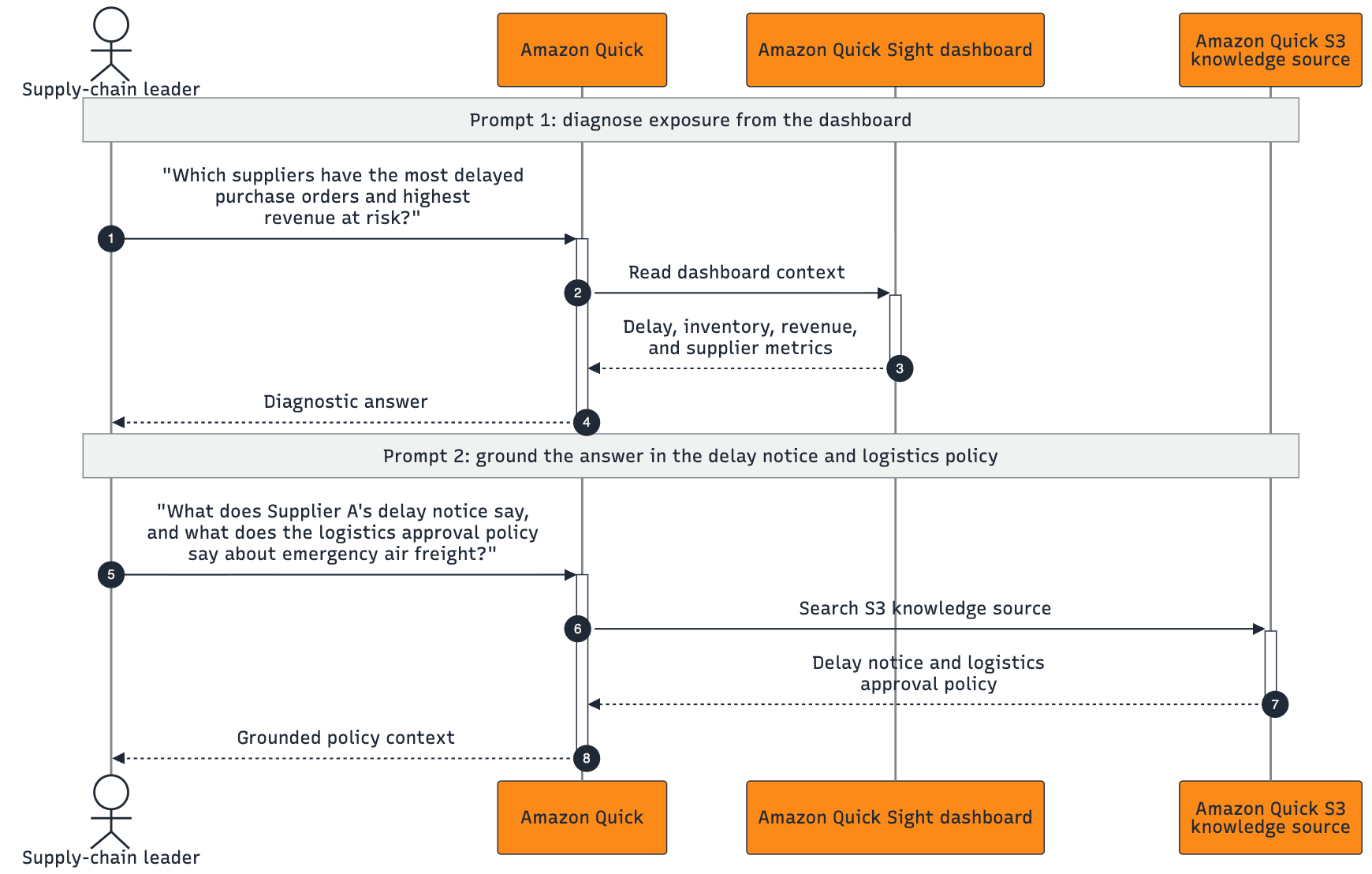
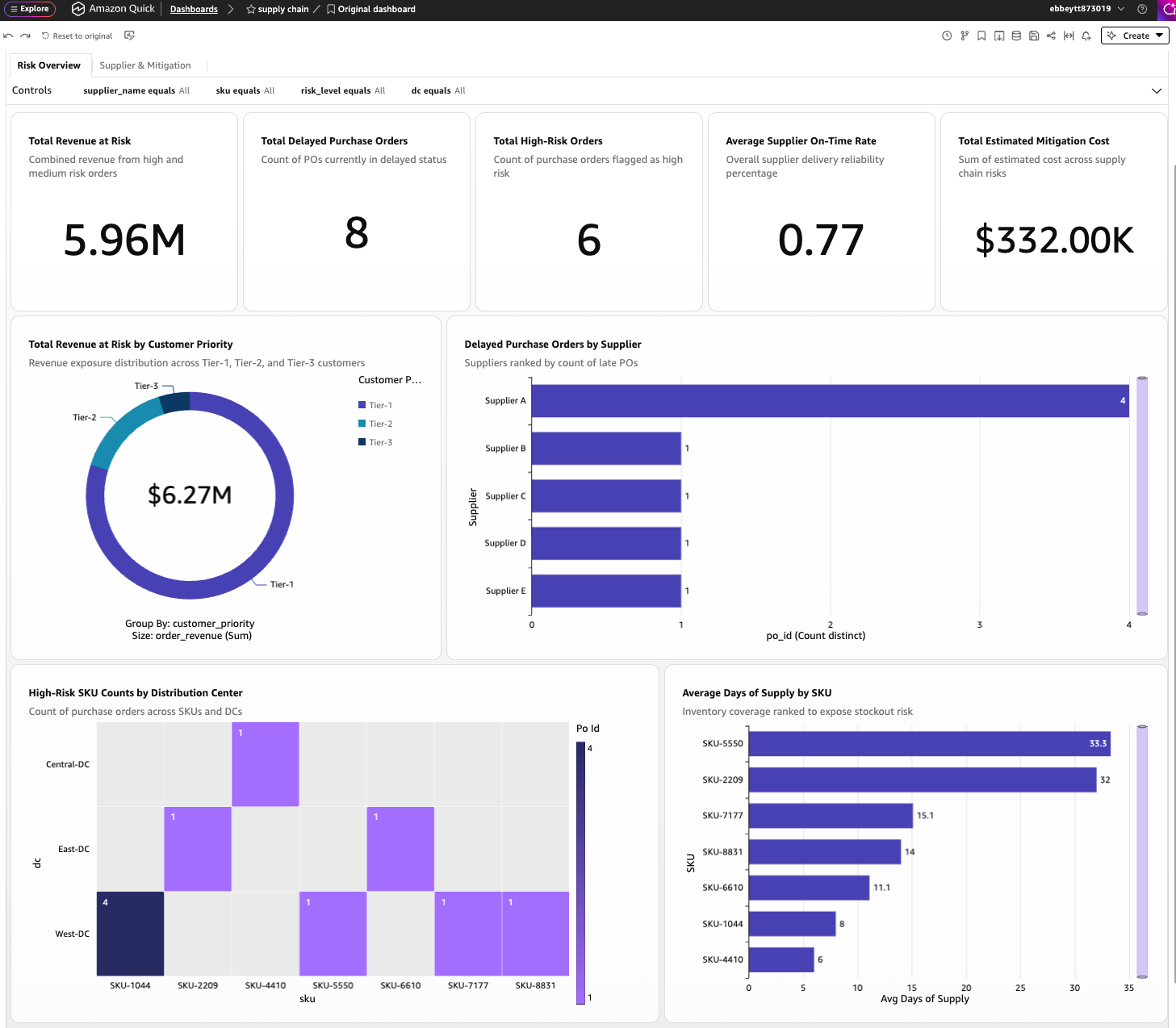
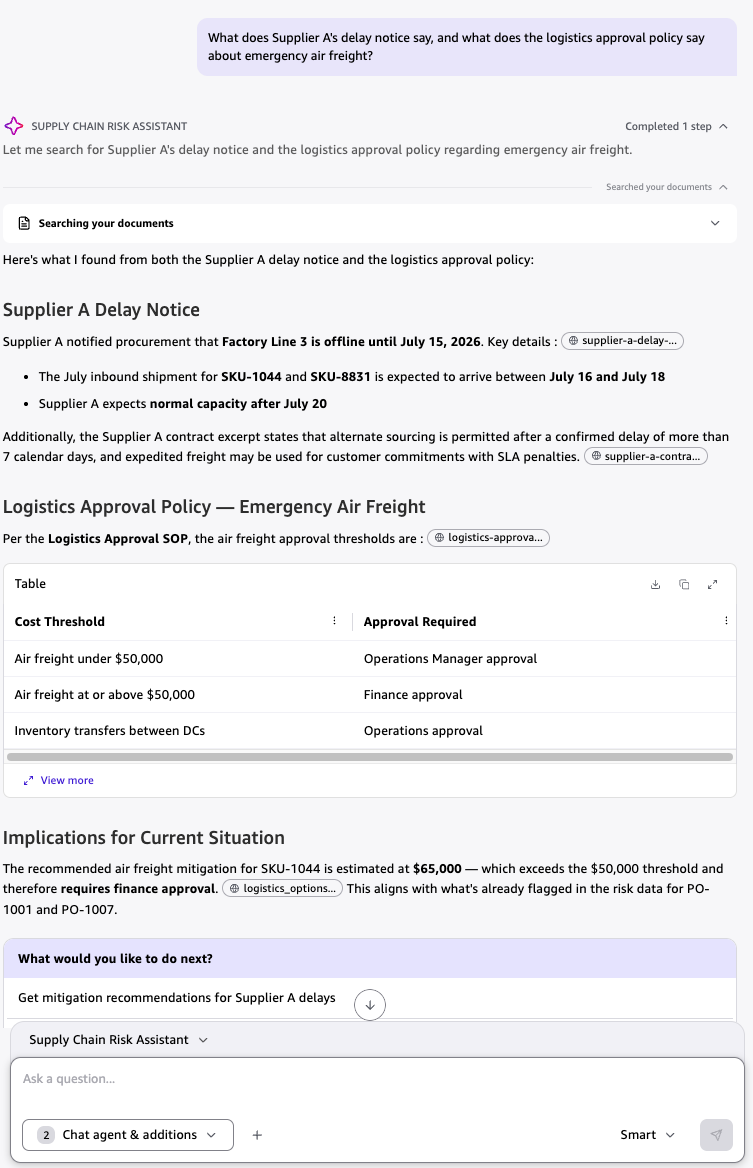
The solution typically supports two primary user interaction patterns. The first pattern, diagnostic, involves the analyst posing questions that Amazon Quick can answer directly from integrated dashboards and knowledge sources.
Figure 2 – Diagnostic flow. Amazon Quick uses dashboard and knowledge context to answer “what is happening?” questions before a backend action is triggered.
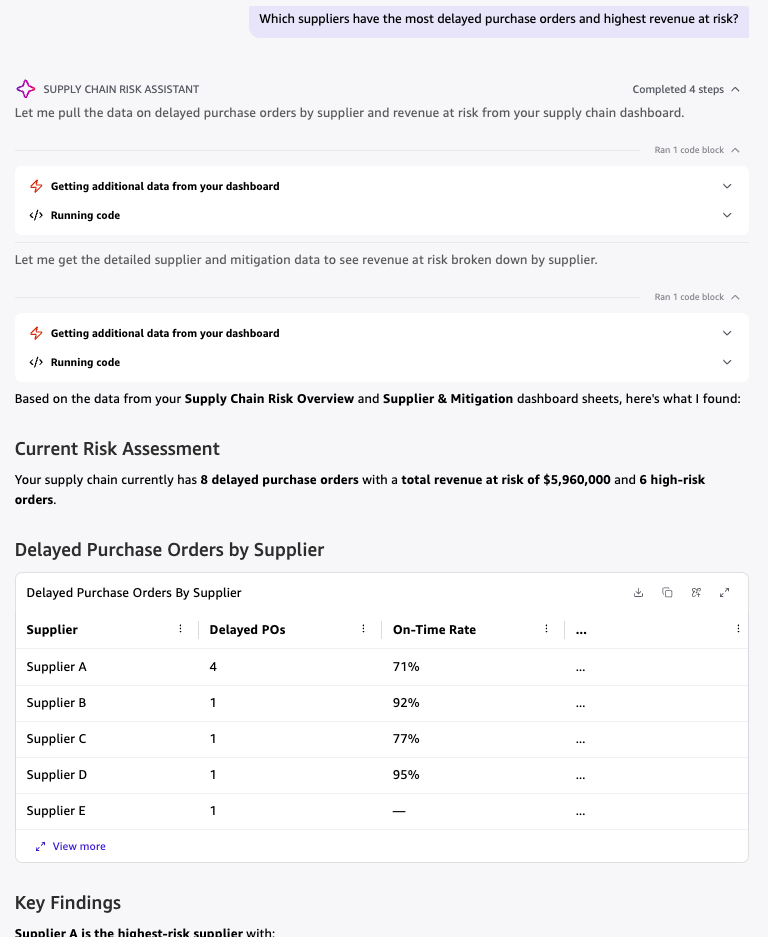
This diagnostic phase allows planners to quickly grasp the scope and nature of a disruption. For instance, an analyst might ask, "Which suppliers have the most delayed purchase orders and highest revenue at risk?" Amazon Quick would then leverage its connection to Amazon QuickSight dashboards to provide a visual and textual summary of supplier delay performance, inventory exposure, and revenue at risk, all without needing to invoke the more complex backend agent. Similarly, questions like "What does Supplier A’s delay notice say, and what does the logistics approval policy say about emergency air freight?" would be answered by Amazon Quick querying its integrated knowledge sources, summarizing relevant documents from Amazon S3.
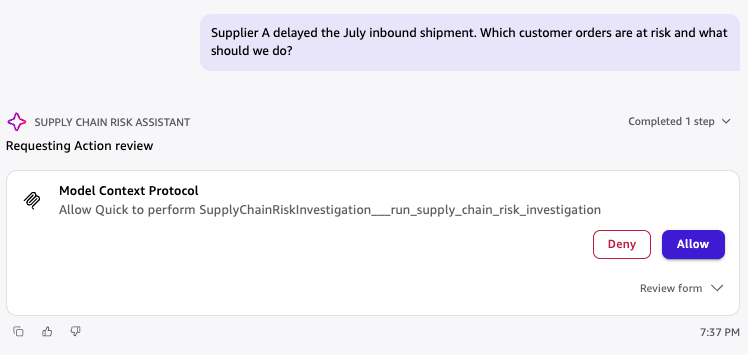
The second, more advanced pattern, the action flow, is triggered when the analyst requires a specific recommendation or intervention. When the analyst asks "what to do next," Amazon Quick invokes the NeMo-backed MCP action.
Figure 3 – Action flow. Amazon Quick calls the MCP action, AgentCore invokes the runtime, and NeMo runs the backend decision workflow to return a mitigation plan.
For those less familiar with the NeMo Agent Toolkit, the backend workflow is structured into three distinct code layers: registered functions, a workflow configuration file, and an orchestrator. Registered functions are modular, reusable capabilities, each designed to perform a specific task, such as assessing purchase order risk, calculating inventory exposure, determining customer impact, looking up contract policies, evaluating logistics options, or generating mitigation recommendations. The workflow configuration, typically defined in a YAML file, explicitly names these functions and defines how they are interconnected to form a complete decision workflow. The orchestrator is the central intelligence that receives the request from Amazon Quick, dynamically calls the configured functions in a predefined or adaptive sequence, and then synthesizes their outputs to return a comprehensive mitigation plan, complete with supporting evidence, an execution trace, latency data, and evaluator metadata. This structured approach ensures that the workflow is explicit, testable, and maintainable.
Figure 4 – NeMo Agent Toolkit workflow inside the runtime container. The supply_chain_risk_orchestrator coordinates the registered supply-chain functions and returns both the mitigation decision package and reliability metadata to Amazon Quick.
Implementation and Development Insights
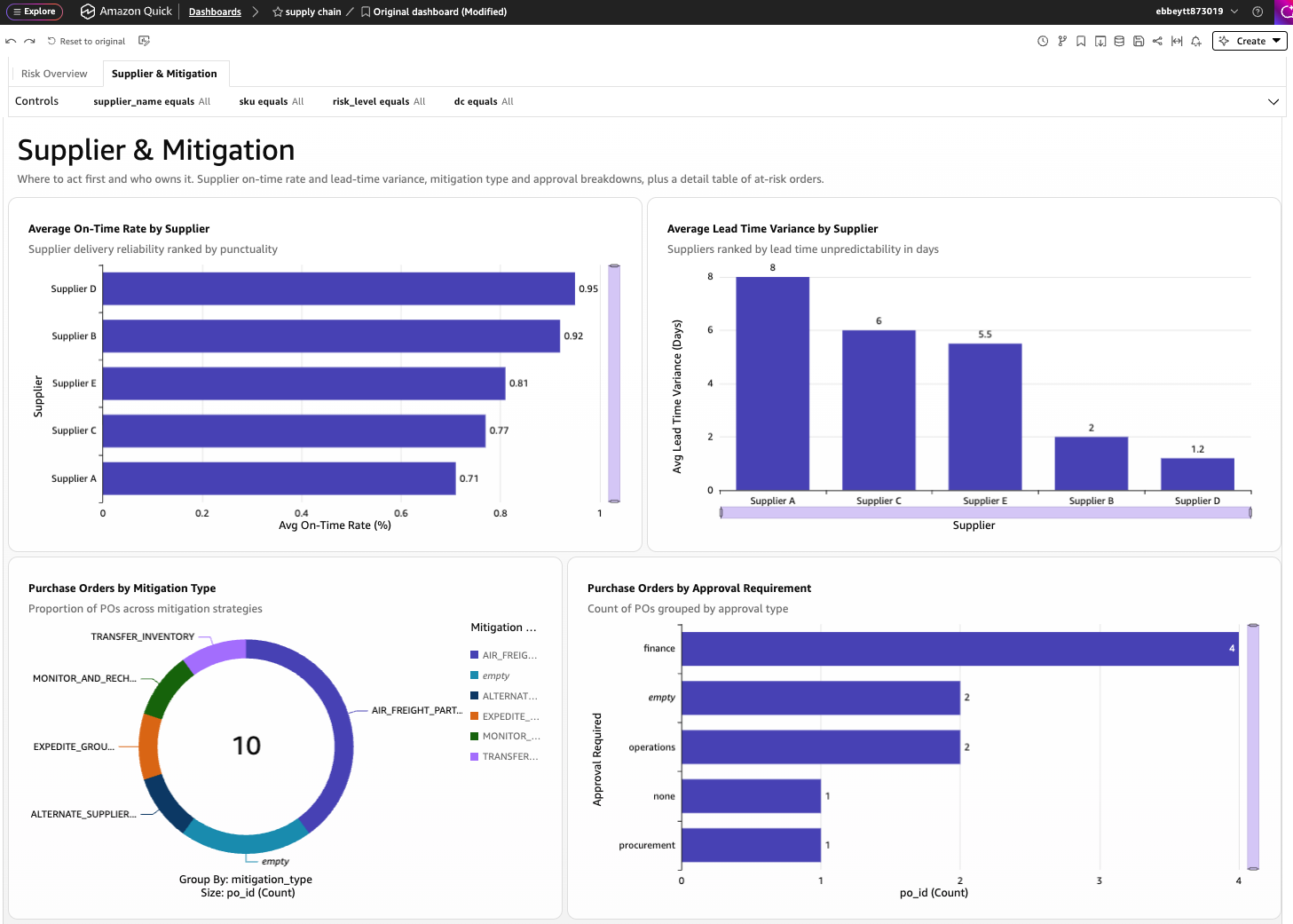
Deploying this solution involves a series of structured steps, starting with cloning the provided repository, which contains the necessary AWS CloudFormation templates, deployment scripts, sample data, the NeMo Agent Toolkit workflow plugin, and detailed Quick setup notes.
Prerequisites and Deployment: To deploy and test the sample, users require an AWS account, configured AWS CLI with SSO authentication, and sufficient IAM permissions. The deployment script automates critical tasks, including creating an Amazon S3 bucket for data and knowledge bases, setting up an Amazon Bedrock AgentCore agent and its associated runtime, and configuring an AgentCore Gateway endpoint. This gateway is crucial as it exposes the Model Context Protocol (MCP) action, allowing Amazon Quick to discover and invoke the NeMo Agent Toolkit workflow.
NeMo Agent Toolkit Workflow Configuration: The core decision logic of the backend is meticulously defined through a NeMo Agent Toolkit workflow configuration, typically a YAML file. This configuration explicitly lists each function available to the workflow, mapping a local name to a registered NeMo function within the plugin code. This clear separation allows for functions to be individually instrumented, thoroughly tested, and reused across different workflows, significantly enhancing modularity and maintainability. In a production environment, these sample CSV-backed functions would be replaced with robust integrations to governed data sources such as Amazon Athena queries, Amazon RDS, ERP APIs, WMS/TMS APIs, or other MCP tools, ensuring real-time data accuracy and integrity.
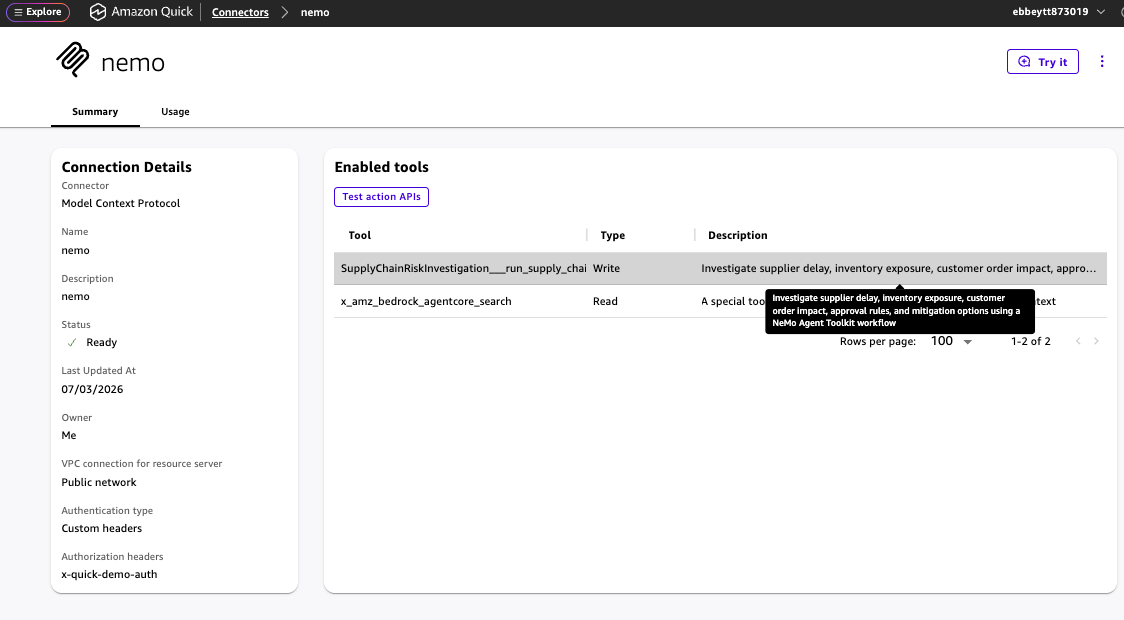
Amazon Quick Setup: The setup in Amazon Quick involves creating a dashboard, establishing a knowledge source, registering the NeMo Agent Toolkit workflow as an MCP action, and finally creating a chat agent.
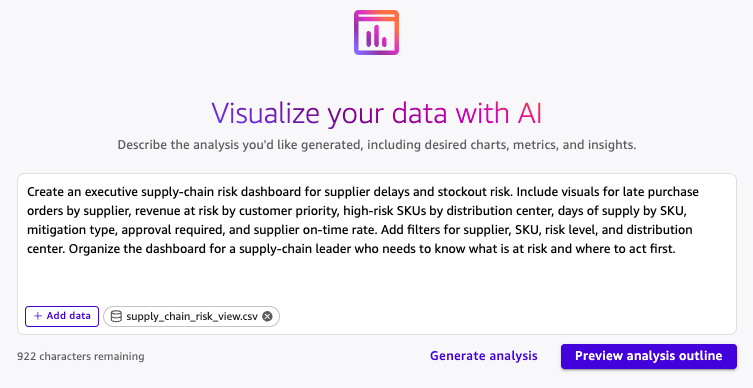
- Dashboard Creation: Utilizing a flattened CSV dataset, Amazon QuickSight is used to generate an executive supply-chain risk dashboard. A sample prompt like "Create an executive supply-chain risk dashboard for supplier delays and stockout risk. Include visuals for late purchase orders by supplier, revenue at risk by customer priority, high-risk SKUs by distribution center, days of supply by SKU, mitigation type, approval required, and supplier on-time rate. Add filters for supplier, SKU, risk level, and distribution center. Organize the dashboard for a supply-chain leader who needs to know what is at risk and where to act first," enables Quick to intelligently construct a comprehensive visual summary of critical metrics.
- Knowledge Source Integration: An Amazon S3 bucket serves as the knowledge source, providing the chat agent with access to unstructured context such as supplier notices, contract excerpts, logistics approval policies, SKU substitution rules, and customer SLA summaries. This enriches the agent’s ability to provide contextually relevant answers.
- MCP Action Registration: The NeMo Agent Toolkit workflow is registered as an MCP action in Amazon Quick. This step is critical, bridging Amazon Quick’s conversational interface with the powerful backend agentic workflow. For demo purposes, the AgentCore Gateway might be configured with
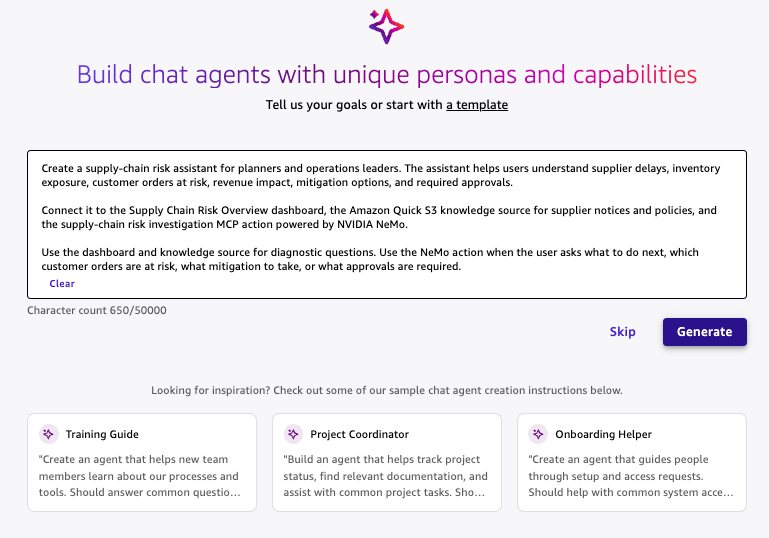
AuthorizerType=NONE, which is suitable only for isolated demo environments with non-sensitive data. Production deployments necessitate robust inbound authorizers likeCUSTOM_JWTwith OAuth/OIDC-based authentication for secure access. - Chat Agent Creation: A dedicated chat agent is created, acting as the single point of interaction for analysts. Its summary clearly defines its purpose: "Create a supply-chain risk assistant for planners and operations leaders. The assistant helps users understand supplier delays, inventory exposure, customer orders at risk, revenue impact, mitigation options, and required approvals. Connect it to the Supply Chain Risk Overview dashboard, the Amazon Quick S3 knowledge source for supplier notices and policies, and the supply-chain risk investigation MCP action powered by NVIDIA NeMo Agent Toolkit. Use the dashboard and knowledge source for diagnostic questions. Use the NeMo action when the user asks what to do next, which customer orders are at risk, what mitigation to take, or what approvals are required." This ensures the agent intelligently routes queries to the appropriate data source or action.
Testing the End-User Flow: The end-user experience is tested with a series of prompts demonstrating the seamless transition between diagnostic questions and action triggering. A prompt like "Supplier A delayed the July inbound shipment. Which customer orders are at risk and what should we do?" would trigger the NeMo-backed MCP action. The expected result is a comprehensive response, including a risk summary, revenue impact, affected customers, recommended mitigations, required approvals, and evidence drawn from purchase orders, inventory, customer orders, policy context, and logistics options. For a sample scenario, this might identify specific SKUs at high or medium risk, proposing actions like partial air freight, inventory transfers, or monitoring, along with required finance or operations approvals.
Inspect NeMo Trace, Latency, and Evaluation Results: Developers and reviewers can delve into the backend workflow’s performance by inspecting the NeMo trace, latency data, and evaluation results. The trace provides a step-by-step path of the workflow, indicating which registered functions were executed. Latency data pinpoints performance bottlenecks, allowing for targeted optimization, such as caching policy lookups or narrowing data queries. An evaluation harness checks if the workflow returns the expected risk level, mitigation action, and approval routing for known test cases, ensuring the system’s reliability and accuracy before production deployment. Amazon Quick can even visualize these JSON artifacts, transforming raw data into a dashboard-style summary of workflow trace, latency, risk recommendations, and evaluation results, providing an accessible performance overview. For instance, a visual might show that a particular PO risk lookup or contract policy retrieval accounts for a significant portion of the total execution time, highlighting areas for optimization.
Real-World Impact and Business Implications
The integration of Amazon Quick and NVIDIA NeMo Agent Toolkit represents a profound shift in how enterprises manage supply chain disruptions. The implications are far-reaching, affecting operational efficiency, strategic decision-making, and competitive advantage.
Firstly, the solution drastically improves decision-making speed and accuracy. By automating the investigation and recommendation process, planners can identify, assess, and respond to disruptions in minutes rather than hours or days. This agility is critical in fast-moving markets where delays can quickly erode profits and customer trust. The evidence-backed recommendations foster greater confidence in decisions, reducing the likelihood of costly errors.
Secondly, it enhances operational scalability and efficiency. For fast-growing companies, this architecture allows them to handle increasing order volumes and supplier complexity without proportionally increasing their planning workforce. Existing teams can manage a larger scope of operations, focusing on strategic initiatives rather than manual data collation. Enterprises can streamline their planning departments, reallocating human capital to higher-value tasks such as strategic sourcing, supplier relationship management, or innovation.
Thirdly, the solution contributes to stronger risk mitigation and resilience. By providing comprehensive risk summaries and validated mitigation plans, businesses are better equipped to withstand unexpected events. The ability to quickly pivot and adapt to disruptions minimizes revenue loss, avoids stockouts, and protects customer relationships. The explicit workflow and evaluation capabilities also drive continuous improvement in risk management strategies.
Finally, the user-friendly interface of Amazon Quick democratizes access to advanced AI capabilities. Business users, who may not have deep technical expertise, can interact with sophisticated AI agents through natural language. This empowers a broader range of personnel to leverage cutting-edge technology, fostering a more data-driven and proactive culture across the organization. The blend of diagnostic capabilities (dashboards, knowledge bases) with prescriptive actions (NeMo agent) creates a holistic environment that supports the full spectrum of a planner’s needs.
Security and Scalability Considerations
While the sample solution is designed for demonstration, its transition to a production environment necessitates rigorous security hardening. Key recommendations include configuring robust inbound authorizers for AgentCore Gateway, such as CUSTOM_JWT, and leveraging OAuth/OIDC-based user or service authentication within Amazon Quick. Implementing network isolation, encrypting data at rest and in transit, and ensuring comprehensive audit logging are also paramount. Regular security assessments and adherence to the principle of least privilege for IAM roles are essential to protect sensitive supply chain data and prevent unauthorized access.
From a scalability perspective, the architecture is inherently designed to grow with organizational needs. AWS services like Amazon Quick and AgentCore are managed services that automatically scale to meet demand. The modular nature of NeMo Agent Toolkit workflows, with reusable functions and explicit configurations, allows for easy expansion and adaptation to new tools or complex decision criteria. This robust foundation ensures that as supply chains evolve and become even more intricate, the underlying AI-powered decision support system can scale to meet future demands, maintaining its effectiveness and performance.
Conclusion
The integration of Amazon Quick and NVIDIA NeMo Agent Toolkit represents a significant advancement in transforming supply chain visibility into guided, actionable decision workflows. This powerful synergy empowers planners with a governed business workspace that seamlessly combines interactive dashboards, extensive knowledge context, intelligent chat agents, and the ability to trigger sophisticated backend actions. The NVIDIA NeMo Agent Toolkit, in its role, not only executes these complex decision workflows but also provides invaluable telemetry, including execution traces, per-step latency output, and comprehensive evaluation metadata. These insights are crucial for development teams to identify performance bottlenecks, validate logical integrity, and continuously refine the workflow’s accuracy and efficiency before it reaches production.
This innovative pattern holds immense value for both burgeoning startups and established enterprise teams aiming to scale their operational decision-making without resorting to manual, time-consuming review steps for every disruption. The architecture’s adaptability extends beyond supply chain risk, proving equally effective in diverse domains such as customer renewal risk assessment, incident response management, manufacturing quality control, and logistics exception handling, promising a future where AI-driven agents play an increasingly pivotal role in optimizing complex business operations.