The Strategic Imperative of Persistent AI Agents
The rationale behind advocating for long-running coding agents is rooted in a fundamental shift in the bottlenecks of the software development lifecycle. Historically, the primary time sink in programming was the actual implementation of code. However, with the advent of highly capable AI coding agents, particularly after the release of models such as Claude Opus 4.5, this bottleneck has decisively moved to the human review and verification phase. Industry analysts and developers alike now frequently observe that while AI can generate code at an unprecedented pace, the subsequent human effort required to review, validate, and ensure adherence to specifications consumes a disproportionate amount of time.
This phenomenon is critical because human review time represents a significant cost in terms of developer hours and project delays. Every interruption to an agent’s workflow, whether for human input, permission requests, or clarification, necessitates a context switch for the human developer. Such context switching is a well-documented drain on productivity, costing developers valuable time as they re-orient themselves to the task at hand. By minimizing these interruptions and enabling agents to run autonomously for extended periods – ideally completing entire tasks or sub-projects before requiring human oversight – organizations can drastically reduce the time spent on manual verification. This strategic approach transforms the role of the human engineer from a constant overseer to a high-level architect and final validator, thereby accelerating development cycles and increasing overall output. Studies, such as those from McKinsey and other tech consultancies, have projected potential productivity gains ranging from 20% to 50% in coding tasks through effective AI integration, with a significant portion of these gains attributable to reducing human review cycles.
Architecting Autonomy: Core Techniques for Sustained Operations
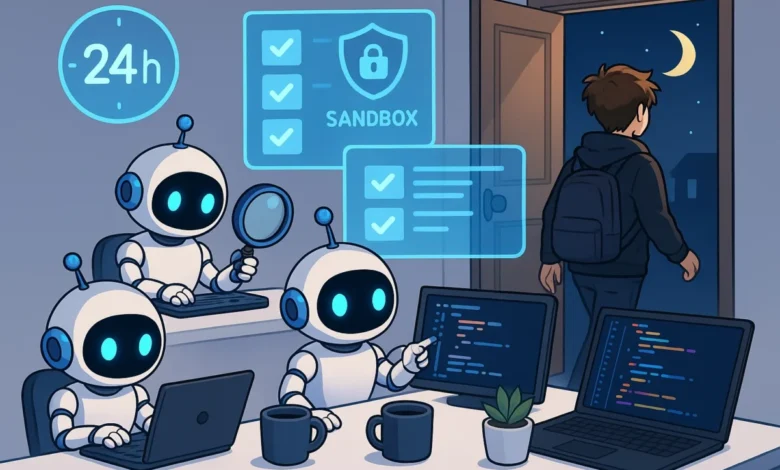
Achieving the goal of long-running, autonomous coding agents requires more than just advanced AI models; it demands a robust "harness and structure" around their operation. Several key techniques are emerging as best practices for ensuring agents can run for extended durations, even exceeding 24 hours, without interruption.
Streamlining Permissions for Uninterrupted Workflow
One of the most immediate and impactful steps to enable continuous agent operation is to pre-emptively grant all necessary permissions. Interruptions for permission requests are not only time-consuming but often redundant, as human approval is typically granted anyway. Modern coding agent platforms, including tools like Codex and Claude Code, offer settings such as "auto-mode" or options to "skip all permissions," which can be configured to allow agents to proceed without constant prompts.
However, this convenience must be balanced with robust security protocols. Running agents in a sandbox environment is paramount. A sandbox, typically a virtualized or containerized workspace, isolates the agent’s operations, preventing it from accessing or modifying data outside its designated operational scope. This is crucial for protecting the host system and sensitive data. The importance of this measure was underscored by a notable incident where OpenAI acknowledged that certain specific circumstances could lead to its GPT models inadvertently deleting files from users’ computers. While rare, the potential consequences highlight the necessity of protective measures.
To mitigate such risks, cybersecurity experts recommend a multi-layered approach:
- Sandboxing: Always run agents within isolated environments (e.g., Docker containers, virtual machines) where their access to the host file system and network resources is strictly controlled.
- Version Control: Utilize robust version control systems like GitHub for all code and critical work. This not only provides secure storage but also maintains a complete history of changes, allowing for easy rollback in case of unintended modifications.
- Regular Backups: Implement comprehensive backup strategies for the entire computer system, such as Apple’s Time Machine or cloud-based backup solutions. This ensures data recovery is possible even in the event of unforeseen data loss or corruption. These measures collectively safeguard intellectual property and operational continuity.
Empowering Agents with Self-Verification Capabilities
A critical aspect of enabling agents to run for extended periods without human intervention is their ability to verify their own work. This involves crafting detailed instructions for the agent that not only define the task but also explicitly outline the criteria for successful completion and the methodology for self-testing. The approach often involves supplying agents with the necessary tools to perform these validations.
For instance, when tasked with implementing a specific UI design, the agent should be instructed to:
- Implement Exactly as Specified: Replicate the design with pixel-perfect accuracy.
- Self-Test via Visual Comparison: Utilize browser access (e.g., to Chrome) to open both the reference design and its own implementation, take screenshots of both, and then programmatically compare them to identify discrepancies.
- Flag Discrepancies: If visual differences are detected, the agent should report these to the human, explaining the nature of the disparity. This is particularly important because designs sometimes include elements that are technically infeasible given the existing codebase or system constraints. The agent’s ability to identify and highlight these issues prevents unnecessary rework and allows human developers to make informed decisions about design compromises.
This philosophy extends to virtually all programming tasks. Whether it’s developing a new feature, refactoring existing code, or fixing a bug, the prompt should detail the desired outcome, the constraints, and the specific tests or checks the agent must perform to confirm its work. This could involve running unit tests, integration tests, end-to-end tests, static code analysis, or even performance benchmarks. By embedding verification directly into the agent’s workflow, the need for constant human oversight is drastically reduced, transforming the agent from a mere code generator into an autonomous problem-solver.
The Rise of Agentic Code Review: A Paradigm Shift
Beyond self-verification of a task, an even more potent method for minimizing human interaction is the implementation of agentic code review. This approach leverages AI agents to review code generated by other agents (or even human developers), effectively automating a significant portion of the quality assurance process. Many developers are finding that when implemented correctly, agentic code review can substantially reduce, if not eliminate, the need for human code review for non-critical application components.

The efficacy of AI in code review has reached a point where it can identify bugs, enforce coding standards, and suggest improvements with a consistency and speed that often surpasses human capabilities. Codex, for example, is highlighted as a particularly effective review agent. It offers two primary modes of operation:
- GitHub Integration: By enabling its GitHub review implementation, developers can simply tag Codex in a Pull Request (PR), and it will automatically analyze the proposed changes, providing feedback directly within the PR workflow.
- Command Line Interface (CLI): For more direct control or faster execution, Codex can be triggered via its CLI to perform a review by comparing two specified branches. This method is often preferred for its speed and the ability to integrate it into continuous integration/continuous deployment (CI/CD) pipelines.
The benefits of agentic code review are substantial. It frees human engineers from the often tedious and time-consuming task of reviewing routine code changes, allowing them to dedicate their expertise to more complex architectural challenges, innovative feature development, and critical security audits. The outcome is a significant acceleration in the delivery of production-ready code, with a notable reduction in new-code-introduced bugs, thereby enhancing software quality and reliability across the board.
Remote Execution: Ensuring Agent Resilience and Continuity
For truly long-running agent sessions, especially those spanning multiple days, the concept of remotely running agents becomes indispensable. Local execution on a developer’s personal computer inherently carries the risk of interruption. Closing a laptop, a system restart, or even a network disconnection can prematurely terminate an agent’s progress. While some operating systems offer settings to prevent sleep mode when a laptop lid is closed, this often leads to overheating and is not a sustainable solution for prolonged operation.
Remotely running agents, whether in the cloud or on a dedicated always-on machine, circumvent these interruptions entirely. These environments are designed for continuous operation, providing the stability required for tasks that may take hours or days to complete.
Pros and Cons of Remote vs. Local Execution:
| Feature | Local Execution | Remote Execution (Cloud/Dedicated Server) |
|---|---|---|
| Control | Full, immediate access and visual oversight. | Less direct visual feedback, often command-line based. |
| Setup | Simpler, often out-of-the-box experience. | Can be more complex, requiring configuration and networking. |
| Interruption | High risk (sleep, shutdown, network issues). | Minimal risk, designed for continuous operation. |
| Scalability | Limited to local hardware resources. | Highly scalable, on-demand resources. |
| Security | Dependent on local machine security, easier data access. | Requires careful secrets management, data residency concerns. |
| Cost | Initial hardware investment. | Operational costs (cloud fees, power for dedicated servers). |
Many developers adopt a hybrid model, using local environments for rapid prototyping and interactive debugging, and then deploying tasks to remote setups for long-duration, non-interactive execution. The author’s personal setup, involving a primary portable computer for daily work and a secondary, always-on machine for bots and long-running agent sessions, exemplifies this practical approach. Cloud alternatives, such as virtual machines on AWS, Google Cloud, or Azure, offer immense scalability but introduce challenges related to secure storage of documents and secrets, as well as potential data residency and compliance issues. The industry trend clearly indicates a growing adoption of remote or hybrid solutions to ensure agent resilience.
Broader Implications and the Future Landscape of Software Engineering
The widespread adoption of long-running, autonomous coding agents carries profound implications for the software development industry and the very definition of an engineering role.
Evolution of Developer Roles: As AI agents increasingly handle routine coding, testing, and even initial code review, human developers will find their roles evolving. The focus will shift from boilerplate code generation to higher-order tasks: architectural design, complex problem-solving, strategic planning, ethical considerations, and intricate system integration. Developers will become orchestrators of AI workflows, responsible for crafting precise prompts, designing robust verification frameworks, and ensuring the overall quality and security of agent-generated solutions. This transition promises to unlock new levels of creativity and innovation, freeing engineers from repetitive tasks to concentrate on challenges that truly require human intuition and critical thinking.
Economic Impact and Productivity Gains: The economic benefits are substantial. Faster development cycles translate to quicker time-to-market for new products and features, providing a competitive edge. Reduced human review time and minimized context switching lead to significant cost savings in engineering resources. Companies may find that they can achieve more with leaner, more focused teams, or alternatively, that existing teams can tackle a greater volume and complexity of projects. Early adopters of these methodologies are already reporting considerable improvements in project velocity and resource utilization.
Enhanced Security and Governance Requirements: While the productivity gains are appealing, the increased autonomy of AI agents necessitates a heightened focus on security and governance. Granting agents extensive permissions, even within sandboxed environments, requires robust auditing and logging mechanisms. Organizations will need to establish clear policies for data access, intellectual property handling, and accountability for agent-generated code. The incident of AI agents deleting files, though rare, serves as a stark reminder of the need for fail-safes and human oversight in critical junctures. Future AI development will likely integrate more sophisticated self-correction mechanisms and explicit ethical guardrails to prevent unintended consequences.
The Future of Development Environments: The "harness and structure" around coding agents will become increasingly sophisticated. This includes advanced agent orchestration platforms that manage multiple agents, allocate resources, and provide comprehensive monitoring. Integrated development environments (IDEs) will evolve to seamlessly incorporate AI agent interactions, offering tools for prompt engineering, real-time agent feedback, and streamlined deployment to remote execution environments. The vision of a truly autonomous software factory, where AI agents collaborate to build and maintain complex systems, is moving closer to reality.
Conclusion
The shift towards long-running, autonomous coding agents marks a transformative phase in software development. By strategically minimizing human interruptions, empowering agents with self-verification capabilities, leveraging agentic code review, and embracing remote execution, engineering teams can unlock unprecedented levels of productivity. The techniques discussed—streamlining permissions while maintaining rigorous security, enabling agents to verify their own work through detailed instructions and tool access, and implementing AI-driven code reviews—are not merely incremental improvements but foundational changes to how software is built.
The future of software engineering is undeniably moving towards greater automation and agent autonomy. The increasing prevalence of remotely running agents, decoupled from the limitations of local workstations, is a clear indicator of this trajectory. As AI models continue to advance in reasoning and task completion, the ability to orchestrate these agents in a continuous, uninterrupted fashion will be the differentiator for leading technology organizations. Embracing these practices is no longer an optional enhancement but a strategic imperative for engineers aiming to maximize their impact and for businesses striving for innovation in a rapidly evolving technological landscape.