Demystifying the Agentic Architecture: Amazon Quick Team Shares the Core Taxonomy Behind Modern AI Agents

The rapid evolution of artificial intelligence over the past several years has shifted conversational systems from passive question-answering engines into active participants capable of executing complex workflows. From automated research and report generation to proactive calendar management, modern AI agents increasingly handle multifaceted tasks across enterprise environments. However, as development teams scale these systems, a persistent structural hurdle has emerged across the industry: the lack of a standardized, universal vocabulary to define the fundamental building blocks—or primitives—of agentic work.
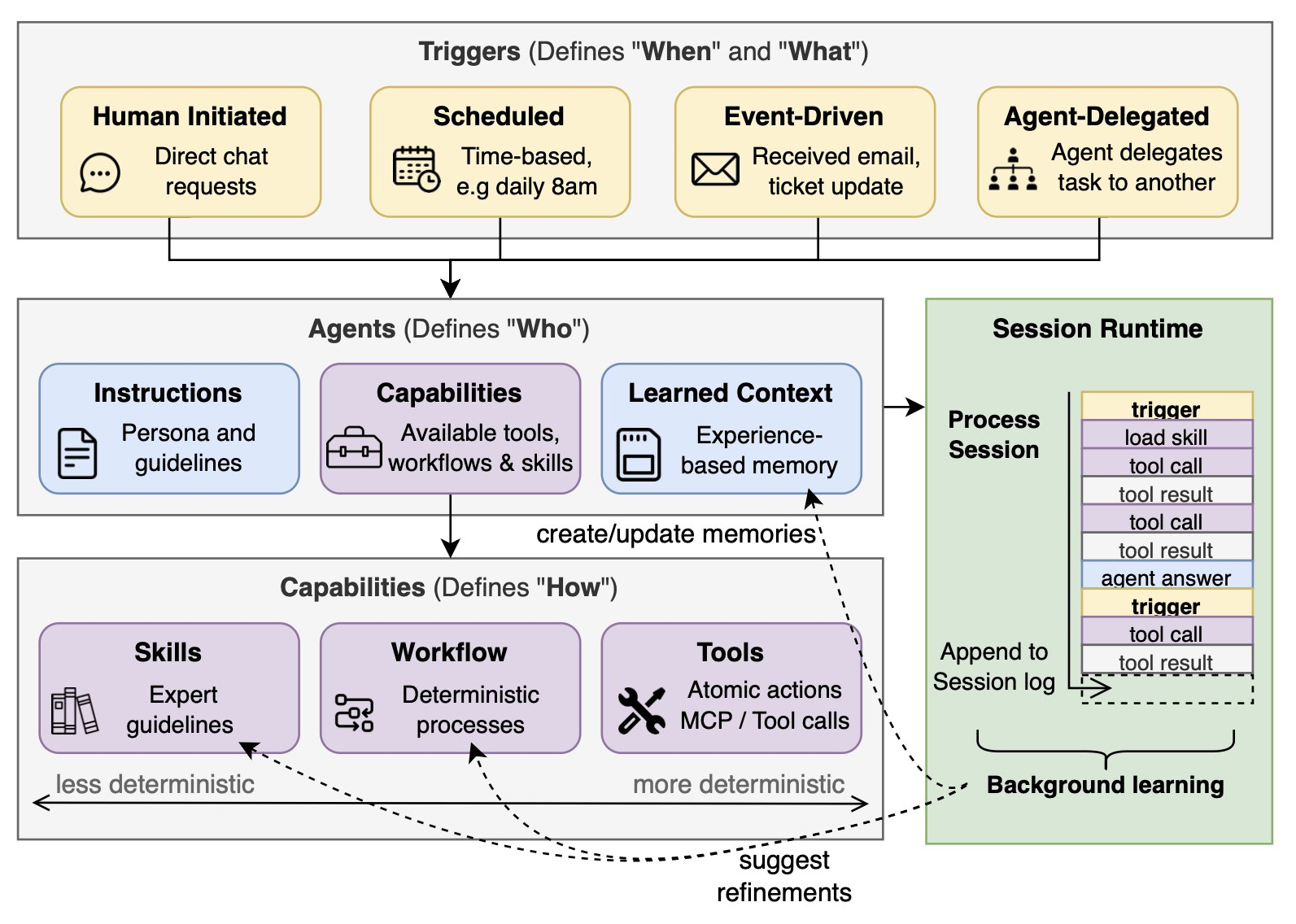
Without a shared taxonomy, developers frequently reinvent foundational concepts under disparate names, leading to fragmented product designs and confusing user experiences. To address this challenge, the engineering team behind Amazon Quick has released a comprehensive structural framework designed to categorize and rationalize agentic systems. By decomposing autonomous work into four fundamental questions—When, What, Who, and How—the Amazon Quick framework aims to establish a common language for software architects, machine learning researchers, and platform designers.
The Background of Agentic Complexity and the Need for Standardization
The development of Amazon Quick over the preceding year highlighted a recurring design ambiguity. When a user issues a command such as "monitor my Slack channel and send me a daily digest," the architectural classification of that request becomes immediately muddy. Is the user asking for an entirely new autonomous agent? Are they configuring a scheduled instruction set for an existing agent? Or are they simply deploying a pre-packaged workflow or a specialized skill?
In the absence of a unified taxonomy, these distinct structural questions collapse into a confusing array of overlapping choices for both developers and users. Industry analysts note that as enterprises deploy larger fleets of AI agents, managing the lifecycle, permissions, and execution boundaries of these systems becomes a critical operational bottleneck.
The Amazon Quick team’s newly published taxonomy attempts to resolve this ambiguity by establishing clear boundaries between system activation, execution ownership, and task execution methodologies. While this intricate framework largely remains invisible to end users—who simply state their objectives in natural language—it provides a vital blueprint for the engineers and systems architects building beneath the surface.
Deconstructing the Framework: When, What, Who, and How
At the core of the Amazon Quick taxonomy is a clean division of labor that maps directly to four basic interrogatives. This structure allows any agentic task, whether it is a transient chat query or a long-running corporate compliance audit, to be categorized and executed with predictable reliability.
Triggers: Managing When and What
Triggers serve as the activation mechanism that initiates work within the ecosystem. Crucially, a trigger fulfills a dual purpose: it establishes When the task should occur while simultaneously carrying the What—the explicit instructions or message defining the objective.
Triggers can range from human-initiated chat messages to scheduled background cron jobs and event-driven webhooks. The nature of the trigger fundamentally conditions how the system executes the task. For instance, a scheduled background task operating without direct human supervision typically adheres to a conservative execution policy—such as pausing or halting execution if confidence levels dip below a designated threshold. Conversely, a human-initiated prompt is generally handled with a responsive policy, prompting the system to ask clarifying questions rather than abruptly stopping when ambiguity arises.
Agents: Defining the Persistent Actor
In the Amazon Quick framework, an agent is explicitly defined as a persistent, learning actor. Representing the Who in any computational execution, the agent acts as the primary anchor against which institutional memory and experiential learning accrue over time.
A critical distinction emphasized by the engineering team is that an agent is not merely the static set of instructions it follows. Rather, it is the dynamic entity capable of interpreting those instructions. Consequently, two distinct agents given identical initial inputs can produce entirely different outcomes because they carry unique histories, capabilities, and learned behaviors.
An agent consists of three core components:
- A core identity and system prompt defining its baseline persona and operational boundaries.
- A persistent memory store that retains lessons, user preferences, and contextual feedback across sessions.
- An assigned set of capabilities that it can deploy to accomplish objectives.
By contrast, extrinsic elements such as the underlying large language model (LLM) are treated as swappable parameters, while conversation histories are categorized as transient, per-session states. This definition successfully bridges the historical gap between chat-based assistants, scheduled cron-style bots, and autonomous agents, merging them into a unified actor that can converse with users, run on automated schedules, and inspect its own past performance.
Capabilities: Navigating the Spectrum of Determinism
Capabilities represent the How through which an agent acts, spanning a continuous spectrum from fully autonomous agentic behavior to entirely deterministic software routines. This axis functions essentially as a "confidence contract," governing how much operational latitude the agent retains versus how much procedural rigidity the developer or user fixes in advance.
The framework breaks capabilities down into three distinct tiers:
- Tools: These are atomic operations defined by a strict, typed schema—such as sending an email, querying a relational database, or reading a local file. Whether implemented as a native function, a Model Context Protocol (MCP) server, or an encapsulated external agent, the calling interface remains uniform, detailing a clear name, description, parameters, and expected results.
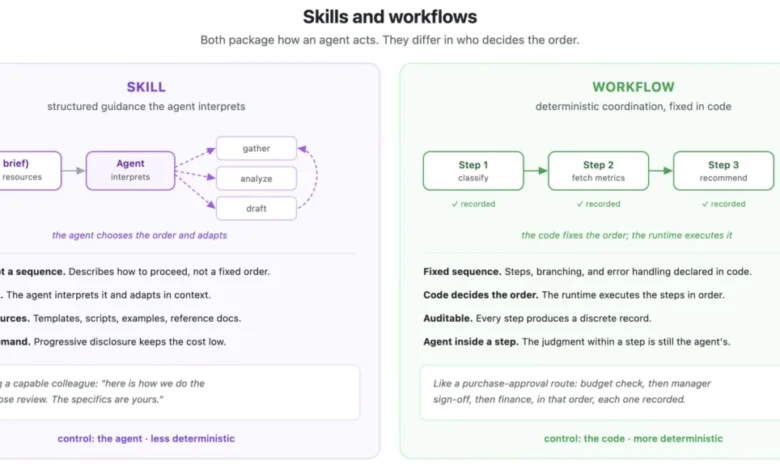
- Skills: Skills provide structured guidance that leaves room for model-driven judgment. They bundle instructional text with supporting resources, such as templates, scripts, and few-shot examples, outlining a recommended approach rather than a rigid sequence of execution. Skills leverage progressive disclosure, ensuring that the agent initially consumes only lightweight metadata (names and brief descriptions) and loads the full instructions only when contextually relevant. This allows a system to maintain an expansive library of deep expertise without incurring continuous token or memory overhead.
- Workflows: Workflows represent fully deterministic coordination. They feature explicitly declared steps, branching logic, explicit control flow, and formalized error handling that execute in a fixed, auditable sequence. Decision logic within a workflow is governed by traditional code rather than probabilistic model inference. A corporate purchase-approval routing system—requiring sequential budget checks, managerial sign-offs, and final finance validation—typifies a workflow. While the administrative route is fixed by code, the cognitive judgment executed within individual steps remains the responsibility of the agent.
The Symbiosis of Skills and Workflows
A common debate within enterprise AI architecture is whether advanced foundation models will eventually render structured skills and workflows obsolete. As base models become increasingly capable of general reasoning, some engineers question the necessity of codifying human processes.
The Amazon Quick team argues the opposite, asserting that skills and workflows hold intrinsic value independent of underlying model advancements. Skills serve as the definitive organizational unit for capturing, versioning, and sharing institutional knowledge across teams. Meanwhile, workflows provide strict auditability, step-wise visibility, and reliable multi-service coordination that probabilistic models alone cannot guarantee in regulated environments.
Furthermore, these structures are dynamic. Through a continuous learning framework integrated into Amazon Quick, well-understood and frequently executed skills can naturally "crystallize" into rigid, automated workflows over time. Conversely, workflows that continually encounter unpredictable edge cases can "dissolve" back into flexible skills, allowing the agent to apply adaptive judgment.
Practical Implications and Enterprise Deployment
To illustrate the practical utility of this taxonomy, the Amazon Quick team returned to the recurring user request: "monitor my Slack channel and send me a daily digest."
Under the newly defined framework, this single objective can be implemented in at least three valid ways, depending on organizational risk tolerance:
- Agent-Led Execution: The user deploys an existing agent, attaches a scheduled trigger, and grants the agent relevant tool access to scan the Slack workspace and draft a digest using its general capabilities.
- Skill-Guided Execution: The user assigns a specialized "Slack Digest" skill to an agent, providing structured guidance on formatting preferences and signal-to-noise filtering, balancing autonomy with guardrails.
- Workflow-Enforced Execution: The process is bound to a strict, deterministic workflow where data extraction, summarization, and delivery steps are hardcoded to satisfy strict internal compliance and auditing requirements.
While all three approaches yield the identical end product—a daily morning digest—they offer fundamentally different confidence contracts. An organization prioritizing operational speed may opt for the autonomous agent approach, whereas a heavily regulated financial institution may demand the deterministic workflow model.
Over time, continuous learning shifts these trajectories. A vague, one-sentence instruction accumulates domain-specific feedback—such as preferred summarization styles, critical vocabulary terms, and priority senders—transforming the tenth execution into a highly optimized process without requiring manual human re-coding.
Broader Industry Impact and Future Outlook
The introduction of the Amazon Quick taxonomy reflects a maturing software engineering discipline around generative artificial intelligence. As enterprises move past the initial proof-of-concept phase and into large-scale production deployments, architectural predictability, security compliance, and maintainability have taken center stage.
By organizing agentic work around four elemental questions—When, What, Who, and How—Amazon’s engineering group has provided a conceptual bridge between human intent and machine execution. By decoupling the activation trigger from the persistent agent identity, and clearly demarcating the spectrum between autonomous tools and deterministic workflows, the framework offers a scalable blueprint for enterprise AI orchestration.
Industry observers expect that as multi-agent systems become more prevalent across cloud ecosystems, the formalization of primitives such as triggers, agents, skills, and workflows will serve as a foundational standard for interoperability.
The Amazon Quick team confirmed that this publication is merely the first installment in an ongoing technical series. Subsequent publications will delve deeper into the underlying agentic operating system, background learning architectures, proactive notification feeds, and advanced orchestration mechanics powering the platform.