DuckLake Redefines Data Lake Architecture by Replacing Complex Metadata Layers With Standard SQL Databases and Plain Parquet Files

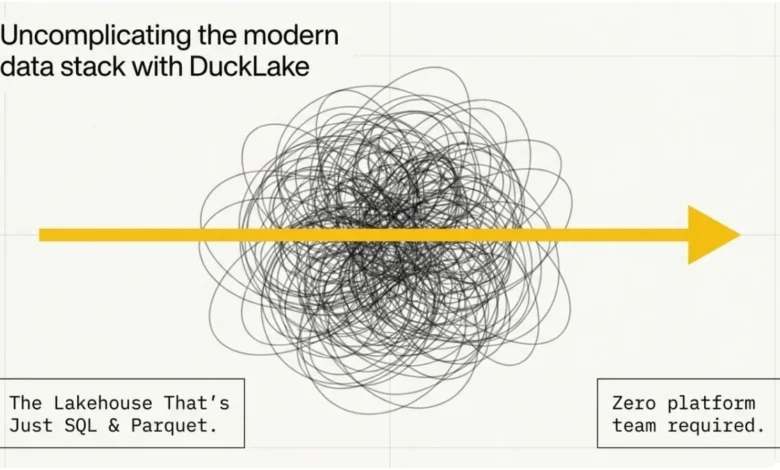
The modern enterprise data stack has long been plagued by operational bloat, particularly within data lakes. Traditional open table formats such as Apache Iceberg and Delta Lake require queries to traverse intricate hierarchies of JSON, Avro, and metadata files merely to identify which underlying data fragments are relevant. This multi-layered abstraction layer introduces significant query latency, storage overhead, and maintenance complexity.
Enter DuckLake, an emerging open table format developed by the core engineers behind DuckDB. DuckLake introduces a radical architectural simplification: the metadata layer resides within a standard relational database management system, while the actual data remains untouched in plain Apache Parquet format. By anchoring metadata inside a real database engine, DuckLake collapses the traditional multi-hop discovery process into a single, highly efficient SQL query.
The architectural departure proposed by DuckLake is designed to streamline modern data operations, reduce infrastructure costs, and bridge the gap between analytical efficiency and transactional performance. With the debut of the Quack protocol, DuckLake demonstrates unprecedented transactional throughput under heavy contention, setting a new benchmark for open-source data architectures.
The Evolution of DuckDB and the Genesis of DuckLake
The roots of DuckLake stretch back to the academic origins of DuckDB. Pedro Holanda, lead DuckLake developer, joined the project in 2018 when it was still a research prototype housed at CWI (Centrum Wiskunde & Informatica) in Amsterdam, the Netherlands. Working alongside co-creators Hannes Mühleisen and Mark Raasveldt, Holanda initially focused on foundational components such as high-performance CSV readers. Over the subsequent years, DuckDB evolved from an academic curiosity into the preeminent embedded analytical database for developers and data scientists.
As DuckDB gained widespread adoption in production environments, its creators observed a persistent industry-wide frustration. While data scientists and engineers gravitated toward local data frame tools and zero-server paradigms, they routinely avoided legacy enterprise data warehouses due to complex provisioning cycles, slow data transfer protocols, and prohibitive operational costs. Simultaneously, organizations attempting to build scalable data lakes encountered the friction of open table formats. These formats, while offering storage flexibility across cloud object stores like Amazon S3 and Azure Blob Storage, accumulated massive metadata overheads, particularly under high-frequency streaming insertions.
Guillermo Sanchez Dionis, a former software and data engineer who joined the DuckDB team after experiencing the steep costs and operational friction of second-generation cloud warehouses like Snowflake and Google BigQuery, recognized the urgency of a simpler paradigm. Collaborating with Holanda, Sanchez Dionis began contributing to DuckLake and the newly developed Quack protocol. Their shared objective was to strip away unnecessary layers of abstraction, providing organizations with a foundation that is both performant and economical to operate.
Architecture of DuckLake: Simplicity Meets Scalability
The fundamental philosophy of DuckLake rests on a tripartite architecture comprising storage, catalog services, and compute engines.
Storage is maintained entirely within commodity object stores using standard Parquet files. Unlike formats that scatter auxiliary tracking files across the bucket, DuckLake relies exclusively on Parquet data files. The metadata—historically fragmented across JSON manifests and Avro files—is entirely offloaded to a relational database.
The catalog service can be powered by any standard SQL database supporting fundamental data types such as integers, text, and timestamps, alongside primary key constraints. Supported catalogs include SQLite, MySQL, PostgreSQL, DuckDB, and the new Quack protocol. When a query is initiated, the compute engine—whether DuckDB, DataFusion, or Apache Spark via custom integrations—issues a single SQL query to the catalog. The catalog immediately returns the exact list of relevant Parquet files and their internal statistics, eliminating multi-stage file traversal.
This design yields profound performance advantages. Traditional formats suffer from the "small file problem," where continuous streaming insertions generate thousands of minor metadata and data fragments. Traversing this lineage creates severe query bottlenecks. DuckLake mitigates this via a feature known as data inline. Small insertions are temporarily buffered directly within the relational catalog tables, bypassing the immediate creation of tiny Parquet files. Once sufficient volume accumulates, data is cleanly flushed to standardized 512-megabyte Parquet files, maintaining optimal read performance without sacrificing insertion frequency.
Furthermore, schema evolution—historically a resource-intensive operation requiring file rewrites in formats like Iceberg—is handled natively via standard database alter statements, executing instantaneously without altering underlying data blocks.
Unprecedented Transactional Performance Under Contention
Historically, open table formats and data lakehouses have prioritized batch processing over transactional (OLTP) workflows. Systems like Apache Iceberg were engineered for large-scale, append-only analytics, making them ill-suited for high-concurrency transactional updates. In high-contention environments with numerous concurrent writers, traditional lake formats frequently encounter snapshot conflicts, triggering costly retry loops that degrade throughput to single-digit transactions per second.
DuckLake fundamentally alters this dynamic. By leveraging relational databases as its metadata catalog, DuckLake inherits robust ACID (Atomicity, Consistency, Isolation, Durability) guarantees directly from the underlying database engine.
To scale this capability further, the engineering team developed the Quack protocol. Quack serves as a modern HTTP-based client-server protocol specifically optimized for DuckDB ecosystems. When Quack is utilized as the catalog for DuckLake, transactional concurrency scales dramatically. During heavy write contention involving multiple simultaneous transactions, Quack handles retry logic server-side within the embedded DuckDB instance, preventing expensive round-trips to the application layer.
Benchmarks released by the DuckDB team indicate that DuckLake, powered by Quack, handles up to 200 high-contention transactions per second. No other open table format currently approaches this level of transactional responsiveness, opening new possibilities for real-time streaming ingestion directly into open storage formats.
Industry Implications and the Path Forward
The rise of DuckLake reflects a broader industry movement toward architectural minimalism. For over a decade, enterprise data infrastructure expanded vertically and horizontally, adding layers of middleware, distributed consensus protocols, and proprietary serialization formats. While these systems successfully solved hyperscale challenges, they imposed severe financial and operational tolls on mid-market and enterprise engineering teams alike.
By decoupling data storage (plain Parquet) from transactional metadata management (relational databases), DuckLake demonstrates that extreme performance does not require architectural complexity. Organizations can deploy production-grade data lakes using low-cost object storage combined with lightweight database engines like SQLite for local workloads, PostgreSQL for multi-writer environments, or Quack for high-throughput distributed operations.
Early adopters, including analytics platforms and software providers such as Firebolt and AlterTable, have already begun migrating internal infrastructure to leverage DuckLake’s streamlined design. With the recent stabilization milestones and ongoing optimizations—such as asynchronous I/O integration planned for upcoming releases—DuckLake transitions from an innovative research concept into a robust production standard.
As enterprises continue to seek cost containment and architectural transparency, DuckLake provides a compelling blueprint for the next generation of data infrastructure: one where simplicity, openness, and raw performance coalesce.
Related posts: