Transforming Legacy PHP Codebases into Enterprise Java: A Measurable, AI-Driven Approach Using Kiro and AWS

Migrating a mature PHP application to Java is a strategic undertaking that organizations frequently pursue to achieve stronger type safety, broader third-party library support, and more predictable, enterprise-grade scalability. However, moving away from legacy frameworks such as Laravel, Symfony, or Doctrine introduces inherent architectural risks. Over years of organic development, critical business logic inevitably becomes obfuscated within Eloquent traits, custom service providers, and scattered XML mapping files. Consequently, a structurally similar Java port can compile cleanly yet produce subtle, catastrophic behavioral divergences that threaten business continuity.
Historically, enterprises have treated legacy migrations as high-risk, one-off engineering leaps of faith prone to scope creep, budget overruns, and prolonged testing cycles. A new methodology developed around Kiro—an AI-integrated development environment (IDE) that couples autonomous AI agents with human-in-the-loop oversight—aims to transform this chaotic paradigm into a measurable, repeatable, and compounding engineering process. By treating the original PHP application as the definitive specification and enforcing a rigorous parity harness as an immutable referee, this engine redefines how legacy modernization is executed at scale.
The Dual Execution Model: Interactive IDEs versus Portfolio-Scale Automation
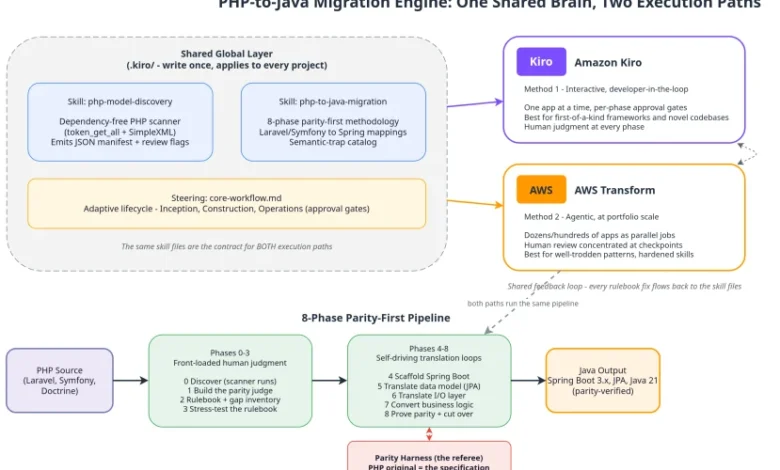
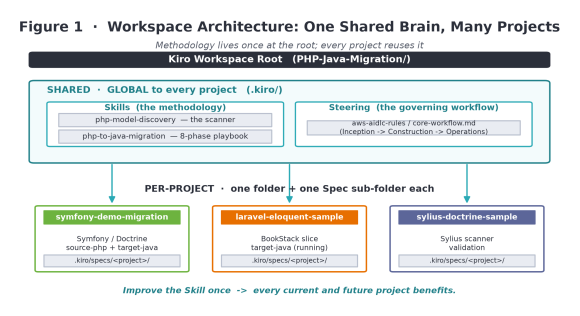
The core architecture of this migration engine relies on a separation of concerns: a single shared methodological brain applied across diverse application portfolios. Rather than binding migration rules to hardcoded software logic, everything the engine knows is packaged within versioned Markdown capability packages, known as skill files. These files codify the overarching methodology (php-to-java-migration) and the mechanical discovery scanner (php-model-discovery), supplemented by core workflow steering documents.
Because these capabilities are encapsulated within portable file assets rather than proprietary platform tools, engineering teams can execute the same foundational methodology through two distinct operational pathways:
-
Kiro (Interactive, Developer-in-the-Loop): Designed for deep, hands-on modernization, Kiro brings an AI agent directly into the developer’s workspace. By opening a repository root as a Kiro workspace, the migration skills activate automatically. The agent navigates an explicit eight-phase workflow featuring strict approval gates. Engineers review discovery manifests, validate rulebooks, and sign off on major architectural phases before the system proceeds. This interactive path is optimal for complex, monolithic codebases requiring nuanced architectural adjustments.
-
AWS Transform (Agentic, Portfolio-Scale): AWS Transform, the native AWS agentic AI service designed for large-scale modernization, natively integrates with Kiro skill files. By feeding the exact same skill set into AWS Transform, organizations can scale discovery, translation, and validation across dozens or hundreds of applications simultaneously. Autonomous runs execute the pre-translation discovery, rely on the parity harness as an objective referee, and operate under a strict "fix the loop, not the code" philosophy.
This unified workspace architecture establishes a global layer under the .kiro/ directory containing the shared methodology. Beneath this global layer reside per-project folders, housing individual PHP source trees, generated Java outputs, and local specification sub-folders. Consequently, any optimization made to the shared methodology layer immediately benefits every active modernization project across the enterprise portfolio.
Discovery Before Translation: The Mandate of the Scanner
A foundational tenet of this modernization framework is absolute adherence to discovery sequencing: teams are explicitly prohibited from reading, guessing at, or hand-translating model and entity files prior to running the automated discovery scanner.
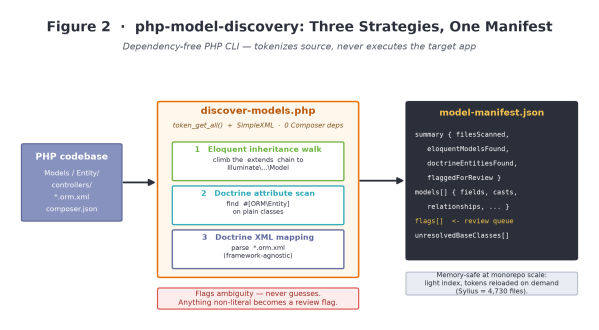
To achieve this, engineers utilize discover-models.php, a single-file, dependency-free command-line tool written in PHP. Critically, this scanner does not execute the target application code; instead, it parses source text purely as tokens. This architectural choice allows the scanner to run successfully against arbitrary legacy codebases regardless of whether their original runtime dependencies, database connections, or package managers are fully operational.
The scanner executes three distinct discovery strategies in a single pass:
- Eloquent Model Discovery: Traces class inheritance chains upward to
IlluminateDatabaseEloquentModel. - Doctrine Attribute Detection: Scans for native PHP attributes such as
#[ORMEntity]. - ORM XML Mapping: Parses external
*.orm.xmlconfiguration files.
The output of this process is a unified JSON manifest (model-manifest.json) containing a comprehensive models[] array detailing every field, cast, relationship, and visibility rule. Crucially, the scanner introduces a flags[] array for ambiguous code structures. Rather than forcing the AI or human engineer to guess the intent of runtime-evaluated expressions (such as dynamically constructed $fillable arrays), the scanner converts ambiguities into plain-English flags that populate a structured human review queue.
The Eight-Phase Parity-First Migration Pipeline
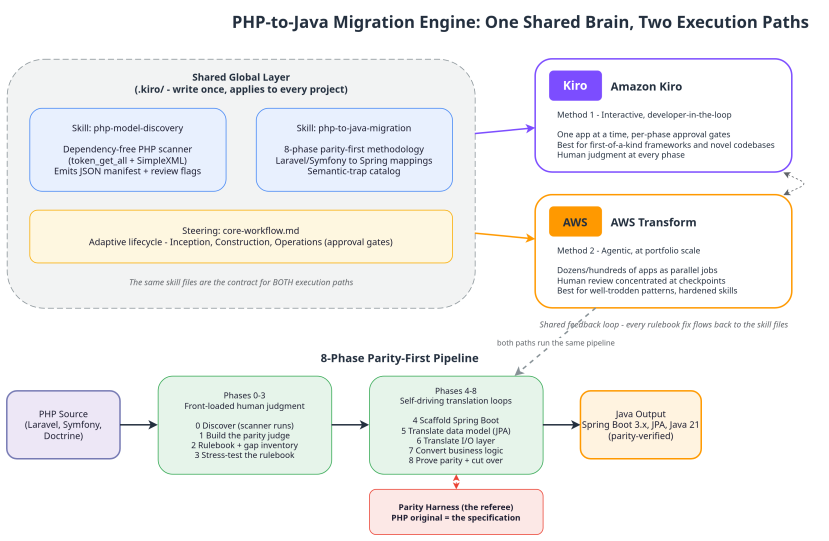
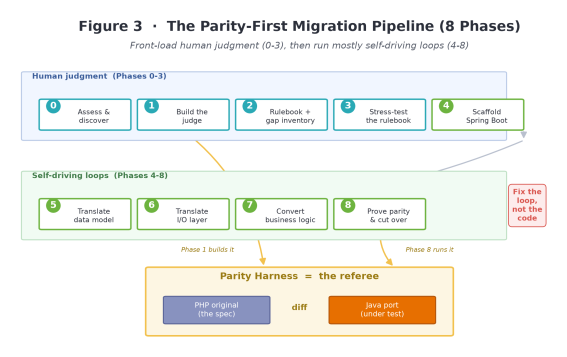
The modernization lifecycle is structured into eight distinct phases, front-loading human expertise into the preparatory stages to ensure subsequent automated loops operate with absolute precision.
Phase 0 focuses on assessment and discovery, executing the scanner to generate the model manifest, build inventory baselines, and establish cutover strategies. Phases 1 through 3 concentrate human judgment. Phase 1 constructs the parity harness before a single line of Java is written. This harness functions by replaying identical HTTP request-response pairs against both the legacy PHP original and the nascent Java port. To ensure trustworthiness, the harness must successfully pass against the working PHP application and deliberately fail when injected with artificial code breakage; a validation harness that fails to catch synthetic defects is rejected. Phase 2 seeds the foundational rulebooks and gap inventories (RULEBOOK.md and GAP_INVENTORY.md), while Phase 3 stress-tests these rules against representative application files before widespread application.
Phases 4 through 8 transition into largely self-driving automation loops:
- Phase 4 (Scaffold): Establishes a compiling, baseline Spring Boot project structure.
- Phase 5 (Translate Data Model): Maps discovered JSON manifest data directly into JPA entities and database schema baselines.
- Phase 6 (Translate I/O Layer): Converts legacy routes into controllers, middleware into security filters, and validation rules into annotated data transfer objects (DTOs).
- Phase 7 (Convert Business Logic): Translates core application logic in manageable, verifiable batches.
- Phase 8 (Prove Parity and Cut Over): Executes comprehensive parity validation against the harness referee, generating a definitive cutover checklist.
Throughout these automated phases, two governance rules apply. First, the legacy PHP code serves as the absolute specification; the migration is only complete when the parity harness referee confirms alignment, or when every behavioral divergence is formally logged as an approved change. Second, engineers are strictly instructed to "fix the loop, not the code"—amending underlying rulebooks and regenerating outputs rather than engaging in ad-hoc, unmaintainable hand-patching of generated Java files.
Practical Implementation: From Eloquent to Spring Boot
To validate this methodology, development teams frequently utilize reference implementations such as laravel-eloquent-sample. This bounded repository provides a read-only slice of an open-source Laravel application, migrating core models—specifically Book, Chapter, Page, and User—to Spring Boot 3.4.1 running on Java 21, utilizing Maven for dependency management and an in-memory H2 database for testing.
The mechanical mapping process is entirely traceable from the discovery manifest. PHP namespaces translate directly to Java packages; Eloquent models map to JPA @Entity declarations; HasMany and BelongsTo relationships transform into @OneToMany and @ManyToOne annotations; and Eloquent query scopes convert seamlessly into Spring Data repository methods.
Data serialization rules are similarly preserved through manifest inspection. For instance, specific model attributes containing rich text, markdown, or raw HTML are automatically annotated with @JsonIgnore if the discovery scanner recorded them within the legacy model’s $hidden property array, whereas standard attributes remain fully exposed.
Enterprise Implications and Future Outlook
The introduction of parity-first, AI-assisted migration engines signals a mature evolution in how organizations approach technical debt and cloud modernization. By divorcing migration logic from monolithic scripts and encapsulating it within portable, versioned skill files, enterprises can standardize modernization practices across heterogeneous portfolios.
While frameworks like Kiro and AWS Transform currently demonstrate exceptional efficacy in migrating PHP applications to modern Spring Boot architectures, the underlying methodology is language-agnostic. The core principles—treating legacy codebases as specifications, front-loading discovery through deterministic scanners, and enforcing immutable parity harnesses as operational referees—apply equally to migrations originating from Ruby, Python, or legacy .NET environments.
As enterprises increasingly look toward generative AI to accelerate technical transformation, tools that combine rigorous human oversight with autonomous execution loops offer a viable roadmap. By shifting the engineering focus from manual translation to rulebook refinement and parity verification, organizations can mitigate migration risks, compress timelines, and achieve predictable, enterprise-grade modernization at scale.