Bridging the Live State Gap: Marimo Pair Brings State-Aware Coding Agents Directly into Reactive Python Notebooks

For software engineers and data scientists relying on modern artificial intelligence coding agents, a fundamental workflow disconnect has long persisted. Standard tools like Claude Code, Codex, and OpenCode have grown exceptionally proficient at a specific category of software development: scoping a feature, editing static files on a disk, executing test suites, and shipping code. However, this file-centric paradigm starkly contrasts with the reality of data science and exploratory programming.
Data work is inherently interactive and stateful. A practitioner typically loads a dataset into memory, inspects data frames visually, executes specific cells to observe immediate feedback, and determines subsequent steps based on live variable states residing in volatile memory. Until recently, AI coding agents remained entirely blind to this dynamic environment, constrained to reading static code and configuration files without access to the live execution state.
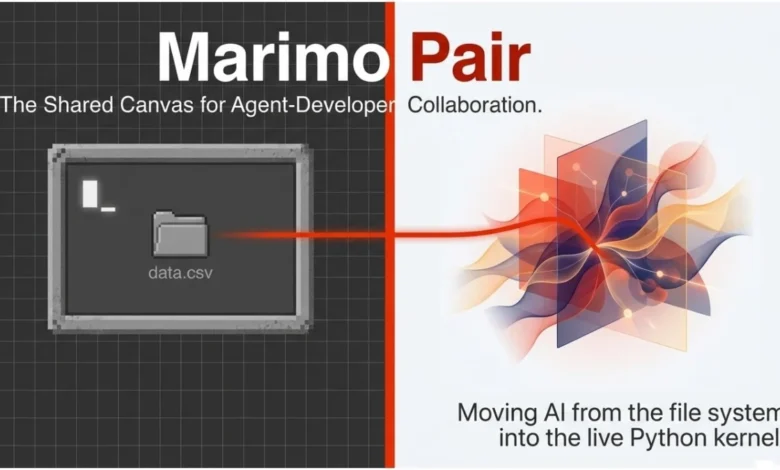
Addressing this architectural limitation, the development team behind marimo—a modern, reactive Python notebook environment—has introduced marimo pair. This newly released agent skill integrates a coding agent directly inside a running notebook kernel, granting the assistant full visibility into every variable and data structure Python holds in memory.
The Architectural Limitations of Traditional Notebooks for AI
The integration of artificial intelligence into computational notebooks has historically been fraught with friction. Traditional notebook formats, most notably Jupyter’s .ipynb JSON architecture, bundle code cells alongside massive output logs, rendered graphics, and intermediate display data. When a standard file-reading coding agent encounters these files, it must parse thousands of lines of unstructured JSON, wading through potentially stale outputs, out-of-order execution artifacts, and irrelevant visualization code.
Furthermore, traditional computational notebooks suffer from hidden state problems. Users frequently execute cells out of order, modify intermediate variables, or leave orphaned memory structures behind, creating a divergence between what the code file displays and what the Python kernel actually holds. When an external AI agent attempts to modify an .ipynb file on disk, it operates without runtime context, frequently leading to broken dependencies, syntax errors, and runtime failures that require extensive manual intervention to resolve.
Marimo was engineered from the ground up to solve these foundational issues through a reactive execution model. By tracking explicit dependency graphs between variables declared across cells, marimo automatically manages execution order, ensuring that modifying an upstream cell deterministically updates all downstream dependencies. This reactive foundation laid the technical groundwork necessary to safely introduce state-aware AI agents into notebook environments.
How Marimo Pair Works: Direct Kernel Integration
Marimo pair bypasses the traditional limitations of file-system-only agents by dropping the AI directly into an active Python kernel via an agent skill architecture. Rather than relying on rigid Model Context Protocol (MCP) tools or predefined API schemas, marimo pair equips the agent with a powerful, flexible primitive: the ability to execute arbitrary Python code within the running notebook session.
Through a semi-private API layer known internally as "code mode," the agent gains programmatic access to the notebook’s active state. It can query current variables, inspect data frame schemas, examine data types, and review cell outputs without parsing bloated JSON files on disk. Crucially, the agent can also perform mutations: creating new cells, editing existing code blocks, and executing them in real time.
This setup establishes a tight, low-latency feedback loop. When a developer prompts the agent to analyze a dataset, the assistant does not have to blindly guess column names or manually parse CSV files from scratch. Instead, it queries the live data frame currently sitting in memory, retrieves exact data types and row counts, and executes targeted diagnostic code.
Because the agent interacts with Python directly, it can compose complex execution logic dynamically. For instance, rather than depending on a rigid tool interface to generate multiple cells, the agent can write a programmatic loop that sets up a multi-step analytical workflow, executing and verifying each step sequentially against the live kernel.
Deployment and Ecosystem Interoperability
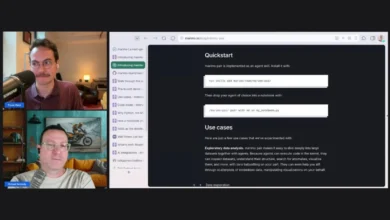
Marimo pair has been designed to integrate seamlessly into existing developer toolchains without forcing practitioners to abandon their preferred AI harnesses. The skill can be installed across multiple agent platforms, including Claude Code, Codex, and OpenCode.
Installation is streamlined to accommodate diverse engineering preferences. Developers utilizing Node-based ecosystems can install the skill globally or locally via standard npm packages, while Python-centric engineers can leverage tools like uvx to execute Deno-based skill installations without managing separate JavaScript runtimes. For Claude Code users, dedicated plugin configurations allow direct integration with marketplace repositories, ensuring seamless synchronization and automated updates.
Moreover, marimo pair supports both local and remote execution models. Developers can run notebooks locally on their workstations or connect their local AI harness to remote sandboxed environments—such as cloud-hosted infrastructure equipped with high-performance GPUs—allowing resource-intensive machine learning tasks to be driven effortlessly from a local terminal.
Implications for Data Science and Exploratory Programming
The introduction of state-aware notebook agents represents a significant evolution in AI-assisted data analysis. By transforming the reactive notebook into a shared digital canvas between human and machine, marimo pair reduces the cognitive overhead of exploratory programming.
In traditional workflows, translating a high-level analytical objective into functional code requires manually wiring data loading pipelines, handling idiosyncratic file formats like multi-sheet Excel workbooks, and debugging plotting libraries. With marimo pair, a developer can delegate these boilerplate-heavy tasks to the agent, which handles the initial ingestion, validation, and schema inspection interactively within the kernel.
Once the foundational data structures are established in memory, the human practitioner can pivot to high-level strategic decision-making: evaluating visual trends, refining modeling parameters, and interpreting insights. Because marimo enforces a strict reactive dependency structure, the resulting notebook remains clean, reproducible, and ready for handoff to team members without hidden state anomalies.
As the software development ecosystem continues to grapple with fragmentation across AI assistants and integrated development environments, marimo’s agnostic approach offers a sustainable path forward. By focusing on deep kernel integration rather than proprietary chat interfaces, marimo pair ensures that computational notebooks remain powerful, adaptable workspaces capable of evolving alongside the rapidly advancing landscape of artificial intelligence.
Related posts: