Mastering AWS Security and Resilience: Insights from the Front Lines of Cloud Engineering

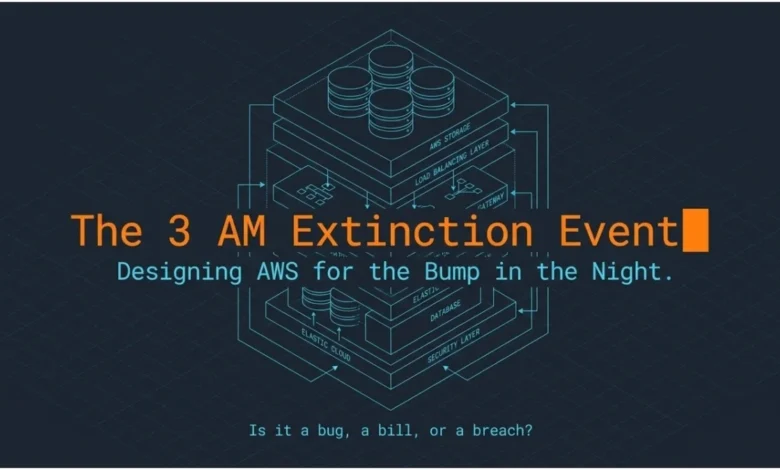
The 3:00 a.m. server outage is a universal rite of passage for modern software developers and system administrators. Whether triggered by an undetected application bug, an unexpected billing spike, or a sophisticated cyber breach, the initial moments of an enterprise infrastructure failure are intensely high-pressure. In these critical minutes, technical leads find themselves under the microscopic scrutiny of executive leadership, stakeholders, and customers who measure system reliability in lost revenue per hour. However, according to veteran cloud consultant and infrastructure expert Matt Lea, the ultimate outcome of a midnight crisis is rarely determined during the emergency itself. Instead, the trajectory of an incident is dictated months earlier on ordinary afternoons, when engineers and architects make seemingly minor decisions driven by short-term convenience.
Lea, who has spent over a decade and a half stepping in as the primary emergency responder for companies suffering severe cloud outages, advocates for a fundamental shift in how organizations approach Amazon Web Services (AWS) architecture. Through his consulting agency Schematical and his educational platform Cloud War Games, Lea emphasizes that sustainable cloud reliability relies on rigorous upfront engineering discipline. By examining core architectural pillars—such as infrastructure as code, granular identity and access management, and strict network isolation—organizations can inoculate themselves against catastrophic failures before they ever materialize in a production environment.
The Foundation of Reliability: Infrastructure as Code
One of the most critical paradigms in modern cloud engineering is the elimination of manual server provisioning in favor of Infrastructure as Code (IaC). In the early days of cloud computing, engineers frequently relied on manual configurations, directly logging into virtual servers via Secure Shell (SSH) to install dependencies, modify firewall rules, and patch operating systems. While this artisanal approach might work for a small, single-user Virtual Private Server (VPS), it introduces an unsustainable single point of failure at scale.
When infrastructure exists only as a collection of manual tweaks across a web console, understanding the system state becomes nearly impossible. If a primary server fails catastrophically, recreating that environment relies entirely on tribal knowledge and undocumented terminal commands. Modern tooling such as Terraform, OpenTofu, and AWS CloudFormation allows development teams to declare their entire infrastructure stack in version-controlled configuration files. This methodology ensures that if a resource is accidentally deleted or compromised, an identical environment can be spun up or restored with a single command.
Nevertheless, automation introduces its own hazards if executed carelessly. Industry incidents frequently highlight the dangers of unverified automated scripts, where artificial intelligence assistants or rushed developers execute destructive infrastructure changes—such as replacing a production database instead of performing a non-destructive schema update. Establishing strict code review processes for infrastructure updates is just as vital as reviewing application logic.
Identity, Access Management, and the Dangers of the Wildcard
Security breaches in the cloud frequently trace back to poor credential management. A common anti-pattern among engineering teams is the reliance on static AWS access keys hardcoded into environment files or accidentally committed to public code repositories. Automated bots scour public code-sharing platforms in real-time, harvesting exposed cryptographic keys and deploying unauthorized workloads—ranging from illicit cryptocurrency miners to massive spam distribution networks—within minutes of exposure.
To mitigate this risk, organizations must transition away from long-lived access keys and embrace AWS Identity and Access Management (IAM) roles. IAM roles allow permissions to be dynamically assigned to running services, such as an EC2 instance or a Lambda function, ensuring that the application interacts with the cloud ecosystem using temporary, automatically rotated credentials.
Furthermore, engineers must strictly adhere to the principle of least privilege. The temptation to use wildcards—such as granting full administrative permissions across all S3 buckets using an asterisk notation—creates an unacceptably wide attack surface. If a compromised application possesses unrestricted access to storage resources, a localized bug can quickly escalate into a catastrophic data exfiltration event. Granular policies restricting permissions to specific resources and exact file paths are essential for containing potential security incidents.
Network Architecture and the Perils of Public Exposure
Proper network segmentation is another cornerstone of resilient cloud design. Placing backend resources, such as relational databases and internal microservices, onto public subnets exposes critical infrastructure directly to the public internet. While configuring a database to accept connections from any IP address may simplify local development and testing, it leaves the system vulnerable to brute-force attacks and unauthorized data harvesting.
Robust AWS architectures utilize Virtual Private Clouds (VPCs) partitioned into public and private subnets. Public subnets are reserved strictly for perimeter defenses and load balancers that manage incoming web traffic, while private subnets house sensitive databases and application servers isolated from direct internet access. When developers require administrative access to private resources for debugging, they should leverage secure management tools such as AWS Systems Manager (SSM) Session Manager rather than maintaining traditional, exposed bastion hosts running on public IP addresses.
Security groups act as virtual firewalls at the instance and service level, controlling inbound and outbound traffic. Configuring these groups requires the same granularity as IAM roles; allowing lateral movement across an entire internal network after a single perimeter breach compromises the entire security posture. Isolating services ensures that even if an application layer is breached via an external software vulnerability, attackers cannot easily traverse the network to compromise core data stores.
Observability, Logging, and Cost Governance
As architectures scale from monolithic servers to distributed cloud services, centralized visibility becomes paramount. Debugging an issue across dozens of ephemeral containers or serverless functions requires robust logging and telemetry pipelines. Cloud monitoring tools such as Amazon CloudWatch allow engineers to aggregate application logs, track performance metrics, and establish automated anomaly detection.
However, observability tools must be managed with fiscal discipline. Serverless logging and log-querying services frequently operate on data-ingestion and query-scanning pricing models. Without proper query constraints, developers attempting to diagnose an issue by scanning years of historical log data can inadvertently generate thousands of dollars in unexpected cloud bills. Comprehensive cost management requires proactive monitoring, strict budget alerts, and resource tagging to attribute infrastructure expenditures accurately across development, staging, and production environments.
Simulated Outages and Stress Inoculation
Despite rigorous adherence to best practices, unforeseen incidents will inevitably occur. Whether facing a volumetric Distributed Denial of Service (DDoS) attack, a sudden surge in retail traffic during major shopping holidays, or an unexpected platform-level service disruption, a team’s reaction time is often the defining factor between a minor operational hiccup and a business-threatening catastrophe.
To prepare teams for these high-stress scenarios, proactive organizations increasingly turn to chaos engineering and simulated incident response exercises—often referred to as cloud war games. By intentionally injecting failures into non-production environments, engineering teams can practice diagnosing system bottlenecks, coordinating incident response, and executing disaster recovery plans under controlled pressure.
These simulations serve a dual purpose: they expose architectural weaknesses before they impact paying customers, and they provide psychological stress inoculation for junior and senior engineers alike. Post-incident reviews and blameless post-mortems following both simulations and real-world outages ensure that organizations continuously adapt, transforming operational failures into enduring engineering improvements. Ultimately, building a resilient cloud infrastructure is not about achieving absolute perfection, but about cultivating a culture of preparedness, rigorous automation, and continuous verification.
Related posts: