Enterprise Architecture Blueprint Redefines Secure Agentic AI Deployment at Scale Through Amazon Bedrock AgentCore

The commercial deployment of artificial intelligence agents has encountered a fundamental paradigm shift. While foundational large language models and advanced tool-use capabilities have matured rapidly, organizations scaling generative AI initiatives have discovered that the primary engineering bottlenecks are no longer model capabilities. Instead, enterprise friction stems from governance, infrastructure isolation, cross-departmental accountability, and multi-account cost tracking. Addressing these systemic challenges, cloud architecture teams have introduced a comprehensive enterprise reference framework utilizing Amazon Bedrock and Amazon Bedrock AgentCore to streamline the operationalization of autonomous AI systems.
The Structural Bottleneck of Production AI
For enterprise platform engineering groups, transitioning experimental AI applications into secure production environments has historically exposed severe operational gaps. When multiple business units independently construct autonomous workflows, technical controls inevitably drift. Shared services quickly become performance and administrative bottlenecks, and organizational ownership models become nearly impossible to audit.
Industry analysts and cloud architects have identified four critical requirements that must be standardized to achieve sustainable enterprise AI adoption: approved foundational models and secure tool registries, short-lived workload identities, isolated execution runtimes and memory allocations, and automated evaluation pipelines featuring strict compliance gates. Without a cohesive platform product designed specifically to govern these elements, scaling agentic use cases introduces unacceptable security vulnerabilities and regulatory risks.
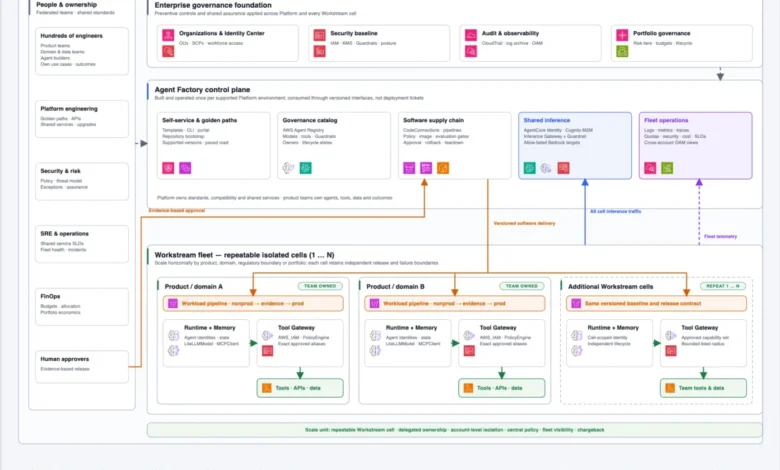
To mitigate these complexities, the newly released Enterprise Agentic AI Platform Blueprint establishes a structured multi-account operating model. This architecture clearly delineates responsibilities between a centralized Platform engineering organization and decentralized product development teams, known within the framework as Workstream teams.
Core Architecture and Operating Models
The architectural foundation relies upon a federated operating model that balances central oversight with localized development agility. Under this structure, the central Platform team acts as the operational hub, establishing golden paths, version-controlled templates, organizational policies, and security guardrails. Conversely, individual Workstream teams operate as specialized spokes, maintaining ownership over business logic, application prompts, domain-specific data access, and localized runtime performance.
This federated approach is executed across four interconnected planes:
- The Developer Experience Plane: Offers a curated catalog of versioned agent templates supporting popular orchestration frameworks including Strands, LangGraph, and CrewAI.
- The Platform Control Plane: Manages organization-wide governance, service control policies, centralized logging, and fleet-wide monitoring.
- The Workstream Execution Plane: Implements isolated runtime environments, dedicated memory stores, and independent tool gateways per business unit to ensure containerized failure domains.
- The Assurance and Operations Plane: Enforces rigorous automated evaluation gates, security validation frameworks, and comprehensive cost attribution telemetry.
By treating each Workstream cell as an independent unit of scale rather than relying on a monolithic shared workspace, enterprises can effectively isolate operational failures, streamline debugging, and maintain strict regulatory compliance across distinct business domains.
Multi-Account Topology and Security Guardrails
The blueprint leverages a multi-account AWS landing zone topology to enforce strict separation of duties and defense-in-depth security principles. Logical account roles are mapped across distinct operational tiers, beginning with the Management Foundation root account, which governs enterprise-wide organizations, identity federation, and high-level billing policies.
Security and log archival are isolated within dedicated security accounts utilizing immutable storage for AWS CloudTrail, AWS Config, Security Hub, and GuardDuty telemetry. Centralized observability mechanisms aggregate cross-account performance metrics, distributed traces, and cost analytics without exposing underlying operational workloads to unauthorized inspection.
Within the execution tier, individual Workstream cells operate within dedicated AWS accounts. Each cell contains its own localized runtime engines, memory stores, and specialized tool gateways. This structural segregation guarantees that a security anomaly or system crash within one business unit’s agentic workflow remains strictly contained within that specific boundary, preventing lateral movement or cascading infrastructure failures.
Furthermore, the platform employs comprehensive Service Control Policies (SCPs) to constrain maximum operational permissions. These policies systematically prevent administrative users within Workstream accounts from bypassing established security controls, modifying core networking configurations, or disabling mandatory telemetry collection.
Automated CI/CD Pipelines and Evaluation Gates
A cornerstone of the enterprise blueprint is its rigorous software delivery lifecycle (SDLC), which mandates strict automated validation before any autonomous agent is promoted to production environments. Unlike traditional software deployment pipelines, agentic systems require continuous behavioral evaluation to detect prompt drift, hallucination anomalies, and unintended tool execution patterns.
The promotion sequence follows a deterministic, multi-stage pipeline:
- Source Code and Policy Validation: Initial code commits undergo automated static analysis, security scanning, and policy compliance verification against organizational standards.
- Sandbox Deployment: The agent template and associated tools are deployed into an isolated sandbox environment representing the target Workstream cell.
- Automated Behavioral Evaluation: The runtime executes a comprehensive suite of domain-specific test cases, evaluating accuracy, safety boundaries, latency, and resource consumption against predefined Service Level Objectives (SLOs).
- Security and Guardrail Verification: Automated validation confirms that all inference calls route exclusively through approved gateways and that content guardrails are actively enforced.
- Production Promotion: Upon successful completion of all evaluation gates, the deployment pipeline promotes the agent version to production aliases, updating routing tables with zero downtime.
This automated gating mechanism eliminates manual shortcuts and ensures that every autonomous workflow meets rigorous enterprise quality standards before interacting with external systems or sensitive data repositories.
Industry Implications and Strategic Outlook
The introduction of standardized enterprise frameworks for agentic AI reflects a broader maturation phase within the software industry. As organizations move past proof-of-concept deployments, the demand for repeatable, secure, and auditable artificial intelligence infrastructure has become paramount.
By decoupling core model inference from application logic and enforcing strict infrastructural boundaries, architectures built upon Amazon Bedrock and AgentCore provide a scalable blueprint for digital transformation. Financial institutions, healthcare providers, and large-scale enterprises can now leverage autonomous AI agents while maintaining stringent data privacy, regulatory compliance, and cost visibility.
Industry analysts note that organizations adopting federated, platform-driven approaches to generative AI significantly reduce their time-to-market while simultaneously mitigating the operational risks traditionally associated with autonomous software agents. As enterprises continue to expand their artificial intelligence initiatives, the implementation of structured platform controls, automated evaluation pipelines, and robust multi-account governance will remain a critical determinant of long-term success.