The Ultimate Guide to Naming UI Components, Design Tokens, and Digital Assets

In the complex ecosystem of digital product design and software development, terminology often serves as both a bridge and a barrier. As multidisciplinary teams increasingly collaborate on enterprise-grade applications, websites, and cross-platform experiences, the challenge of nomenclature has emerged as a critical friction point. Whether defining variables in a stylesheet, organizing layers in a design file, or labeling micro-interactions in a user interface, naming things remains one of the most persistent hurdles in the technology sector. Industry analysts estimate that software and design teams lose thousands of cumulative hours annually simply clarifying ambiguous terminology, debating variable structures, and untangling legacy naming conventions across codebases and design systems.
The root of the issue lies in the tension between generality and specificity. When identifiers are overly broad—such as labeling a button simply as "item" or a color as "blue-one"—developers and designers lose critical contextual cues, leading to misinterpretations and maintenance bottlenecks. Conversely, when labels are hyper-specific, components lose their modularity, hindering reusability across multi-brand design systems. Recognizing this industry-wide pain point, prominent design technologists, developers, and information architects have curated a comprehensive suite of open-source frameworks, digital glossaries, and taxonomy maps to standardize the language of the web.

Historical Evolution of Design and Code Taxonomy
To understand why naming has become such a specialized discipline, one must look at the evolution of modern front-end development and UX engineering. In the early days of the web, naming conventions were largely ad hoc, driven by individual developer preferences or rudimentary methodologies like OOCSS (Object-Oriented CSS) and BEM (Block, Element, Modifier). While BEM successfully introduced scoped modularity to HTML classes, the subsequent explosion of design systems, atomic design methodologies, and scalable CSS frameworks (such as Tailwind) exponentially increased the volume of variables, design tokens, and UI primitives that teams needed to manage.
By the mid-2010s, enterprise organizations managing multi-brand ecosystems realized that siloed naming practices were actively slowing down product delivery. A design token named after a specific visual property—such as #ff0000 or bright-red—would break entirely during a seasonal rebranding initiative that shifted the primary brand hue to corporate blue. Consequently, the industry pivoted toward semantic naming structures, decoupling visual representation from functional intent. Today, modern taxonomy maps bridge the gap between design tools like Figma and production codebases in React, Vue, and Angular, ensuring seamless synchronization between visual designers and software engineers.

Leveraging Curated Repositories for General and Technical Naming
When technical professionals encounter a mental block while drafting HTML classes, CSS properties, or JavaScript functions, specialized lexicons have emerged to spark creative solutions. Platforms like Classnames, curated by developer Paul Robert Lloyd, provide thematically grouped lists of semantic terms designed to encourage out-of-the-box thinking. Rather than relying on repetitive, utilitarian descriptors, these resources offer taxonomies rooted in architecture, publishing, nature, and the dramatic arts, helping engineers construct logical and memorable class hierarchies.
Similarly, color nomenclature has historically been plagued by subjectivity. What one designer perceives as teal, another may classify as turquoise or cyan. To address this, open-source color repositories like the database maintained by David Aerne catalog more than 30,000 unique color designations sourced from community contributions and historical references. Equipped with integrated color pickers and search utilities, these tools provide standardized naming conventions that engineering teams can directly integrate into design token pipelines, eliminating discrepancies between graphic mockups and production stylesheets.

Best Practices for Structuring Layers, Groups, and Components
Within collaborative design environments like Figma, Sketch, and Adobe XD, the structural organization of layers directly impacts team scalability. According to design system guidelines compiled by experts such as Javier Cuello, an effective layer or component name must possess a logical hierarchy, remain concise, convey distinct functional meaning, and avoid direct reliance on transient visual properties.
Cuello’s framework emphasizes a strict adherence to standardized do’s and don’ts. For instance, naming a frame "Rectangle 4" introduces cognitive overhead for developers inspecting the file, whereas labeling the same element "Navigation/Header/Primary" instantly communicates its architectural placement and interaction level. Implementing these rigorous standards significantly reduces onboarding times for new design hires and accelerates the developer handoff process.

Enterprise Case Studies: Scaling Design Token Taxonomies
The complexities of naming multiply exponentially when scaling across enterprise portfolios. A prominent industry benchmark is the design token taxonomy overhaul executed by the engineering and design teams at Intuit. Serving major financial and productivity platforms including QuickBooks, Mailchimp, TurboTax, and Mint, the parent organization faced a monumental challenge: developing a unified, flexible design token system capable of supporting diverse brand identities without fracturing under localized customizations.
In detailed architectural case studies, design token leads like Nate Baldwin have outlined the transition from rigid, legacy naming conventions to a multi-tiered taxonomy. By establishing clear distinctions between primitive tokens (raw values like hex codes and spacing scales), semantic tokens (intent-based values like background-default), and component-specific tokens, Intuit successfully unified its product suite. This structured methodology ensures that any update to a core brand asset propagates predictably across hundreds of distinct user interfaces.

Standardizing User Interface Components Across the Open Web
When establishing a new design system or auditing an existing codebase, product teams frequently struggle to determine industry-standard nomenclature for common interface patterns. To mitigate this, community-driven archives like The Component Gallery, researched and developed by Iain Bean, aggregate real-world naming conventions from dozens of enterprise design systems. Spanning more than 50 distinct UI components—ranging from complex accordions to accessibility-focused visually hidden elements—the gallery cross-references alternative terminologies utilized across the technology sector.
Complementary visual dictionaries, such as Name That UI, further assist junior developers and cross-functional stakeholders in identifying interface patterns correctly. By establishing a shared vocabulary, teams prevent the common pitfall of inventing proprietary names for standard UI widgets, thereby improving code readability and accelerating component reuse.

Feature Discoverability and User-Centric Feature Naming
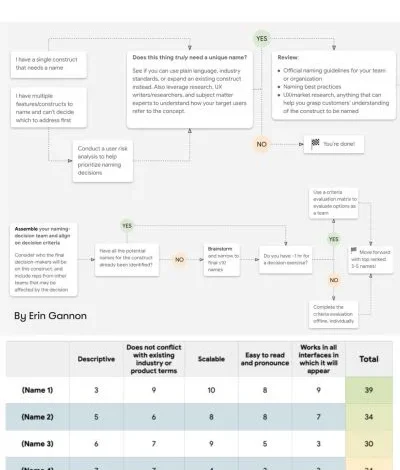
Beyond internal code architecture and design files, the nomenclature applied to consumer-facing features directly dictates product adoption metrics. UX researcher Erin Gannon has highlighted that low feature adoption rates are frequently symptoms of poor discoverability caused by ambiguous or overly technical internal naming.
User acquisition and retention rely heavily on a seamless cognitive pipeline: a feature must first be discovered, subsequently understood, actively tried, mastered, and finally integrated into the user’s established daily workflow. To achieve this, product teams are advised to abandon internal codenames and corporate jargon in favor of the user’s native vocabulary. Conducting user interviews to observe how customers naturally describe a problem space ensures that feature titles signal clear, value-driven outcomes aligned with the "jobs-to-be-done" framework.

Multi-Brand Architecture: The Vodafone UK Variables Taxonomy Map
Enterprise design system management reaches its zenith in multi-brand telecommunications environments. A prime institutional model is the Variables Taxonomy Map released by the Vodafone UK Design System team. Built upon foundational token architecture theories pioneered by design systems expert Nathan Curtis, Vodafone’s framework orchestrates a sophisticated multi-tiered collection mapping system.
The architecture connects variables across four distinct structural layers: brand primitives, theme attributes, semantic roles, and page-level implementations. By structuring token nomenclature systematically, any stakeholder examining a variable name can immediately ascertain its scope, intended context, and hierarchical origin. This transparency minimizes regression bugs during multi-brand theme swaps and establishes a bulletproof foundation for automated design-to-code pipelines. Supplementary open-source toolkits, such as Romina Kavcic’s Design Token Naming Guide and associated spreadsheet inventories, offer practitioners interactive builders to configure states, categories, and roles without losing tracking oversight.

Implications and Broader Industry Impact
The ongoing industry-wide focus on standardized naming conventions carries profound implications for software engineering efficiency, design system maturity, and digital accessibility. When multidisciplinary teams—spanning product management, UX design, software engineering, and quality assurance—operate using disparate terminologies, organizational friction inevitably arises. Discrepancies between the designer’s dialect and the developer’s dialect lead to misaligned implementations, protracted review cycles, and user-facing inconsistencies.
By treating nomenclature as a first-class engineering and design discipline, modern organizations can systematically dismantle communication barriers. Adopting structured taxonomies not only optimizes internal developer velocity and design system governance but also directly enhances the end-user experience. Clear, intuitive feature naming and accessible component labeling ensure that digital products remain comprehensible, navigable, and inclusive for all audiences, solidifying nomenclature as a foundational pillar of digital craftsmanship.