Automating Knowledge Graph Population: Extracting Entities and Triples from Unstructured Text with an LLM

The Problem of Hallucinations and the Promise of Structured Data
For years, the industry relied on vector databases to handle semantic search. While effective at finding relevant documents, these systems often fail to distinguish between nuanced relationships, frequently leading to the synthesis of false information. A knowledge graph, by contrast, organizes data into specific relationships: a subject, a predicate, and an object. By adding a fourth dimension—the context—engineers can create "SPOC quads," which provide a complete audit trail for every fact stored in the database.
The challenge, historically, has been the labor-intensive process of populating these graphs. Manually curating millions of data points is impossible at scale. Consequently, the ability to automate this process using local, privacy-conscious LLMs like Llama 3.2, managed through the Ollama framework, represents a significant leap forward in data engineering.
Technical Foundation and Implementation Strategy
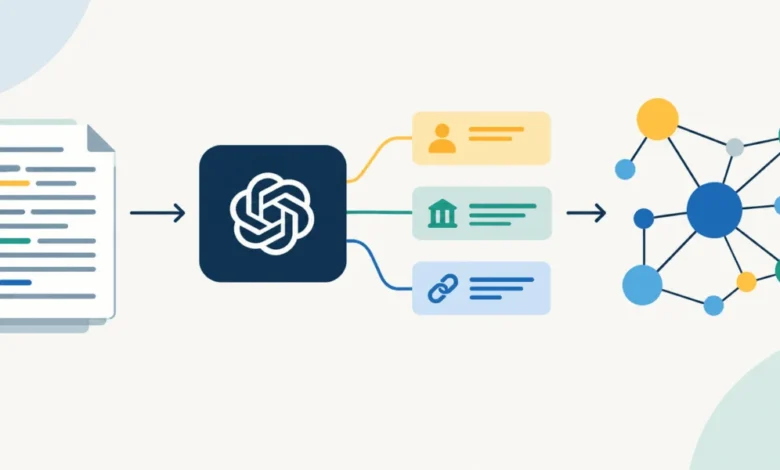
The transition from raw text to a structured graph requires a robust, multi-stage pipeline. The first phase involves the deployment of a local inference engine. By utilizing Ollama, developers can maintain complete control over their data, avoiding the latency and privacy concerns associated with cloud-based API calls.
Once the environment is configured—typically involving a Python-based setup that integrates libraries like wikipedia for data ingestion and requests for communication with the local LLM server—the process of automated extraction begins. The core logic relies on prompt engineering that mandates strict JSON output. By instructing the model to act as an expert data extraction algorithm, the system can parse thousands of characters of unstructured text and distill them into discrete, atomic facts.
For instance, when processing biographical data, the LLM identifies entities (e.g., "Alan Turing"), attributes them to predicates (e.g., "was born in"), and links them to objects (e.g., "London"), while simultaneously tagging the entire entry with a context label (e.g., "Wikipedia_Alan_Turing"). This structured output is then fed into a QuadStore, a lightweight Python-based database architecture that allows for deterministic querying.
Chronology of Development
The move toward graph-based RAG (Retrieval-Augmented Generation) has followed a clear trajectory over the last 24 months:
- The Vector Era (2022-2023): Initial RAG implementations relied exclusively on vector embeddings, leading to the rise of semantic search but highlighting the fundamental limitations of probabilistic retrieval.
- The Emergence of Hybrid Systems (Early 2024): Industry leaders began experimenting with "Graph-RAG," combining the fuzzy matching capabilities of vector search with the strict relational integrity of graph databases.
- The Automation Pivot (Late 2024-Present): The current focus has shifted from "how to store the graph" to "how to build the graph automatically." This era is defined by the use of lightweight, high-performance LLMs to perform the heavy lifting of entity recognition and relationship mapping.
Supporting Data and Performance Metrics
Evidence from recent testing indicates that local models, when provided with specific schema constraints, exhibit high precision in extraction tasks. In tests conducted on standard biographical texts, the extraction engine demonstrated an ability to generate over 10 actionable quads from as few as two paragraphs of text. While non-deterministic behavior—a hallmark of current LLM architecture—remains a factor, the use of a temperature setting of 0.0 effectively minimizes variability, ensuring consistent outputs that are suitable for database ingestion.
The performance of the QuadStore itself is optimized for simplicity. Because the system utilizes a basic list-based append mechanism, it provides near-instantaneous lookup speeds for small-to-medium datasets, making it an ideal candidate for prototyping complex RAG applications.
Broader Impact and Industry Implications
The implications of this technology extend far beyond simple information retrieval. For the legal, financial, and medical sectors, where factual accuracy is non-negotiable, the ability to "pin" an LLM to a deterministic knowledge graph is transformative.
- Deterministic Retrieval: By forcing an AI to query a verified graph before answering, developers can effectively "fence" the model, preventing it from inventing data that does not exist in the source material.
- Reduced Operational Costs: By automating the population of these graphs using local LLMs, companies can reduce the costs associated with human data entry and cloud-based API usage.
- Enhanced Auditability: The context field in the SPOC quad format ensures that for every answer provided by an AI, the system can cite the exact source document, the relationship, and the justification for the claim.
Expert Perspectives and Theoretical Considerations
Data scientists note that while this approach is highly effective for structured, biographical, or encyclopedic text, it remains a work in progress for highly complex, contradictory, or deeply nuanced narratives. Critics often point out that LLMs still struggle with "long-range dependencies," where a subject mentioned at the beginning of a document is separated from a predicate by several pages.
However, the current consensus is that the SPOC quad methodology provides a necessary framework for "Explainable AI." As the industry moves toward more autonomous agents, the ability to maintain a reliable, machine-readable memory bank will likely become the standard for any production-grade deployment.
Future Outlook
As Llama 3.2 and similar models continue to shrink in size while growing in reasoning capabilities, the barrier to entry for building automated knowledge graphs will continue to fall. The next phase of this development will likely involve "incremental updating," where the system automatically updates its graph as new text is ingested, effectively creating a "living" knowledge base that evolves in real-time.
For engineers and researchers, the lesson is clear: the future of AI is not just about having a smarter model, but about building a better infrastructure for the data that the model consumes. By closing the loop between unstructured text and structured graphs, the industry is laying the groundwork for a new generation of reliable, accurate, and truly intelligent systems. This transition marks the end of the "black box" era of AI and the beginning of a more transparent, verifiable, and highly efficient paradigm in information technology.
Related posts: