XAI Integrates Grok 4.6 Into Amazon Bedrock With Expanded 500K Token Context Window and Advanced Agentic Capabilities

The integration of advanced artificial intelligence models into enterprise infrastructure reached a significant milestone as xAI deployed its latest flagship model, Grok 4.6, within the Amazon Bedrock ecosystem. Officially launched on August 18, 2026, this deployment marks xAI’s second major model offering on Amazon Web Services (AWS) following the introduction of Grok 4.3. Designed specifically for long-running autonomous agents, complex software engineering, and intensive knowledge work, Grok 4.6 introduces substantial architectural enhancements, including an expansive 500K token context window and four configurable reasoning effort tiers.
The arrival of Grok 4.6 on Amazon Bedrock reflects a broader industry trend toward deep enterprise integration, where raw computing power is matched with rigorous security, flexible API routing, and deterministic compliance frameworks. By making the model accessible through both the bedrock-mantle and bedrock-runtime endpoints, AWS and xAI have provided developers and enterprise architects with unprecedented flexibility in how they deploy frontier intelligence within existing workflows.
Chronology and Deployment Evolution
The partnership between xAI and AWS began to take shape earlier in the deployment cycle when Grok 4.3 became generally available on Amazon Bedrock. That initial launch established xAI as an official model provider on the platform, allowing developers to route traffic primarily through Bedrock Mantle, the OpenAI-compatible inference engine built into the service. While Grok 4.3 proved capable of handling routine generation and moderate reasoning tasks, user demand quickly pivoted toward models capable of maintaining coherence across extended operational horizons.
Building directly upon this foundation, xAI engineered Grok 4.6 to address the limitations of previous iterations regarding multi-step task execution. Following its initial rollout on August 12, 2026, across xAI’s native channels, the model was rapidly prepared for AWS deployment, achieving general availability on Amazon Bedrock just days later on August 18, 2026. This swift transition highlights the technical alignment between xAI’s training methodologies and the scalable infrastructure provided by AWS.
Unlike its predecessor, Grok 4.6 widens the service surface area considerably. It supports the standard Converse API alongside Chat Completions and Responses, enabling engineering teams to utilize native AWS SDKs without relying solely on OpenAI-compatible client libraries. Furthermore, the model eliminates the restriction of in-region-only inference that characterized the Grok 4.3 launch, introducing robust support for cross-region inference profiles, including Geo and Global routing options.
Architectural Enhancements and Training Methodology
The performance profile of Grok 4.6 is rooted in a comprehensive retraining and fine-tuning regimen. According to technical disclosures from xAI, the model benefited from an extended supplemental training phase that utilized highly curated, model-generated data designed to optimize reasoning chains and master advanced technical concepts. High-quality engineering datasets, paired with an improved optimizer and refined training recipes, formed the backbone of the model’s development.
To cultivate superior agentic behaviors, xAI employed Grok 4.5 to regenerate supervised fine-tuning trajectories across multiple domains, including science, technology, engineering, and mathematics (STEM), complex software engineering, and multi-faceted knowledge work. Automated model-based checks were deployed to filter out problematic reasoning traces before the reinforcement learning phase. The final model was subjected to a diverse array of agentic reinforcement learning tasks, ranging from general codebase manipulation and web development to highly specialized domains such as kernel optimization and computer-aided design (CAD).
Two distinct behavioral improvements have emerged from this training process. First, during prolonged operational trajectories, Grok 4.6 demonstrates an enhanced capacity for self-testing and verification, actively auditing its intermediate steps before proceeding to subsequent phases of a project. Second, the model delivers markedly stronger initial outputs on visual and interactive development tasks, successfully establishing the structural and visual framework of an application in a single pass. This capability significantly accelerates development cycles where iterating upon a substantial baseline is preferred over incremental generation.
Configurable Reasoning and Performance Benchmarks
A defining characteristic of Grok 4.6 is its granular control over computational expenditure via configurable reasoning effort levels. Developers can select between low, medium, high, and a newly introduced xhigh tier. This flexibility allows organizations to tailor resource consumption to the complexity of the task at hand, allocating deeper reasoning tokens exclusively to high-stakes planning and architectural design while reserving lower tiers for rapid data extraction and basic classification.
Independent evaluations and manufacturer benchmarks place Grok 4.6 at the forefront of agentic coding and knowledge management. At its launch, high-effort configurations achieved notable scores across industry-standard evaluations, including a 61 on the Artificial Analysis Intelligence Index, 1753 on GDPVal-AA v2, and 69.9% on CursorBench v3.2. In specialized software engineering benchmarks such as DeepSWE v1.1 and FrontierCode v1.1 (Extended), the model scored 65.9% and 61.3% respectively, underscoring its utility in autonomous software maintenance and repository-scale refactoring.
Performance Across Amazon Bedrock Endpoints
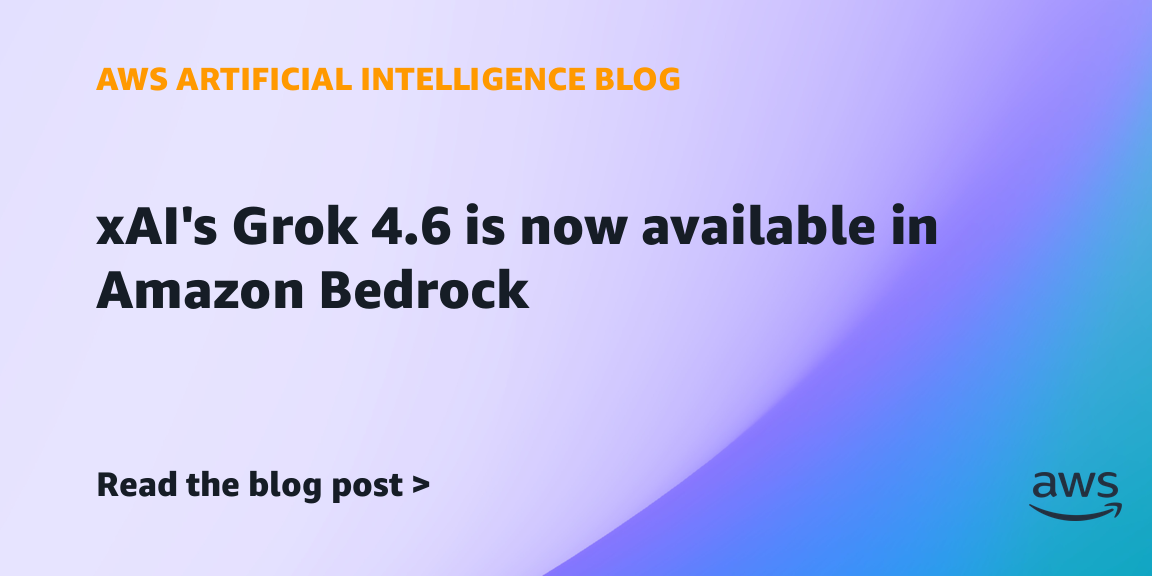
The integration into Amazon Bedrock exposes Grok 4.6 through two primary architectural pathways, each tailored to distinct operational requirements.
The bedrock-mantle endpoint serves developers requiring OpenAI-compatible integration patterns. It supports client-side tool calling, structured outputs via JSON Schema, prompt caching, response streaming, projects, and native abuse detection. This endpoint is hosted in-region, primarily localized within the US West (Oregon) (us-west-2) region.
Conversely, the bedrock-runtime endpoint unlocks native AWS capabilities, including the Converse API, invocation logging via Amazon CloudWatch, and Amazon Bedrock Guardrails. This endpoint operates exclusively through cross-region inference profiles rather than bare model IDs. Developers can select us.xai.grok-4.6 for geographic routing that maintains data residency within the United States, or global.xai.grok-4.6 for worldwide routing across a network exceeding thirty regions. Global routing offers a reduced baseline cost structure, making it the preferred choice for workloads without strict data residency mandates.
Enterprise Governance, Security, and Safety Protocols
As artificial intelligence systems transition from assistive tools to autonomous agents capable of modifying codebases and executing multi-step business logic, enterprise governance becomes paramount. Grok 4.6 addresses these concerns through deep compatibility with Amazon Bedrock Guardrails. By attaching a guardrail by ID and version to runtime requests, organizations can enforce content filters, block denied topics, redact personally identifiable information (PII), and implement custom word policies that evaluate both incoming prompts and generated outputs.
Furthermore, xAI reports that Grok 4.6 underwent its most rigorous pre-deployment safety evaluation suite to date, combining automated capability testing with extensive third-party and post-deployment audits. The safety framework is engineered to maximize utility in sensitive technical domains—such as vulnerability patch analysis, automated engineering design acceleration, and academic research augmentation—without compromising systemic security.
Invocation logging captures comprehensive audit records within Amazon CloudWatch, logging request bodies, response payloads, detailed token consumption metrics (including specialized reasoning token counts), and the precise inference profile utilized. This transparency is vital for compliance officers and engineering leads auditing autonomous agent workflows.
Economic Models and Cost Management
Deploying frontier models at scale requires careful economic optimization. Grok 4.6 operates across three distinct service tiers within Amazon Bedrock, providing organizations with the ability to balance cost against latency. The Standard tier functions on a pay-per-token model with no long-term commitment. The Priority tier delivers accelerated processing and reduced queue latencies at a 75 percent premium (1.75x standard rates), while the Flex tier offers a 50 percent discount (0.5x standard rates) for asynchronous, non-time-sensitive workloads.
Additionally, native support for prompt caching allows organizations to store frequently accessed system prompts and reference documentation at roughly one-quarter of the standard input rate. For agentic applications that repeatedly inject large foundational contexts into every conversational turn, prompt caching yields substantial operational savings.
Broader Industry Implications and Future Outlook
The deployment of Grok 4.6 on Amazon Bedrock signifies a mature phase in enterprise generative AI adoption. Rather than forcing organizations to choose between proprietary infrastructure and specialized model providers, platforms like Amazon Bedrock act as unified clearinghouses where frontier intelligence is harmonized with enterprise-grade security, logging, and governance.
Industry analysts suggest that the emphasis on long-running agentic workflows and verifiable reasoning marks the definitive shift from conversational chatbots to autonomous software workers. As developers increasingly harness the 500K token context window and the xhigh reasoning tier for complex enterprise tasks, the ability to govern these agents through centralized policy frameworks will determine the pace of enterprise AI deployment. With Grok 4.6 now fully operational within AWS, organizations possess a powerful instrument to drive automation, software engineering, and knowledge synthesis at scale.